
December 31, 2025
12/17/2025 | 55m 50sVideo has Closed Captions
Al Gore; Juanita Goebertus; Noah Bullock; Charlie Savage
Al Gore discusses the threat of climate change and recent protests at the UN's COP30 climate summit. Human Rights Watch's Juanita Goebertus and Noah Bullock of CRISTOSAL detail a new report that alleges that Venezuelans deported by the Trump administration to El Salvador were abused. Charlie Savage reflects on the life of Dick Cheney and the impact he has left on presidential power in the U.S.
Problems playing video? | Closed Captioning Feedback
Problems playing video? | Closed Captioning Feedback
December 31, 2025
12/17/2025 | 55m 50sVideo has Closed Captions
Al Gore discusses the threat of climate change and recent protests at the UN's COP30 climate summit. Human Rights Watch's Juanita Goebertus and Noah Bullock of CRISTOSAL detail a new report that alleges that Venezuelans deported by the Trump administration to El Salvador were abused. Charlie Savage reflects on the life of Dick Cheney and the impact he has left on presidential power in the U.S.
Problems playing video? | Closed Captioning Feedback
How to Watch Amanpour and Company
Amanpour and Company is available to stream on pbs.org and the free PBS App, available on iPhone, Apple TV, Android TV, Android smartphones, Amazon Fire TV, Amazon Fire Tablet, Roku, Samsung Smart TV, and Vizio.
Watch Amanpour and Company on PBS
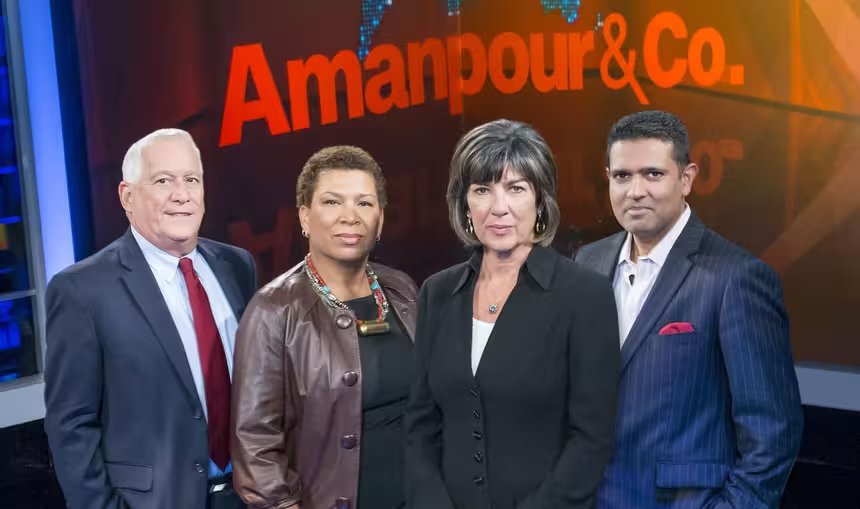
PBS and WNET, in collaboration with CNN, launched Amanpour and Company in September 2018. The series features wide-ranging, in-depth conversations with global thought leaders and cultural influencers on issues impacting the world each day, from politics, business, technology and arts, to science and sports.Providing Support for PBS.org
Learn Moreabout PBS online sponsorship(dramatic music) - Hello, everyone, and welcome to "Amanpour and Company."
Here's what's coming up.
- I think we are going to win this struggle.
The question is whether we'll win it in time.
- [Christiane] From Brazil, a global climate summit with few heavy hitters.
Former Vice President Al Gore joins me on the leadership gap in the critical fight against climate change.
Then, inside El Salvador's mega prison, we look at a new human rights report that tracks the treatment of Venezuelans deported by President Trump.
Plus... - The idea that the country will be better off with a stronger presidency with fewer constraints, with fewer checks and balances.
- [Christiane] The Dick Cheney doctrine, does it hold up?
Reporter Charlie Savage talks to Walter Isaacson about the life and legacy of America's most powerful modern veep.
(dramatic music) (dramatic music continues) - [Announcer] "Amanpour and Company" is made possible by the Anderson Family Endowment, Jim Attwood and Leslie Williams, Candace King Weir, the Sylvia A. and Simon B. Poyta Programming Endowment to Fight Antisemitism, the Family Foundation of Leila and Mickey Straus, the Filomen M. D'Agostino Foundation, the Peter G. Peterson and Joan Ganz Cooney Fund, Charles Rosenblum, Monique Schoen Warshaw, Koo and Patricia Yuen, committed to bridging cultural differences in our communities, Barbara Hope Zuckerberg, and by contributions to your PBS station from viewers like you.
Thank you.
- Welcome to the program, everyone.
I'm Christiane Amanpour in London.
Indigenous protestors against deforestation have been making their voices heard in Belem, Brazil, the site of the UN's major climate summit.
Dozens of demonstrators had forced their way into the COP30 venue and crashed through security guards while carrying signs and shouting that their land is not for sale.
It is a signal of something we already know, that tackling climate change and protecting the planet is an enormous emotional and logistical challenge.
And what it requires is real leadership.
But the world's most powerful people aren't even at the conference.
Presidents Trump and Xi are no shows, and so is India's Prime Minister Narendra Modi, all big polluters.
Meanwhile, the White House is doubling down on fossil fuels.
One well known American trying to fill the leadership gap is the former US Vice President Al Gore, one of the earliest politicians to sound the alarm on climate change.
He won the Nobel Peace Prize in part for his Oscar winning and prescient documentary, "An Inconvenient Truth."
Vice President Al Gore, welcome to our program.
- Thank you very much, Christiane.
I'm happy to be with you.
- What does it feel like to be the only vice president, the only member of an American administration, even if it's passed, at the COP talks?
Because this administration didn't send anybody, not the President, not the Vice President, not even a technical team.
What is it like being there without the full heft of the United States?
- Well, it's disappointing, of course, that the present administration has turned its back on the climate crisis.
During his campaign, Donald Trump famously gathered a whole room full of fossil fuel executives and said, basically, "Give me a billion dollars and I'll do whatever you want."
And he is following through on that and even doing some things that go far beyond what they want.
It's really unfortunate.
And one of the most unfortunate actions of this current US administration is shutting down access to so much data.
That has vastly increased the degree of interest and the requests we're getting at this new Climate TRACE Coalition for the independent data that we're gathering on all of the point source emission sites for the global warming pollution all over the world.
And today, we presented action plans for how to turn that data into real reductions in emissions.
- So can I ask you sort of the big picture, are you optimistic or neutral or pessimistic, given that we've seen this current administration not only pull the US out of its own climate regulations, but also use climate as a weapon with its allies and its adversaries alike?
I mean, urging them to push back on their climate commitments as well.
What does that mean at an international gathering like COP where you are?
Is there a path forward that you can see?
- Oh, yes, very definitely.
There's a very promising path forward and I think we are going to win this struggle.
The question is whether we'll win it in time.
We're in danger of crossing some very dangerous negative tipping points.
But let me give you some examples briefly.
You know, some people are surprised when you ask the question, how much of all the new electricity generation installed everywhere in the world last year, how much of it was renewable, solar and wind?
The answer is 93%.
And electric vehicles are fast following as a second big trend.
In September, 30% of all the new cars sold in the world were electric vehicles.
And that is ramping up so quickly.
And you know, 195 nations, all of them signed the Paris Agreement 10 years ago.
Only one nation has withdrawn under Donald Trump.
He did it before.
The last time he withdrew from the Paris Agreement, following that, solar doubled in the US, electric vehicles doubled in the US, climate finance increased dramatically.
And I hear from some other countries an observation that explains how some people with a US perspective tend to overemphasize what Donald Trump can do and is doing.
And they say, "Remember, 195 minus one does not equal zero."
And we're seeing a lot of other countries stepping up.
The momentum for change is still building very, very powerfully.
It's like there's a big wheel turning in the right direction with some little wheels turning in the wrong direction inside it.
But even they are being moved toward this sustainability revolution, which has the magnitude of the Industrial Revolution coupled with the speed of the digital revolution.
So it is inevitable that we're going to make this change, but we need to accelerate the pace in order to minimize the huge dangers that we're encountering as we continue to put 175 million tons of global warming pollution into the sky, using it as an open sewer.
The accumulated amount there now trapped as much extra heat as would be released by 750,000 first generation Hiroshima class atomic bombs exploding every 24 hours on the Earth.
It's insane for us to allow that to continue.
And the good news is we've got a lot of momentum to make the changes necessary to protect our future.
- So it's really good to hear the optimism and I know that around the United States, for instance, on the state and local level, there's a lot of movement, despite what the federal government says, towards climate change and renewables.
But I wanna ask you, when even people like Bill Gates, who's put his money where his mouth is for decades, you know, on health and on climate, puts out a memo about COP30, quote, "It's a chance to refocus on the metric that should count even more than emissions and temperature change, that's improving lives."
He said, "Climate change is a serious problem, but it won't be the end of civilization.
Temperature is not the best way to measure our progress on climate."
What's your response to that?
It just seems to be, you know, like diametrically opposed to what he's always said.
- Well, yeah, it was disappointing and to some it was surprising.
The only person who gave Bill Gates a rave review for his about face on climate was Donald Trump.
He cheered loudly and said he thought Gates is on Donald Trump's side now.
It's also quite telling, Christiane, that when Gates says we have to choose between climate and health, that the same day that he said that, the highly respected Lancet Commission, the most authoritative body in the world on health, pointed out that this is the biggest health threat.
The World Health Organization has long since said the climate crisis is the number one threat to health in the world.
You know, there are almost 9 million people who are killed every year by the coal pollution from burning fossil fuels, the conventional pollution that makes people sick and creates lung and heart diseases.
And if he said he wanted to take money away from climate and put it toward health, well, they're interlocked completely.
I would advise Bill Gates that one of the best places to get some more money for help is to, instead of advocating turning our backs on the most serious challenge humanity faces, the climate crisis, he ought to advocate reducing the absurd government subsidies that taxpayers are being forced to pay to subsidize fossil fuel burning all over the world.
It's ridiculous that taxpayers are forced by governments, including in the US massively, to subsidize fossil fuels when they pose such a grave danger to humanity's future.
And one other point.
The same day he put out this report, not only the Lancet Commission, but that category five Hurricane Melissa hit Jamaica, knocking out 1/3 of its GDP.
And just the day before, the news hit that same day in the famous city of Hue in Vietnam, 5 1/2 feet of rain fell in 24 hours, 1.7 meters.
These rain bombs that are far more frequent, getting much larger all around the world, and tropical diseases are spreading northward, the health impacts of the climate crisis are extremely severe.
So a very misguided and puzzling in some ways.
And I don't know, he didn't respond to the rave review from Donald Trump, so I guess maybe that's what he was shooting for.
- Maybe, maybe some kind of protective crouch.
I don't know.
But I remember first meeting you, first interviewing you when you represented the Senate delegation at the Earth Summit in Rio in 1992, just before you were tapped to be vice president.
And I know all those calls were coming through to you, but you wouldn't answer any of my very pointed questions.
But here's what you did tell me about American leadership on this issue.
Just take a listen.
- I believe, and many others do, that the task of saving the Earth's environment will become the central organizing principle of the post-Cold War world, especially after the Earth Summit.
I believe deeply that the United States must be in a leadership position in this post-Cold War era.
And all of this mishandling of our country's relationship to the rest of the world here at the Earth Summit by the White House with its divisions, all of that has hurt our country's ability to be a leader on these important issues.
And we should be.
We have the record as a country to do it, if we just stop backtracking on environmental protection.
- Wow.
I mean, first of all, we both look so young, but secondly, you were really prescient.
That bit stands the test of time.
But you know, so the question is, if America, well, you rate America where it is in terms of leadership right now.
'Cause for all I know, the Chinese are accelerating way beyond America on the green technology.
- Yes.
And it's tragic that Donald Trump and his fossil fuel polluter allies are shooting America in both feet metaphorically where the economy is concerned.
You know, here's a new statistic that's just out, Christiane.
China is now exporting to other countries more green technology like electric vehicles and windmills and solar.
The value of their green tech exports now far exceeds the exports from the United States to the rest of the world of all of the fossil fuels, to all of the coal and gas and oil.
And we're seeing this transition away from fossil fuels and toward renewable energy and electric vehicles and batteries and these exciting new technologies that are pollution free.
They create three times as many jobs per dollar spent compared to the old dirty fossil fuels.
And that's where the economic future is, and it's aligned with the future we have to build for a clean environment.
You know, the fossil fuel companies have been lobbying and spending very heavily to buy politicians.
They're much better at capturing politicians than they are at capturing emissions.
And they've captured a lot of them.
And you know, Upton Sinclair wrote 120 years ago in the US, "It's difficult to get a man to understand something if his income depends upon him not understanding it."
And some of these politicians which have been captured by the fossil fuel polluters are scared to do anything that they don't want.
And Donald Trump is leading the pack, but he's hurting the rest of the country.
Now, the good news is we have only three more years of his administration.
We're seeing cities and states and civic society step up.
Last year in the United States, by the way, you look at all the new electricity generation built in the US, 97% of it was renewable.
So Donald Trump is a little bit like King Cnut, who famously tried to stop the tides and the ocean wave.
He cannot stop this sustainability revolution.
He is trying to slow it down.
He may do some damage there, but I think it is essentially unstoppable.
And we have to rebuild the US capacity to play that leadership role again.
- Okay.
So first of all, Donald Trump at the UN, you remember, told the whole rest of the world that you're gonna fail because climate, you know, change is a great big scam and a hoax and this and that.
So that's his view.
But also you talked about the economy, and clearly it was the economy that motivated voters in the latest off year elections just last week and brought a very different message to the fore, which is we want change.
Can I just ask you, since you talked about economic pain, which was the number one issue for voters all over, what do you make of these elections?
Should they be, can they be transposed to the midterms, you know, the next round of presidentials?
How significant and strategically important do you think these elections, like Mamdani's win or the two governors in New Jersey, and Virginia, and Gavin Newsom in California, these were big wins with heavy margins for the Democrats.
- Yeah, it was a surprisingly huge landslide against all of the candidates Donald Trump was for, and in favor of all the candidates that oppose what Donald Trump is trying to do.
He hasn't solved inflation.
He seems to think that he can take charge of the reality that we see with our own eyes.
You know, I live in Nashville, Tennessee, the home of country music, and there's a famous old song that says, "Who are you gonna believe, me or your lying eyes?"
Well, people who go into the grocery store and look at the prices, they believe their eyes rather than the falsehoods that Donald Trump continues to put out.
He says up is down, black is white, the climate crisis is a hoax.
And I think people in the elections last week sent a very powerful message.
What it means for the midterm congressional elections next year remains to be seen.
But I will say this, in the past, when the off-year elections for governor in Virginia and New Jersey went one way, the congressional elections the following year went that same way.
Look at New Jersey, where the pundits before that election were saying, "It could go either way, the Republican might win."
Wow.
The Democratic candidate won by even more than the Democratic candidate in Virginia did.
And two races in Georgia were overwhelming, the Supreme Court elections in Pennsylvania, and the California redistricting plan was a 2/3 majority.
So I think the voters have made a very powerful statement.
I kind of think that some of the Republicans in the House and Senate who have been so frightened to death that Trump will tweet something or say something that'll get them a wacko primary opponent, I think they're reconsidering this week.
I think a lot of them are beginning to say their political future may be a dead end if they continue to just jump every time Donald Trump snaps his finger.
- So do you think then it was a strategic error for the Democrats, certain number of them, to cleave off the senators to essentially, I don't know, it's being portrayed as capitulating, given the strengths you say that they are demonstrating at the polls, over the government shutdown now?
- Well, you know, I think one of the patterns we see in the Trump presidency over and over again is that he manages to confront the people with a terrible choice where you're damned if you do, damned if you don't.
And so I have compassion for those eight Democratic senators who broke ranks and voted to reopen the government.
I understand their reasoning.
I also very fully understand the other side.
And I think the jury is still out on what the long-term, longer term consequences of this action will be.
And we're gonna face it again in another month because it was a very short term measure that was adopted.
So I hate to use the phrase "we will see," but that's the appropriate response to that question.
- Alright, Vice President Al Gore from Belem, thank you so much indeed for joining us.
- Thank you, Christiane.
Thanks for all that you do.
- And now we've heard a lot about Trump's deportations, but what happens to the people he sends away?
A new joint report from Human Rights Watch and the Central American organization Cristosal alleges that Venezuelans deported by the administration to the high security mega prison, CECOT, in El Salvador were tortured and subjected even to sexual violence.
What's more, researchers have found that around half of those sent to CECOT had no criminal history at all.
So with me now is Juanita Goebertus Estrada of Human Rights Watch and Noah Bullock of Cristosal.
Welcome to the program, both of you.
Juanita, let me start with you as director of the Americas Division of Human Rights Watch.
You've titled this report, both of you, "You Have Arrived in Hell."
We'll get to that in a second.
But first, who are these Venezuelans who you're talking to and how did you even get access to them if they've been in CECOT?
- Thank you, Christiane.
These were 252 Venezuelans, the majority of which, as you mentioned, had absolutely no linkages with criminal organizations whatsoever.
In fact, our report finds that only 3% of them had been convicted of any violent crime in the US.
This were people from Venezuela, many of whom were escaping the persecution of the Maduro regime.
In fact, at least 62 of them had been seeking asylum in the US, people that had been arbitrarily detained, even tortured in Venezuela prior to leaving.
So this is really honest migrants trying to rebuild their future.
We were able to reach them when they were transferred back to Venezuela after the agreement between the Bukele government and the Maduro regime that ended up with the release also of 10 prisoners from US residency or citizenship that were being kept in Venezuela.
- Alright, so now you've just mentioned the 3% figure, you know, had been convicted in the US.
Now, despite all of this, the Trump administration defines the whole group as terrorists and gang members of the Tren de Aragua.
Now, Noah Bullock, let me ask you, under what legal grounds were their arrests and deportations permitted?
Did the administration provide the kind of, you know, evidence that would justify this?
- No, Christiane, that's one of the things that's most horrifying about this episode is that hundreds of men were ultimately disappeared into a terrorist confinement prison with no due process.
They were never formally charged with crimes of terrorism, or serious, or membership in the gangs.
They never had a hearing, they were never convicted.
One of the things that the prisoners or detainees said to our investigators was how horrifying it was to find themselves in the prison because they didn't even know why they were there, how long they would be there.
The guards would threaten them and tell them that this is where they were gonna die.
These are men who were disappeared into ultimately a judicial black hole.
And we should also remember that the crimes of forced disappearances are never legitimized in US law.
This is an action that happened while entirely outside of the legal framework.
- So let me just read this from the Homeland Security in response to your report.
This is, as I said, the Homeland Security Department response.
"At President Trump's direction, DHS deported nearly 300 Tren de Aragua and MS-13 terrorists to the Terrorism Confinement Center, CECOT, in El Salvador, where they no longer pose a threat to the American people."
That is the official response.
And then by some deal, the reason you were able to get hold of them is that they were then re-deported out of El Salvador back to Venezuela.
Right?
The Venezuelan Maduro, who's now under threat and attack by the US, took them back and that's when you were able to talk to them.
So let me first ask you, Juanita, what did you find that they had described their situation in this El Salvador prison?
- We came to the conclusion that they faced systematic torture throughout the almost four months that they were at CECOT.
Day in and they out, they were beaten by the guards.
They were beaten because they spoke out loud.
They were beaten because they laughed.
They were beaten because they asked to go to the toilet.
They were beaten for protesting for being beaten constantly.
There was specifically at least four incidents in which those beatings were specially intense when they got to CECOT, which is exactly why we decided the title of the report because they were welcomed, quote unquote, to this prison as arriving into hell.
They were beaten right after some of the official visits, particularly by Kristi Noem, Homeland Security Director, because they had been during that visit saying, "We're not criminals."
Yelling, "We are migrants," doing an L sign for libertad, freedom in Spanish.
And so after that, they were beaten.
They were beaten after the International Committee of the Red Cross came in and interviewed them, and they were punished by the guards for telling the Red Cross the kinds of beatings that they had suffered.
And they were specially beaten also after two of the protests in which they were protesting against all of this mistreatment and they, again, were punished by the guards.
This is why we have come to the conclusion that the US Trump administration is complicit in acts of torture and of enforced disappearance of these Venezuelans sent to El Salvador.
- Okay, so that is essentially the headline of your report.
It's not just that El Salvador and the prison guards you're accusing, but you're accusing the United States of being complicit.
So I wanna read this by the US government.
They have claimed that they have ensured, quote, "That aliens removed to CECOT in El Salvador will not be tortured, and that it would not have removed any alien to El Salvador for such detention if doing so would violate its obligations under the Convention Against Torture."
So Noah, both of you.
Let's go to you first, Noah.
Why then do you think, do you say the US is complicit if this is their statement?
- Well, Christiane, our organization has been documenting for the last three years systematic patterns of torture in Salvadoran prisons.
Our organization has demonstrated that torture in Salvadoran prisons has almost become state policy.
The report that we're presenting today demonstrates how institutionalized torture is, almost as if there's a protocol for beatings.
And also our organization has documented that that torture has caused at least 420 deaths, including the deaths of four newborn children to women who have been detained under emergency decree in El Salvador.
This information has been reported to the State Department and it's been reported in the State Department's own reports about human rights in El Salvador.
It's been also reported in the Inter-American Human Rights Commission's reports about El Salvador.
So there's really very little margin for denial about awareness about the conditions of systematic and mass torture in the Salvadoran prisons.
- So I'm gonna play for you both this soundbite from an interview on "60 Minutes" when President Trump was asked by Nora O'Donnell about immigration raids and whether they've gone too far.
This is what he said.
And this is just a couple of weeks ago, less than a couple of weeks ago.
- Have some of these raids gone too far?
- No, I think they haven't gone far enough because we've been held back by the judges, by the liberal judges that were put in by Biden and by Obama.
- You're okay with those tactics?
- Well, yeah, because you have to get the people out, you know, you have to look at the people.
Many of them are murderers, many of them are people that were thrown outta their countries because they were, you know, criminals.
- Let's have your reactions to that.
That's the President of the United States.
And you had said that actually only a very small percentage, 3% or so, had been convicted in the United States.
And you had also said that the majority of those Venezuelans had fled Venezuela because of their oppression by Maduro.
Not that they had been thrown out of Venezuela because they were criminals.
Explain your reaction to these statements.
Juanita, please.
- I would say exactly those two points.
First, these are not criminals, these are not terrorists, these are migrants, in many of the cases, fleeing the persecution that the Republican allies that helped elect President Trump supposedly defended those Venezuelans in opposition trying to defend democracy in Venezuela, trying to promote a transition to democracy in Venezuela.
Well, it's that same very people.
We documented one of the cases, for example, of one of the detainees that had protests in Venezuela to allow Maria Corina Machado to be able to run for presidency, that was arbitrarily detained, that was tortured while in jail in Venezuela, that skipped the country to escape a dictatorship only to be then abusively deported by the US into an authoritarian regime, into a jail like CECOT to be tortured.
And most importantly, even if there was any evidence of any participation of these people in criminal activities, which there isn't, the US, as any other democracy, does not have a right to torture people even if they believe are criminals, which these people are not.
- And, you know, we speak about the whole issue of democracy and what's going on in, you know, in Venezuela when the United States is at some kind of a war with Venezuela right now.
They call it a narco-terrorist state.
And they also talk about the lack of democracy in Venezuela.
And the opposition leader who you mentioned supports this.
She believes that this regime should fall because they lost the election and they lied about it.
So she supports the action.
I wonder, Noah, whether the fact that it's about Venezuela either complicates or explains this situation.
Is there anything?
I mean, you know, President Trump has used various, is it the Enemy Alien Act?
Is it, you know, saying that Venezuela is kind of sending an invasion of illegals into the United States?
- Yeah, just go back to your earlier point too, that it's important to remember that in democracies, presidents don't convict people, they don't pass sentences, judges do.
And in the case of these Venezuelans, they were, you know, sent to a prison and imprisoned indefinitely without having seen even a single judge.
Also important to remember that while the President of the United States promises to keep Americans safe from violent criminals, as Juanita pointed out, those claims are unfounded based on our investigation.
And torture doesn't keep anybody safer.
The issue with the Venezuelans is something that's affected us directly as an organization founded and based in El Salvador.
Over the last four years, we've been under emergency decree in El Salvador where due process rights have been suspended.
And as I mentioned, that's led to massive systematic human rights violations.
When we came into contact with the Venezuelan families and they learned about the horrors of that injustice in the prison systems, even they thought that that was extreme.
So there's an intimate connection between authoritarian governance in El Salvador and Venezuela.
- So let me just also ask you this because I believe Cristosal has been, as you said, you're not only under pressure, but you've been, I think, kicked out, right?
I mean, you've been thrown out, you've had to leave there.
But I want to ask you what you make of the Venezuelan, sorry, the El Salvadoran government response to CNN.
In the past, El Salvador's government has said that it respects the human rights of people in its custody, quote, "regardless of their nationality," and that its prison system complies with safety and order standards.
What do you know that either, you know, supports or refutes that claim?
- Well, we have an abundance of evidence about torture and killings in Salvadoran prisons, Christiane.
Some of that is produced also in this report that we're presenting today.
There is... We have documentary evidence, testimonial evidence, as well as forensic evidence and independent forensic experts that have concluded that there are extrajudicial killings happening in Salvadoran prisons.
And like I said earlier, we've documented up to this point 420 killings.
It's very difficult to unsee photographs of tortured bodies.
I think the evidence refutes the statement of the Salvadoran government.
- So this is quite a pointed conclusion that you've come to, Noah, and maybe both of you together, but it's in the Cristosal report, I believe, or your end of it.
You said, "The United States government has not been linked to acts of systematic torture on this scale since Abu Ghraib and the network of clandestine prisons during the war on terror."
This was in Iraq.
"Disappearing people into the hands of a government that tortures them runs against the very principles that historically made the United States a nation of laws."
Both of you, what do you expect to see?
I mean, that's an accusation there.
I mean, you're refusing, and we've talked about it a little bit before, Juanita, the US have been complicit.
They will deny that, clearly, as I read out.
What do you expect to be the result of this report of yours landing?
- Well, Christiane, this is a report based in over 200 interviews.
We've corroborated the testimonies with the reports of forensic experts.
So we trust our findings.
This has been a very rigorous investigation throughout the past eight months.
It is very clear that under this Department of Justice, it's most likely that we will not have an independent and transparent investigation into these very serious crimes.
But a time will come in which there is an investigation, as we've seen throughout the world whenever there is torture.
So what we do in human rights organizations is gather that evidence for when the moment comes and it will come a time in which those responsible need to be held to account and the victims of these very serious crimes are redressed.
- I'm sorry we've run out of time, but Juanita Goebertus and Noah Bullock, thank you both very much for being with us with this report today.
And now, from claiming emergency powers, to imposing sweeping tariffs, to ordering federal troops into American cities, President Trump's use of executive authority is straining constitutional limits, according to many experts.
In a recent "New York Times" article, journalist Charlie Savage traces the blueprint for Trump's power grab back to the former Vice President Dick Cheney.
Savage talks to Walter Isaacson about how Cheney set the stage for Trump and about his decision to back Kamala Harris in the 2024 election despite his own solid Republican status.
- Thank you, Christiane and Charlie Savage.
Welcome to the show.
- Thank you.
- Former Vice President Dick Cheney died last week and you've written something about him, you've covered him before, dealt with him in books.
But let me read a quote of yours, which is, "A central project in the political life of former Vice President Dick Cheney was his push to expand presidential power, and the legacy he left became the groundwork for President Trump's own aggressive efforts to concentrate and unleash executive authority."
Tell me about why Cheney believed that and how that has translated to President Trump.
- So Vice President Dick Cheney had one of the longest and most storied political careers in modern American history.
Everyone thinks of him these days as the vice president, the unusually powerful vice president to George W. Bush.
But his career goes back to the Nixon and Ford administrations, when he joined as an aide to Donald Rumsfeld in the Nixon administration and quickly rose to become the youngest White House Chief of Staff in American history under Gerald Ford.
And that was a unique period in the separation of power's story of American democracy.
The power of the American presidency had been growing up since the end of World War II, during the early Cold War, under presidents of both parties.
And the historian Arthur Schlesinger Jr.
famously called this escalation of unilateral authority and ebbing of congressional and judicial authority over government, the imperial presidency.
That peaked under Nixon and then collapsed because of the disasters of the Vietnam War, because of the Watergate scandal, and then because of congressional investigations into intelligence abuses under presidents of both parties, most notably the Church Committee investigation.
And Congress kind of re-woke after a couple decades of doing very little as its power was being ebbed and started reimposing checks and balances on the American presidency, passing a series of laws framing and constraining what a president could do on everything from spending money, to starting wars, to wiretapping people, and much more.
So from inside the Ford White House, from inside the beating heart of executive power, that did not look like a necessary constitutional correction to Dick Cheney.
It looked like an outrage.
He thought that the American presidency was being weakened unnecessarily and unwisely and that that in turn would weaken America.
And so for the remainder of his career, he became a strong proponent of restoring, and from his point of view, the imperial presidency, expanding executive power, getting rid of checks and balances that had been imposed by Congress in the '70s and re-fighting those wars and winning them this time.
- So let's explain what he figured out the president could or should do unilaterally and how that echoes with what President Trump is doing now.
Give me some of the levers that he used.
- Well, even before 9/11, the sort of first battle here involved executive secrecy powers.
Cheney led a, who had been the executive, the CEO of an energy and military contracting company called Halliburton, led an energy policy task force for the Bush administration.
And they fought a battle to the Supreme Court to win a ruling that they did not have to make public what energy executives were advising that policy task force to do.
And that gutted a 1970s open government law called the Federal Advisory Committees Act.
Notably, that act had required Hillary Clinton in the Clinton administration to have her healthcare policy meetings open to the public.
But that was the first battle where they sort of crushed one of those '70s era reforms.
And then after 9/11, there were numerous opportunities for the government to act in national security scenarios in ways that appeared to violate or contradict statutes in matters ranging from wiretapping, to the torture of detainees, to the holding of people without trial and so forth.
And every time, Cheney and his top legal aide was a man named David Addington, who was perhaps the most powerful figure in the Bush-Cheney legal team, would push the administration to do what it thought was necessary as a policy matter, not by going to Congress and asking Congress to adjust the law to permit what it is they thought was necessary, but to act in defiance of those statutes based on idiosyncratically broad constitutional theories of a president's inherent and exclusive power to act without Congress or in defiance of Congress.
And by doing that often in secret, so it later came out, they established historical precedents showing that those theories might be true because in fact the president had acted on those theories and that had happened.
And so those theories would be available not just for them to do what they were trying to do in the moment, but for future presidents when they too wanted to act in a way that laws passed by Congress appeared to forbid.
- One of the other legacies of former Vice President Dick Cheney was advocating the aggressive use of American military power and interventionism in many different things.
The Republican party, under Trump at least, has rebelled against that, has rejected that aggressive foreign policy.
Tell me about that split in the Republican party and what the legacy of Dick Cheney is.
- Certainly Dick Cheney is one of the greatest advocates within the Bush administration of going into Iraq, topple Saddam Hussein.
And that of course was, you know, the greatest geopolitical blunder of the 21st century.
I think many people now across party lines believe is the case, at least from the American government's perspective.
And in many ways, the disaster of the Iraq War, both the grinding insurgency that followed, all the American deaths, all the Iraqi deaths, the spent treasure, the rise of ISIS and so forth that followed, set the stage for the change within the Republican party in which Donald Trump could repudiate Jeb Bush in 2016 and the sort of attempt by Bush-Cheney style Republicans to continue leading that party and take over it, and as an American first person who was not gonna be involved in regime change wars.
That's absolutely correct.
And when Cheney criticized him, Trump attacked Cheney for his role in the Iraq debacle.
That said, it is the case now that Donald Trump is using the US military to attack suspected drug cartel smugglers and summarily kill them in the Caribbean and the Eastern Pacific, building up an enormous amount of force, naval force, but ground forces on ships in that area, and appears to be contemplating a regime change war in Venezuela.
Clearly, members of his administration, chief among them, Marco Rubio, his National Security Advisor and Secretary of State, would very much like a military intervention to change the government in Venezuela, and Trump is thinking about it.
And so how that fits into his rise in repudiating these kinds of foreign entanglements is yet to be seen in terms of whether that was a sticking point or just rhetoric that was useful in the moment.
- President Trump has done a lot of saber rattling, as you say, about maybe using the force and regime change, picking countries around the world, but he hasn't really sent things in to engage in a prolonged, sometimes called forever war or get involved.
Isn't there a fundamental difference between the Trump view of US power and military power and the Dick Cheney view?
- I think it's too early for you to say that he hasn't done that.
He didn't do that in his first term, but the first Trump administration was very different than the second Trump administration.
The first Trump administration was filled with experienced traditional Republicans, to be sure, Republican, very conservative lawyers, to be sure, but people who, internal to the party, acted as constraints to some of the impulses that Donald Trump had.
And I think that the volatility that we have seen these first 10 1/2 months or so of the second Trump administration show how the character of this administration is not a continuation of the first one.
It is a new thing.
They are doing everything Trump wants them to do, whether it's sending US troops into the streets of American cities or imposing wildly large tariffs unilaterally and many other things.
A huge, you know, immigration crackdown that makes the first term look like nothing.
And so with only into November of the first term, with all the military assets that are still moving into place in the Caribbean, the aircraft carrier group that's been directed there and so forth, I think it's much too early to say he, by the end of this, he will have stuck with that non-interventionist tone or vibe that we associate with him from his repudiation of the Bush-era Iraq War.
- Your book "Takeover," published in 2007, begins with a really dramatic scene inside the White House bunker while the September 11th attacks are underway.
And Vice President Cheney's in the room, he's in command, and he issues an order to shoot down that United Airlines Flight 93 that seemed to be heading to the Capitol.
Explain to me the significance of that.
- Yeah, Cheney has been grabbed by his Secret Service and rushed downstairs into the White House bunker.
In Florida, Bush was famously reading to some children at a school and he gets, you know, hurried away and stuck on a plane and their plane, Air Force One is just taking off with no sense yet of even where it's going to land because they don't know what the scope of this attack is.
That, you know, things are blowing up at the Pentagon and in New York, who knows what the final target is.
And communications are bad.
And at this moment, they're tracking what they think is United Flight 93, which is the one that eventually crashes into a field in Pennsylvania, but was probably headed to the US Capitol.
And the military asked what they should do and Cheney orders them to shoot it down.
And why this is, and it turns out not to matter because it turns out the plane by then had already crashed and they were looking at a projected track of where they thought it might be.
It wasn't actually even in the sky anymore.
But why it mattered was it illustrated Cheney's outsized role as a vice president, literally calling the shots on 9/11 and its aftermath, and the sort of way that that administration started to cover up what was really going on or constrict the flow of information to the public and to Congress.
Because they later claimed, including to the 9/11 Commission, which was a creature of Congress, that Bush had authorized Cheney to give the shootdown order ahead of time in an earlier call when Cheney first got to the bunker.
And there was no evidence that call existed in the logs of communications in and out of the bunker, in the logs of communications in and out of Air Force One, in the contemporaneous notes that aides to both of them were making, logging what was happening.
And so it was an attempt to sort of clean up Cheney getting over his skis a little bit as the person who was actually giving the orders but maybe wasn't supposed to be giving the orders, and a moment probably where they misled the 9/11 Commission.
- Well, one of the things I don't get is that Dick Cheney was very dismissive of congressional restraints on the president, congressional power, and yet he was a congressman, he served in the House of Representatives and his daughter served in the House of Representatives.
Why did he feel Congress should surrender so much of its authority granted in Article One of the Constitution?
- You know, he talked about this interestingly in a speech that he wrote in 1988 or early '89.
He was gonna give it at a conference at a conservative think tank.
And he never did because, in the interim, first President Bush nominated him to be Secretary of Defense and he didn't want to go out and say something controversial when he was coming up for Senate confirmation.
But we do have a pretty good guide to his thinking and it's clear that he thought that Congress was ill suited institutionally and structurally to make decisions about foreign policy and national security.
It was this diverse, you know, 435 people who were worried about getting reelected every two years, in the case of the House.
They were prone to leaking, they could... They were not necessarily trustworthy to keep information secret and it was just hard for them to act decisively as a collective decision-making body.
And he was less worried, therefore, about the risks that a bad president would act quickly and decisively and with secrecy in a bad way, the sort of thing that the founders were worried about when they created this system.
He just thought the modern world, at least, was different than the world that the founders.
We have nuclear weapons, et cetera, and the modern world demands one person being able to make a decision and move on without constraint.
- During the 2004 presidential campaign, Cheney breaks with George W. Bush on the issue of gay marriage.
Cheney, whose daughter Mary is a lesbian, said, "With respect to the question of relationships, my general view is freedom means freedom for everyone.
People ought to be free to enter into any kind of relationship they want to."
We just saw this week, the Supreme Court saying it's not gonna revisit the issue of gay marriage.
Do you think that was part of his legacy as well, paving the way for that?
- It was certainly a very important moment in Republican politics.
Of course he was not the mainstream there.
The mainstream was, his own campaign, the Bush campaign, trying to use gay marriage as a wedge issue in the culture war issue to increase turnout among conservative voters.
Certainly though, I think that's an important part of thinking about the complexity of Dick Cheney and in terms of these social culture war issues, he was in fact more moderate than perhaps his overall reputation would, at first glance, portend.
- Cheney and his daughter, Liz Cheney, were the only two Republicans present on the House floor marking the first anniversary of the January 6th insurrection at the Capitol.
And I think Liz Cheney, you could pretty much say, gets excommunicated from the Trump Republican party for her pushback and, you know, fighting against that sort of thing.
What impact did all of that have on Dick Cheney's worldview and his view of a unified executive?
- Right.
I'm not aware of him publicly repudiating his earlier articulation in his career of the idea that the country would be better off with a stronger presidency, with fewer constraints, with fewer checks and balances, that the modern world requires a greater unilateral, you know, imperial presidency.
He wouldn't use the term imperial, of course.
But I think we do see in his dramatic criticism of Trump, especially after January 6th, and ultimately his defense of his daughter when she's running against the Trump primary challenger in terms of attacking Trump, and finally his endorsement of Kamala Harris, whom he clearly disagrees with on 99% of policy issues, that he saw that policy issues were not the most important thing, that there was a structural interest in the United States in preserving democracy and the rule of law that supersedes all those other issues.
And yeah, the idea of Dick Cheney, of all people, endorsing a Democrat for President, I think underscored that at least at the end of his life, he saw things a little bit differently.
- Charlie Savage, thank you so much for joining us.
Appreciate it.
- My pleasure.
- That's interesting analysis.
And finally, tonight, Washington has held the memorial service for Jane Goodall, the world renowned conservationist who died at the age of 91.
Her advocacy inspired millions, including Leonardo DiCaprio, to get into climate action.
- When most of us think about environmental issues, we tend to dwell on destruction and loss.
And I'll admit it's something I've always struggled with myself, but Jane led with hope.
I'll forever cherish every conversation, every adventure I had with her, every laugh, every whiskey we shared, and every time I got to spend time talking with my dear friend.
May we all honor her by carrying forward that same fierce belief that we can do better, that we must do better, and that we have a responsibility to protect this beautiful natural world we all share.
- And that was a mission Jane Goodall started even at the age of 26, when she left England to work with the eminent naturalist Louis Leakey.
He sent her to live and study the chimpanzees in Gombe, Tanzania.
There, she made a groundbreaking discovery.
The chimps were making and using tools and showing profoundly human traits.
In Leakey's words, it meant that, "Now we must redefine tools, redefine man, or accept chimpanzees as humans."
Right up to her death, Jane Goodall continued to travel around 300 days a year to advocate for conservation.
In 2017, I asked her about the state of the natural world and she replied with a pointed question.
How much of a mortal threat or a planetary threat do you think we're under right now?
- It's a huge threat.
We are... You know, the big difference between us and chimpanzees is the explosive development of our intellect.
So how is it that the most intellectual being to ever walk the planet is destroying its only home?
- A good question indeed.
Jane Goodall dedicated her life to protecting the planet, and she hoped her legacy would give young people hope and a sense of empowerment.
And that is it for our program tonight.
If you want to find out what's coming up every night, just sign up for our newsletter at PBS.org/Amanpour.
Thank you for watching and goodbye from London.
(calm music)

- News and Public Affairs

Top journalists deliver compelling original analysis of the hour's headlines.

- News and Public Affairs

FRONTLINE is investigative journalism that questions, explains and changes our world.












Support for PBS provided by: