
February 3, 2026 - PBS News Hour full episode
2/3/2026 | 57m 46sVideo has Closed Captions
February 3, 2026 - PBS News Hour full episode
Tuesday on the News Hour, the House passes a bill to end the partial government shutdown, but lawmakers remain divided over DHS funding. Tulsi Gabbard defends her presence at an FBI raid of a Georgia election facility. Haitians with temporary protected status in the U.S. face an uncertain future. Plus, a new book explores how an agricultural revolution could transform how we eat meat.
Problems playing video? | Closed Captioning Feedback
Problems playing video? | Closed Captioning Feedback
Major corporate funding for the PBS News Hour is provided by BDO, BNSF, Consumer Cellular, American Cruise Lines, and Raymond James. Funding for the PBS NewsHour Weekend is provided by...
February 3, 2026 - PBS News Hour full episode
2/3/2026 | 57m 46sVideo has Closed Captions
Tuesday on the News Hour, the House passes a bill to end the partial government shutdown, but lawmakers remain divided over DHS funding. Tulsi Gabbard defends her presence at an FBI raid of a Georgia election facility. Haitians with temporary protected status in the U.S. face an uncertain future. Plus, a new book explores how an agricultural revolution could transform how we eat meat.
Problems playing video? | Closed Captioning Feedback
How to Watch PBS News Hour
PBS News Hour is available to stream on pbs.org and the free PBS App, available on iPhone, Apple TV, Android TV, Android smartphones, Amazon Fire TV, Amazon Fire Tablet, Roku, Samsung Smart TV, and Vizio.
Providing Support for PBS.org
Learn Moreabout PBS online sponsorshipAMNA NAWAZ: Good evening.
I'm Amna Nawaz.
GEOFF BENNETT: And I'm Geoff Bennett.
On the "News Hour" tonight: President# Trump si.. government shutdown, but lawmakers# are still divided over funding for## the Department of Homeland Security.
We# speak with the House Democratic leader.
AMNA NAWAZ: The director of national# intelligence defends her presence at## an FBI raid of a Georgia election facility,# saying President Trump asked her to be there.
GEOFF BENNETT: And hundreds of# thousands of Haitians in the## U.S.
face an uncertain future,# as a judge temporarily blocks## the Trump administration's plan# to end their protected status.
VILES DORSAINVIL, Haitian Support Center:# I'm afraid of folks being detained for no## reason.
I'm afraid of seeing parents# being separated from their kids.
(BREAK) GEOFF BENNETT: Welcome to the "News Hour."
The four-day partial government shutdown# is now over.
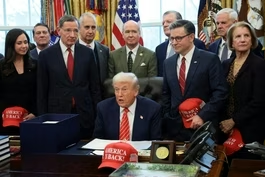
Lawmake.. package today, which President Trump# then signed, reopening the government.
AMNA NAWAZ: But the policy fight behind this# shutdown over Mr.
Trump's immigration crackdown## is far from over.
And the government has given# itself just a small window of borrowed time,## as congressional correspondent Lisa Desjardins# has been following and is now here to explain.
Lisa, good to see you.
LISA DESJARDINS: Good to see .. AMNA NAWAZ: So just kick u.. LISA DESJARDINS: This narrowly passed the House.# It was close and there was a great deal of floor## drama.
And I'm going to talk a little bit about# it because it is important for what lies ahead.
The House does have the narrowest majority,# just a one-vote majority for Republicans,## in history.
And that was a factor today in# an hour or so that this bill was actually## failing on the House floor.
Here's why.# There were five Republicans who House## Speaker Johnson needed to vote yes.
They# either weren't voting or were voting no.
Most of them were trying to use this as# leverage to try and get a voter I.D.
law## passed.
But one of them, John Rose of Tennessee,# notably, the speaker said his problem was he's## running for the governor of Tennessee and# wants some more help from President Trump.
This is a major funding bill and yet it was held# up for that.
Now, this is important because,## as you say, now we still have a period of# time where DHS itself is not funded.
This is## just a short-term patch.
So, again, what happened# today was this law fully funds most agencies and## government, except for the Department of Homeland# Security, which has 10 days worth of funding.
During those 10 days, lawmakers are# supposed to negotiate a deal on ICE## and CBP.
But those frustrated Republicans today,## they're still frustrated.
One of them continued# to vote no, Thomas Massie of Kentucky.
Our producer Kyle Midura caught up with# him and talked about his opposition.
KYLE MIDURA: Is it worth holding out for it or# you think that this is all just brought process?
REP.
THOMAS MASSIE (R-KY): We've got to# hold out for something at some point,## right?
Nobody's holding out for# anything here but me.
And I held## out for the Epstein files and got it done.# They got to start holding out for something.
LISA DESJARDINS: You hear that?# They got to start holding out for## something.
There's only 10 days left# until the next funding wall hits.
This was difficult, but I also want to# say they did manage to get funding passed,## mostly in a bipartisan way.
And, notably,## the appropriations process was starting# to work until it had this holdup.
AMNA NAWAZ: I hear you saying 10 days.
That# is a very short window to reach some kind of## deal when it comes to federal agents and ICE# conduct.
What do you know about those talks?
LISA DESJARDINS: Spent a lot of time working## on this today.
Let's look at the# rough contours of wh.. Democrats haven't presented one specific# plan, but here's what some of the Democrats## are demanding.
They want body cameras.
They# want no more masks.
They want ICE agents## to provide their I.D.s.
And some Democrats# want to require judicial warrants for ICE.
But here's the problem, where it's getting# complicated.
Here's a look at where Republicans## are in general.
We know DHS has already said# they will work to get body cameras on ICE agents,## but, as for masks, I.D.s, unclear exactly# where Republicans will come down on that.
And, Amna, Republicans, including the speaker,# have said they are against the idea of using## judicial warrants.
Another question here# is that Republicans, including the speaker,## want that vote on a voter I.D.
law, which is# unassociated with this.
They want to add it to it.
So here's what Speaker Johnson# said earlier today on both fronts.
REP.
MIKE JOHNSON (R-LA): This is a big priority# for not just House Republicans, but for the## American people.
And we will continue to attach# this to legislation and send it over.
And it will## be part of the discussion over the next couple# of weeks, and we will see how that shakes out.
But I suspect that some of the changes,# the procedural modifications with ICE,## Immigration and Customs Enforcement, will# be codified.
I mean, they have said that## they're willing to do some of this,# and so we will see how it comes out.
LISA DESJARDINS: That was big news, willing# to codify some of this, what Democrats want.
As for what they want exactly, Chuck Schumer,## the Democratic leader of the Senate, said# today he's ready to make the next move.
SEN.
CHUCK SCHUMER (D-NY): The House vote# just passed, and we're going to present a## serious proposal, detailed, along the outlines# of what we have talked about to the Republicans,## both in the Senate, the House and# the White House, very shortly.
LISA DESJARDINS: We're also# watching House Democrats.
They## don't necessarily agree with Senate Democrats.
AMNA NAWAZ: You mentioned those# judicial warrants.
That seems like## one of the most complicated pieces# here.
What do Democrats want there?
LISA DESJARDINS: I think we're going to be# talking a lot more about this in coming days,## but, quickly, the judicial warrants have# a much higher standard.
They have to go## through a judge, through a court, and# that's why Democrats want them.
They## want someone independent of ICE# reviewing that warrant process.
However, Republicans say, no, that's too high of## a standard in this situation.
That's# going to be a major point of debate.
AMNA NAWAZ: So, bottom line for today, Lisa,# when do we expect the full government to reopen?
LISA DESJARDINS: Imagine this.
Right now,# the government is reopening.
As you said,## President Trump signed the law.
Those# many workers who didn't show up today,## who had a brief furlough,# they will be back tomorrow.
But, again, stay tuned because the# Department of Homeland Security,## which is a very large agency, their fate# still awaits another wall in just 10 days.
AMNA NAWAZ: More talks ahead.
Lisa Desjardins covering it all, th.. LISA DESJARDINS: You're welcome.
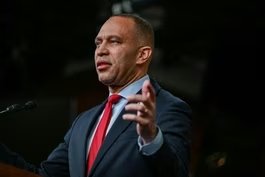
GEOFF BENNETT: For more on the vote# today ending the partial government## shutdown and the latest on the Epstein files,## I spoke earlier today with House Democratic# Leader Hakeem Jeffries of New York.
Leader Jeffries, welcome back to the "News Hour."
REP.
HAKEEM JEFFRIES (D-NY):# Thank you for having me on.
GEOFF BENNETT: More than 20 House# Democrats voted with Republicans## to reopen the government.
You# voted against the measure.
Why?
REP.
HAKEEM JEFFRIES: Well, what's clear to me is## that there needs to be dramatic change# at the Department of Homeland Security.
We supported the five bipartisan bills that# are now on their way to President Trump's desk## because they are actually designed# to promote the health, the safety,## and the economic well-being# of the American people.
Rosa DeLauro, top Democrat on the Appropriations# Committee, did a tremendous job in negotiating## those bills.
The American people don't want# to see their taxpayer dollars, however,## utilized to brutalize and kill American citizens.
Taxpayer dollars should actually be# used to make life more affordable for## everyday Americans.
And that's going to be the# genesis of the fight over the next 10 days as## we approach the funding deadline on February# 13 for the Department of Homeland Security.
GEOFF BENNETT: That's right.
We# should explain to folks who might## be unfamiliar this agreement kicks off# this 10-day sprint now for Democrats## and Republicans to agree on policy# changes for how ICE should operate.
What specific changes do you believe must## be addressed before Democrats# support longer-term funding?
REP.
HAKEEM JEFFRIES: Fundamentally, we# believe that ICE should conduct itself like## every other law enforcement agency in the country.
Police officers don't wear masks.
Sheriffs# don't wear masks.
State troopers don't wear## masks.
There's no justification for the manner# in which ICE is conducting itself in terms of## masks.
They should be required to have body# cameras.
They should be required to obtain## judicial warrants before they can rip everyday# Americans out of their homes or out of their cars.
We want to make clear there's an explicit# prohibition from ICE detaining or deporting## American citizens, which we have seen# examples of, unfortunately.
We believe that,## if ICE agents break the law, they should be# held accountable.
And those investigations## should be fair, complete and independent,# which also means giving state and local## authorities the ability to investigate# violations of state and local law.
GEOFF BENNETT: The DHS secretary, Kristi Noem,# said this week that DHS will deploy body cameras## to Minneapolis and other cities as funding allows# for those agents who are working in those cities.
Is that sufficient?
Is that# a good enough first step,## a sign that the administration# is at least open to changes?
REP.
HAKEEM JEFFRIES: Well, Kristi# Noem has zero credibility.
Certainly,## it is the case that body cameras# should be required.
And we also## know that the Department of Homeland# Security has more than enough funding.
In the one big, ugly bill, where Republicans# enacted the largest cut to Medicaid in American## history and at the same time stripped# away about $186 billion in support for## nutritional assistance, they literally stole# food from the mouths of hungry children,## seniors and veterans in order to# give the Department of Homeland## Security a $191 billion slush fund,# $75 billion of which went to ICE.
So the funding clearly exists for every# single ICE agent to have body cameras on## and functioning at all times.
And the fact# that Kristi Noem is suggesting that there## may be a funding shortfall indicates# further the lack of credibility that## she has.
She should be fired.
And if she's# not fired, I have indicated that the House## Democrats are prepared to initiate# impeachment proceedings against her.
GEOFF BENNETT: In the time that remains,# I want to ask you about the Epstein files,## because the Justice Department last# week released over three million pages## of Epstein-related documents.
Many of# them were heavily redacted.
There are## legislators who say that not all of the# relevant material has been disclosed.
In your view, did the DOJ comply with the# congressional intent and with the law in## the way that it has gone about# making these documents public?
REP.
HAKEEM JEFFRIES: The Department of# Justice continues to hide documents from## the American people in a manner that is# entirely inconsistent with the law that## was passed with huge bipartisan majorities# and, of course, signed by Donald Trump.
And the question has to once again be asked,## what are the Department of Justice lawyers# hiding from the American people and who## are they protecting?
There are more than three# million documents that have not been released.
And, as you indicated, several documents have# been heavily redacted.
And so the survivors of## the Epstein crime spree have boldly and# appropriately called for accountability## and transparency.
And the only way to achieve# that is to make sure that the Department of## Justice releases the Epstein files in their# entirety.
They have failed to do that today.
GEOFF BENNETT: Meantime, the Clintons have# agreed to testify in this Republican-led inquiry.
It's led by the House Oversight Committee# chairman, James Comer, as you well know.## This appears to be an effort by the GOP to make# the Clintons the face of this Epstein scandal,## the Epstein investigation.
The# question I have for you, though,## is about the precedent.
If Democrats win the# House come November, does this mean that future## investigations will apply the same standard to# presidents and political leaders of both parties?
REP.
HAKEEM JEFFRIES: Well, I think that the# Clintons have endeavored to enter into good-faith## negotiations with a Republican majority that is# clearly trying to create a political circus in## order to try to distract from the accountability# and lack of full transparency that the Trump## administration has been blocking since the# very beginning of this whole sordid matter.
And so, from our standpoint, I'm thankful# that it appears that we're now on a path## toward the Clintons reaching an agreement# with the House to provide their testimony.## But I don't believe that James Comer is a# serious individual or that he's seriously## trying to actually get information that then# can be presented to the American people as part## of what we're trying to accomplish here,# which is transparency and accountability.
He wants to politicize things.
He's targeting the# Clintons so he can distract from the fact that the## Trump administration is failing to comply with# the law, a law that Donald Trump himself signed.
GEOFF BENNETT: House Democratic Leader Hakeem# Jeffries, thanks again for your time this evening.
REP.
HAKEEM JEFFRIES: Thank you so much.
GEOFF BENNETT: Turning to the# day's other headlines now:## The U.S.
military says it's shot down an# Iranian drone in the Arabian Sea that was## approaching a U.S.
aircraft carrier with what# officials described as an unclear intent.
Just hours earlier, Iranian forces are said to# have harassed a U.S.-flagged merchant vessel## in the Strait of Hormuz.
The two developments# come as Iran's president called for fair and## equitable negotiations with the U.S.
in# talks scheduled for later this week.
That## marks a shift in tone following weeks# of heightened tensions between the two## nations over Tehran's bloody crackdown# of protests that left thousands dead.
Russia renewed its attacks on Ukrainian energy# targets overnight just a day ahead of planned## peace talks aimed at ending the nearly four-year# war.
The bombardment included hundreds of drones,## as well as missiles, and knocked# out heating in parts of the capital,## Kyiv, which is suffering one of# its coldest winters in years.
It comes as Russia and Ukraine differed on a# timeline for a pause on hitting each other's## energy infrastructure.
That temporary halt# was requested by President Trump last week.
Speaking alongside NATO Chief# Mark Rutte in Kyiv today,## President Zelenskyy said the pause was# supposed to expire this coming Friday.
VOLODYMYR ZELENSKYY, Ukrainian President (through# translator): We will contact the American side## regarding this matter.
I expect that our partners# will not remain silent about what is happ.. It is critical for everyone to continue# to support the defense of our country.
GEOFF BENNETT: But in the# Oval Office this afternoon,## President Trump insisted that the pause was# only due to last until this past Sunday,## and that President Vladimir Putin of Russia# had indeed -- quote -- "kept his word."
More Palestinians gathered on both# sides of the Rafah Crossing today,## hoping to pass through on day two of its# long-awaited reopening.
Ambulances were## seen departing Gaza, evacuating patients in# dire need of medical care to hospitals in## Egypt.
And Palestinians who previously fled# Gaza returned home today via the crossing.
It's not clear how many people made# the journey in either direction.
It## comes after only a dozen Palestinians were# allowed back into Gaza last night.
Some## recounted their experience, which they say# included an interrogation by Israeli troops.
ROTANA AL-REGEB, Palestinian Returnee (through# translator): The army took us and blindfolded us,## me, my mother, and another woman.
They# tied our hands and began questioning## us about things we didn't know and# had no connection to.
We had nothing## to do with anything they were asking us about.
GEOFF BENNETT: The reopening of the# crossing is a vital step toward the## second phase of the Israel-Hamas cease-fire.
President Trump says he now wants $1 billion# in damages from Harvard University to settle a## long-running dispute over alleged antisemitism# on campus.
That's double the amount the Trump## administration had been seeking.
And it# comes after The New York Times reported## that Mr.
Trump was backing away from a# demand for a cash payment from Harvard.
In a series of social media# posts, the president fired back,## calling that reporting completely# wrong.
Harvard has been fighting the## administration in court over its efforts# to freeze billions of dollars in federal## funding and to hinder the school's# ability to enroll foreign students.
Disney named the head of its theme# parks, Josh D'Amaro, as its new CEO.## The 54-year-old replaces longtime Disney# head Bob Iger and becomes just the ninth## boss in the company's more-than-100-year# history.
Josh D'Amaro takes over at a time## when Disney is riding high with box office hits# like "Zootopia 2" and the latest "Avatar" film,## but is also seeing fewer international# visitors at its U.S.
theme parks.
Disney shares ended slightly# lower following the news.
Elsewhere on Wall Street today, stocks# fell amid weakness in tech shares.
The## Dow Jones industrial average slipped more than 160# points.
The Nasdaq dropped more than 330 points,## or nearly 1.5 percent.
The S&P 500# also closed in negative territory.
Still to come on the "News Hour": a# former secretary of homeland security## weighs in on the agency's immigration crackdown;## Colombia's president visits the White House after# months of high tensions between the two nations;## and a new book explores the agricultural# revolution that could transform how we eat meat.
AMNA NAWAZ: We're learning new details about the# FBI raid on an elections office in Fulton County,## Georgia, last week.
Director of National# Intelligence Tulsi Gabbard explained in a## letter to Congress that President Trump personally## asked her to be on site as federal# agents executed that search warrant.
The incident has raised serious questions# about election security and federal authority.
White House correspondent Liz Landers has# been following all of this and joins us now.
So, Liz, let's start with the FBI raid# in Georgia and Tulsi Gabbard's role.
What## more do we know about why she was there?
LIZ LANDERS: Well, this has been raising## concerns amongst Democrats in Congress, who# asked her to explain her presence.
So she## wrote this letter late last night defending# why she was down there in Fulton County.
She said that: "The president specifically# directed my observance of the execution of## the Fulton County search warrant."
She also# in this letter confirmed a phone call that## she facilitated between President Trump and# FBI agents who participated in that operation,## which I should underscore, Amna, is very unusual.
White House Press Secretary# Karoline Leavitt was asked## about this and explained a bit more# about Gabbard's role this afternoon.
KAROLINE LEAVITT, White House Press Secretary:# This is a coordinated whole-of-government effort## to ensure that our elections, again, are fair# and transparent moving forward.
I don't see## anything wrong with the president tasking# a Cabinet member to pursue an issue that## most people want to see solved.
Maybe you# don't, but I know many Americans do want## to make sure our elections are protected, and# that's what Tulsi Gabbard is focused on doing.
LIZ LANDERS: And Fulton County election officials# there are saying that they are going to sue the## FBI and the Department of Justice over the# search warrant that they say was not proper.
AMNA NAWAZ: I'm sure you have heard there are some# who are worrying this could be a sort of dry run## for other places to interfere in the 2026 midterms# and beyond.
What are you hearing about that?
LIZ LANDERS: Well, one of the main# concerns about what happened in Fulton## County is that they seized voter rolls.
That# was something we saw in the warrant last week.
And there are concerns from other state election# officials about this now.
I spoke earlier with## Tammy Patrick.
She served as a Maricopa# County election official for 11 years.
TAMMY PATRICK, National Association for Election# Officials: And I think that state and local## officials for a number of months now, if not for# the last year, have been .. better understanding of what the laws are in their# state around their voting materials post-election,## who has access to them, what needs to be done# in order for someone to gain that access,## and what are the protocols for chain of custody to## make sure that the integrity of the# materials remains and is retained?
LIZ LANDERS: Patrick also added that# these local election officials are## working very closely with their county# and state attorneys right now to make## sure that they are properly maintaining# voting material even after the voting## concludes in case there are these kinds of# operations that happen further down the line.
One more thing that I would add, Amna,# Senator Mark Warner, who sent that letter## to Tulsi Gabbard, he is also worried that the# kinds of actions that we saw in Fulton County,## seizing election materials, that# that could spread to other states.
AMNA NAWAZ: Meanwhile, we heard from the# president yesterday in a radio interview## saying Republicans should nationalize# the voting in some states ahead of the## midterms.
He doubled down on that# idea today.
Here's what he said.
DONALD TRUMP, President of the United States:# Look at some of the places that -- horrible## corruption on elections.
And the federal# government should not allow that.
The## federal government should get involved.
These# are agents of the federal government to count## the votes.
If they can't count the votes legally# and honestly, then somebody else should take over.
AMNA NAWAZ: Liz, the question is,## does the president have the power to#.. LIZ LANDERS: The short answer to this is no.
And it's worth reminding people what# the Constitution says specifically## about how elections are supposed to# be administered in this country.
The## Constitution is clear that states are# the ones who set the time and place## for federal elections.
But it does give# Congress the right to alter those rules.
Congress has exercised this power# sparingly during the Reconstruction## period after the Civil War.
And this# also applies to congressional elections,## not state elections, like governor# or secretary of state elections.
This ultimately, though, does not give the# president or any president unilateral power## to nationalize congressional elections.
That# power is explicitly given to Congress.
And I## would add that even those in his own party,# like Senate Majority Leader John Thune,## was asked about the president's# comments, nationalizing elections,## and he said to reporters today: "I am# not in favor of federalizing elections."
AMNA NAWAZ: I know you have# been covering this as well,## but we should point out this Trump# administration has been fighting## for almost a year now in court to obtain# private voter data from a number of states.
When you talk to election security# watchers, what do they say about that?
LIZ LANDERS: Well, the main concern that# we heard, and we heard this last week from## secretaries of state who were in Washington# all convening together talking about this,## is that there could be personally identifying# information that gets out if they're sending## some of this information to the federal# government and to the Department of Justice.
So about 20 states now have been sued by the# Department of Justice, trying to get more of## their voter roll information and some of these# details that these states say, we're trying## to safeguard this to make sure that people's# identities don't get stolen, stuff like that.
So when we're talking to these state and# local election officials, they are sort of## on the front lines of fighting against what# the administration is asking for right now,## and they say they're doing it to# protect the voters in their states.
AMNA NAWAZ: That's our White House# correspondent, Liz Landers, reporting tonight.
Liz, thank you.
In a forum on federal agents' use of force# in the president's immigration crackdown,## Democratic lawmakers heard from# Americans directly impacted.
That included the brothers of Renee Good,# shot and killed in Minneapolis last month,## Marimar Martinez, shot five times by# Border Patrol agents in Chicago last fall,## and Aliya Rahman, dragged from# her car by agents in January in## Minneapolis.
ICE agents said they'd# instructed Rahman to move her car.
The administration has claimed that Good and# Martinez threatened agents with their cars.,## Charges against Martinez were later dropped.
Here's just some of what they shared.
LUKE GANGER, Brother of Renee Good: The# completely surreal scenes taking place## on the streets of Minneapolis are beyond# explanation.
This is not just a bad day## or a rough week or isolated incidents.# These encounters with federal agents are## changing the community and changing# many lives, including ours forever.
MARIMAR MARTINEZ, Shot By Border# Patrol Agents: I struggle with the## memories of the day, the initial# swerving int.. the shots ringing out and the burning sensation# as the bullets ripped through my skin and body.
I had seven bullet holes in my body.
I remember# the agents rushing the nurses to finish up so they## could take me with them.
I still felt dizzy.
I was# not able to fully process what had happened to me.
ALIYA RAHMAN, Dragged From Vehicle By ICE: Then# the glass of the passenger side window flew across## my face.
I yelled "I'm disabled" at the hands# grabbing at me.
And an agent said: "Too late."
AMNA NAWAZ: No DHS officials# appeared at today's forum.
For more on all this, I'm joined now by Janet# Napolitano.
She served as homeland security## secretary under President Obama.
She's also served# as Arizona's governor and as attorney general.
Secretary Napolitano, welcome back to the# "News Hour."
Thank you for joining us.
JANET NAPOLITANO, Former U.S.
Secretary# of Homeland Security: Thank you.
AMNA NAWAZ: Can I just ask you to res.. forum today of people testifying about the use# of force they or their families experienced,## and also the videos I'm sure you have# seen of federal agents breaking windows,## pointing guns at civilians,# dragging people from cars?
You ran DHS.
Is this what an immigration# enforcement operation is supposed to look like?
JANET NAPOLITANO: No, it is not.
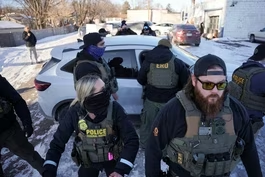
And what we have seen in Minneapolis and# in other cities where the so-called surges## occurred is increasingly aggressive# behavior by federal agents.
Look,## immigration is a tough topic.
I know.# I have dealt with it for decades,## but it is no excuse for the excessive use of# force against the citizenry of the United States.
AMNA NAWAZ: You will recall under# President Obama when he was dubbed## by immigration rights advocates# as the deporter in chief, right?
JANET NAPOLITANO: Yes.
AMNA NAWAZ: He logged more than three million deportations across both his# administrations under ICE.
So what was being done differently# then compared to what we're seeing now?
JANET NAPOLITANO: Well, first of all, we# prioritized.
We gave clear direction to## ICE to focus on those in the country illegally# who had also committed other serious crimes.
And that's primarily what we did.
We also# focused on border and border security and## deportations right at the border before# individuals had the opportunity to get## into the United States and settle here.
And# so I was secretary for about five years,## and in that period we deported# about 3.2 million or so individuals.
That's what gave President Obama,# I think much to his chagrin,## the nickname deporter in chief.# But it was a clear prioritized## operation that was designed to protect the# nation from undocumented illegal immigration,## but also to rid the nation of illegal immigrants# who had otherwise committed other crimes.
AMNA NAWAZ: As you have seen, we have seen a# little bit of a change from the president's## administration in Minneapolis,# at least, replacing Greg Bovino,## who was running the operation there, with# Tom Homan, his so-called border czar.
I understand you know Mr.
Homan# from your time at DHS.
He was there## when you were secretary.
What can you# tell us about him and how, if at all,## you think things will change# on the ground in Minneapolis?
JANET NAPOLITANO: Well, I think the switch was# long overdue, because Bovino was such a showboat,## rather than being really an effective# law enforcement leader and manager.
Tom Homan is a career public servant.
He's very# conservative on immigration, don't get me wrong,## but when I was secretary, he was head of ERO at# ICE.
And that's when we implemented the guidelines## that we had begun under President Obama, which# was in the interior of the country to focus on## those who were in the country in undocumented# status who had committed other serious crimes.
AMNA NAWAZ: When you look at what's happening# on the ground, though, and contrast that with## the message we're hearing from some of the# senior-most officials in the White House,## the vice president himself, Stephen Miller,# who we know formulates a lot of this policy,## they have been messaging to ICE agents that# they have absolute immunity in how they act.
How do you think federal agents are# incentivized to be less aggressive## or pull back when that's the message# they're getting from the White House?
JANET NAPOLITANO: Well, it's -- not# only is it wrong on the law.
They## don't have absolute immunity and# have never had absolute immunity.
But just the words that are being used, the# rhetoric that comes from the White House,## from the secretary's office, et cetera, in# essence, gives permission to field agents to do## overly aggressive behaviors in order to# accomplish what they're supposed to do.## And that has resulted in some of the# real unfortunate abuses that we have## seen in Minneapolis and in other# cities across the United States.
AMNA NAWAZ: So how much of a difference# would it make when you look at what## Democrats are asking for, in example, in these# shutdowns -- well, the shutdown is now over,## but in the negotiations over# a change in ICE tactics?
They want things like ending roving patrols,# removing agents' masks, requiring judicial,## not administrative warrants.
Would# those things make a real difference?
JANET NAPOLITANO: Well, roving patrols# are a function of the quota that has## been issued by the White House for 3,000# arrests per day, which is a great increase## from any prior administration.
And they# simply can't find enough of those people.
So they're just running around looking.# And that has caused all kinds of abuse and## the kinds of things that we have seen in# Minneapolis and elsewhere.
Other things,## requiring a judicial warrant, which# seems to be a sticking point, well,## judicial warrants are required when a# federal agent wants to enter a home.## It's a function of the Fourth Amendment to# the Constitution.
There's no difference.
Under the current law, immigration agents# do not need a judicial warrant when they're## effecting an arrest in a public place if they# have probable cause to believe an individual## is otherwise removable.
So if that's where they# end up, that's what the law currently requires.
And what we have seen -- where we have seen# the law broken is an agent going into houses,## not with judicial warrants, which is# a fundamental of the Fourth Amendment,## but with simple administrative warrants.
AMNA NAWAZ: You have mentioned in# previous interviews that you don't## know the current DHS secretary, Kristi Noem.
You## haven't spoken to her.
You did say in one# interview she's clearly out of her depth.
But if you could advise her at this moment about# what you think should happen next to avoid more## loss of life or further aggressive# use of force, what would you say?
JANET NAPOLITANO: Well, first, I would say that# she needs to watch what she says and how she## says it.
She is the leader of the Department of# Homeland Security.
She shouldn't rush to judgment## and immediately say a victim is a domestic# terrorist or an insurrectionist or an anarchist,## when we can see the videos for ourselves, the# American people can see the videos for themselves.
But, in essence, it's giving permission# to those agents who are out there who## are acting overly aggressively, not using# law enforcement best practices to continue## that kind of behavior.
The second# thing I would recommend to her is to## make sure that investigations of these excessive# force cases are done independently, openly,## transparently, and in cooperation and coordination# with state attorneys general and local police.
That is the only way that the department# will reestablish the credibility of these## investigations, since there was such# a rush to judgment at the outset.
AMNA NAWAZ: That is the former Homeland Security# Secretary Janet Napolitano joining us tonight.
Secretary Napolitano, thank you# for your time.
We appreciate it.
JANET NAPOLITANO: Thank you.
GEOFF BENNETT:## The Trump administration's plan to end# temporary protected status for Haitians## in the U.S.
was blocked yesterday by# a federal court in Washington, D.C.
The program, which allows Haitians# to live and work legally in the U.S.,## was set to expire today, a move that# would have left roughly 350,000 people## vulnerable to deportation.
But the# Trump administration plans to appeal.
And, as Stephanie Sy reports,# that uncertainty has won Ohio## city bracing as it fears becoming the# next focus of immigration enforcement.
WOMAN: Thank you.
I have a right to remain silent.
STEPHANIE SY: Masked men confronting# congregants while others record on## their cell phones.
A chaotic scene unfolds at a# church in Springfield, Ohio, only, it's not real.
WOMAN: Department of Homeland Security.
Open up.
STEPHANIE SY: Community members are role-playing# how an ICE raid might unfold.
And they clearly## plan to resist, armed with Scripture and# knowledge of their constitutional rights.
WOMAN: They are supposed to not be able to# enter private spaces without a judicial warrant.
CARL RUBY, Senior Pastor, Central Christian# Church: I can't imagine what it would be like## for me if I had to leave my country# because I couldn't live here safely.
There is a lot of support# for Springfield out there.
STEPHANIE SY: Senior Pastor Carl Ruby# founded a network of churches in the## area offering support to the city's# Haitians and, in some cases, sanctuary.
CARL RUBY: I would want people to stand with me.
I## would want people to protect me.
So# that's all that we're trying to do.
STEPHANIE SY: Nancy Flinchbaugh has# called Springfield home for 30 years.
NANCY FLINCHBAUGH, Springfield, Ohio,# Resident: I'm here because I'm very## concerned about what's going to happen to the# immigrants in ou.. because I think it's going to have# a detrimental effect on all of us.
STEPHANIE SY: In recent years, Springfield# has experienced a surge in Haitian migrants,## most of whom came under the Department of# Homeland Security's temporary protected## status designation.
TPS lets people from# countries deemed temporarily unsafe due## to war or natural disasters live# and work in the U.S.
legally.
The Trump administration has tried to terminate# TPS status for 11 countries in his second term.
DONALD TRUMP, President of the United States:# In Springfield, they're eating the dogs,## the people that came in.
They're eating the cats.
STEPHANIE SY: And the president has had# Springfield's Haitian population in his sights## since the 2024 election, when the city became a# political flash point and focus of misinformation.
If the Trump administration's# decision not to renew TPS for## Haiti is ultimately allowed by the# Supreme Court, many of the city's## roughly 15,000 Haitian residents will# become subject to deportation orders.
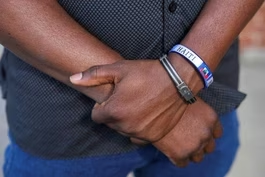
VILES DORSAINVIL, Haitian Support Center: The USA## that used to be seen as the beacon# of t.. STEPHANIE SY: Viles Dorsainvil is originally# from Haiti's capital, Port-au-Prince,## and moved to Springfield in 2021.
He runs# the Haitian Support Center in Springfield.
VILES DORSAINVIL: I'm afraid of folks# being detained for no reason.
I'm afraid## of seeing parents being separated from their kids.
STEPHANIE SY: Despite the Homeland Security# Secretary Kristi Noem's determination that## Haiti no longer meets the criteria for TPS,# the U.S.
State Department has a do not travel## for any reason advisory for the country due# to kidnapping, crime, terrorism and unrest.## And the FAA has a ban on commercial flights to# its main airport in place at least until March.
VILES DORSAINVIL: I think that the American# people who've been enjoying their country not## having those type of problems that immigrants have# would not understand what we are going through.
If## they were living in a condition where they feel# insecure by armed hoodlums, if they were in a## condition where they wouldn't be able to feed# their kids, if they were in a condition where## they were persecuted by their own government,# wouldn't they try to get to somewhere safer?
STEPHANIE SY: A federal judge sided with# that view yesterday.
In a challenge to the## Trump administration's move to end TPS,# D.C.
District Judge Ana Reyes wrote that## the decision appeared driven by hostility# to nonwhite immigrants, and she called the## termination of TPS preordained and not based# on the realities on the ground in Haiti.
The Trump administration is expected to# file an immediate appeal.
Ultimately,## their fate could end up decided by# the Supreme Court.
But not everyone## in Springfield would be upset# to see Haitian migrants leave.
LAURA ROSENBERGER, Executive Chairman, the Clark# County, Ohio, Republican Party: There's definitely## a resentment in Clark County, and that's# the tens.. Oh, here's a good one.
STEPHANIE SY: Laura Rosenberger has# lived in Sprin.. and is the executive chairman of the Clark# County Republican Party.
She says many in## Springfield were taken off guard by the arrival# of such a large number of Haitian immigrants.
LAURA ROSENBERGER: I think a lot of the people,# the native people, feel like they were not asked.## It was not put to a vote.
The people had# no voice.
All of a sudden, this happened.
STEPHANIE SY: And she says the surge IN# population led some Ohioans to feel pushed aside.
LAURA ROSENBERGER: There's a lot of competition# for jobs.
And when you bring in such a large## amount of people, that increases the# friction because people are fighting## each other for jobs and resources.
The# wages that the Haitians will work for## are much lower than what your typical# American worker is going to work for.
STEPHANIE SY: But if these manufacturing# companies lose their workers, might that## lead to a greater shift away from areas like yours# that have already lost so much of their industry?
LAURA ROSENBERGER: Well, we need our# people to step up and apply for these## jobs and the manufacturers need to hire# them, even if it means hiring them for a## little bit of a higher wage than what# the Haitians would have worked for.
MELANIE WILT, Former Clark County,# Ohio, Commissioner: When you see the## erosion of the economy over time, you can start# to be kind of protectionist.
And then you h.. scarcity mind-set that is, well, if somebody else# is getting this, then I'm not getting something.
STEPHANIE SY: Melanie Wilt is the former# commissioner of Clark County, which## includes Springfield.
She admits the population# surge was difficult to manage at first, but: MELANIE WILT: We have spent the last four# or five years really adjusting to that,## helping to assimilate the Haitian community,## making them part of our work force.
And they're an# important part of this community now.
So, if that## were to change overnight with the expiration# of TPS, our community would have to adjust.
STEPHANIE SY: Like many Industrial Midwest cities,# Springfield lost jobs and residents for decades,## a trend that began reversing in recent# years partly due to Haitian immigrants.
MELANIE WILT: One of the goals that we have had# for a long time is to increase our population,## because increased population strengthens# the tax base.
And we have seen that## our immigrant neighbors really do# spend their money in the community.
STEPHANIE SY: But with the end# of TPS come a lot of unknowns.
What do you think should# happen to these folks?
I mean,## it's called TPS because it's# supposed to be temporary.
MELANIE WILT: Well, I'm a conservative.# I'm a Republican.
And I believe that this## country needs immigration reform, but# I think we need to do it in a way that## is respectful of human dignity.
I think we# need to do it in a way that is predictable.
STEPHANIE SY: Viles Dorsainvil says that# uncertainty is weighing heavy on his community.
VILES DORSAINVIL: They are tired.
When I say# tired, I mean, they just not know what to## do next.
They're not accepted back home,# and they're not accepting anywhere.
They## keep running from time to time and not being# able to set up anywhere.
So they are tired.
STEPHANIE SY: Tired, with no# clear place to run to next.
For the "PBS News Hour," I'm Stephanie Sy.
GEOFF BENNETT:## Today, two presidents known for their# fiery rhetoric toward each other met## in the Oval Office and apparently put their# acrimony behind them.
Colombia's President## Gustavo Petro has long been a critic# of President Trump and the U.S.
itself.
AMNA NAWAZ: But Mr.
Trump this afternoon# praised Petro and did not repeat previous## threats of military action.
And# in a press conference tonight,## Petro said the meeting eased tensions# between Trump and all of Latin America.
Nick Schifrin reports.
NICK SCHIFRIN: Today, at the White House, a# Colombian president who for decades criticized## what he calls American imperialism was all smiles# for the man he recently dubbed a would-be king.
President Trump greeted Gustavo Petro# warmly, offered a personal tour of what## he's labeled the Presidential Walk# of Fame and wrote Petro a letter,## "A great honor.
I love Colombia" and inscribed# his "Art of the Deal" "You are great."
DONALD TRUMP, President of the# United States: I thought he was## terrific.
He's great.
We got.. NICK SCHIFRIN: Tonight, Petro said# the meeting defused regional tensions.
GUSTAVO PETRO, Colombian President# (through translator): He gave me a## red cap that said "Make America .. and said "Make Americas Great," and that can# only be done on the basis of mutual respect.
NICK SCHIFRIN: That is a far cry# from months of mutual maliciousness.
DONALD TRUMP: Colombia is out of control,# and now they have the worst president## they have ever had.
He's a lunatic who's# got a lot of problems, mental problems.
GUSTAVO PETRO (through translator): We# must respond to defend people's rights,## the rights of democracy not# to be governed by tyrannies.
DONALD TRUMP: He has cocaine mills and cocaine# factories.
He's not going to be doing it.
QUESTION: So, there will be# an operation by the U.S.?
DONALD TRUMP: It sounds good to me.
GUSTAVO PETRO (through translator):## For us, ICE operates the same way as the# Nazi and Italian brigades, the fascists.
NICK SCHIFRIN: But after the U.S.
'# -- quote -- "law enforcement action"## against Venezuelan President Nicolas# Maduro ended with him in handcuffs,## President Trump says there's# been a change in tone.
DONALD TRUMP: I mean, he's been very nice over the## last month or two.
He was certainly# critical before that.
But, somehow,## after the Venezuelan raid, he became very# nice.
He changed his attitude very much.
NICK SCHIFRIN: What hasn't changed, the# Colombian military's desire to combat drug## smuggling.
For years, they have worked# with the U.S.
to take steps like this,## interdict cocaine from Colombia# on the way to the United States.
The Trump administration's solution was military,## dozens of strikes on alleged drug boats.
Petro# described that as murder.
And his solution,## voluntary eradication, letting farmers# themselves rip up the root of the problem.
WOMAN (through translator): It# doesn't interest us.
We don't## want it because we know there's no# future or way forward there for us.
KEVIN WHITAKER, Former U.S.
Ambassador# to Colombia: The theory is not wrong.## The problem is, it's never worked in practice.
NICK SCHIFRIN: Kevin Whitaker was ambassador to# Colombia from 2014 until 2019 under Presidents## Obama and Trump.
He points out that Colombia's# cocaine production has grown year over year,## and the country now supplies nearly# 70 percent of the world's cocaine.
KEVIN WHITAKER: I mean, a serious flaw# in the Petro administration's approach## to this entire issue is to completely stop# the process of military engagement with these## illegal armed groups who# are behind the coca trade.
A serious approach would be to design# a strategy aimed at undercutting the## illegal armed groups as a military# matter.
I think that that would be## very attractive to the U.S.
administration.
I# also think it could be effective in Colombia.
NICK SCHIFRIN: Whitaker also says that,# despite historic ties, Petro and the U.S.## could cooperate on overlapping goals# with the new government of Venezuela.
The U.S.
has forced that government to# stop exporting oil to Cuba, and now,## under U.S.
pressure, Mexico could# also cut off its own supply to Cuba.
DONALD TRUMP: It's a failed nation now, and# they're not getting any money from Venezuela,## and they're not getting any money from# anywhere.
It's a failed nation.
Mexico## is going to cease sending them oil.
But we# are dealing with the Cuban leaders right now.
NICK SCHIFRIN: Since the Cuban Revolution,## the country has relied on an outside patron.
It# first lost t.. KEVIN WHITAKER: People have been predicting# the end of the Castro regime in Cuba for many,## many years.
It's hard to think that# this will be the time when it will## really make a difference.
But petroleum# is very important to the economy.
And if## they lose the flows both from Mexico and from# Venezuela, that's going to hurt economically.
NICK SCHIFRIN: And Cuba and the region# will remain under enormous U.S.
pressure## that today brought a former guerrilla# fighter to the seat of U.S.
power.
For the "PBS News Hour," I'm Nick Schifrin.
GEOFF BENNETT: In his new book, Bruce# Friedrich argues that the way we produce## meat is unsustainable for the climate,# for public health, and for the planet,## and that the solution isn't eating# less meat, but making it differently.
From lab-grown meat to plant-based alternatives,## he says a food revolution is already under# way, whether consumers realize it or not.
I spoke with him about the book "Meat: How the## Next Agricultural Revolution Will Transform# Humanity's Favorite Food and Our Future."
Bruce Friedrich, welcome to the "News Hour."
BRUCE FRIEDRICH, Author: Thanks#very much, Geoff.
I'm delighted to be here.
GEOFF BENNETT: You open the book by saying -- this## is a quote -- "I'm not here# to tell anyone what to eat."
Why was it important for you to start# there and to focus on how meat is made,## rather than on the personal choice?
BRUCE FRIEDRICH: Well, because the environmental# and global health and animal protection## communities have been basically starting# on personal choice for more than 50 years.
And what we have seen is that meat# consumption just keeps going up.## So the U.N.
Food and Agriculture Organization,# they started tracking this in 1961.
And we have## literally hit a new global meat production record# every single year since.
And that's a problem,## because cycling crops through# animals is incredibly inefficient.
It takes nine calories into a chicken to# get one calorie back out in the form of## chicken meat.
It's just a shockingly# inefficient system that has a lot of## negative externalities, negative external costs.
GEOFF BENNETT: And you describe this moment# as the next global agricultural revolution.## What makes this shift comparable# to past revolutions in farming?
BRUCE FRIEDRICH: Well, for 12,000 years we have## been growing crops to feed them to# animals, so that we can eat animals.
That is -- after hunting and# gathering, that's how we have## been doing it for 12,000 years.
As I just# mentioned, it's fantastically inefficient,## but it's not just the inefficiency of growing# the crops to feed them to animals.
So,## the most efficient animal being the# chicken, and that's 800 percent food waste,## so eight times the land, eight times the water,# eight times the herbicides and pesticides.
You also have to ship all of those crops# to a feed mill, operate the feed mill,## ship the feed to the farm, operate the farm,# ship the animals to the slaughterhouse,## operate the slaughterhouse.
Like, that's a bunch# of extra gas-guzzling, pollution-spewing vehicles,## a bunch of extra factories, which take a lot# of energy and spew out a lot of pollution.
If we can remove the animal from the equation# and give human beings what they love about meat,## because I call it humanity's# favorite food in the subtitle,## that would be really a revolution,# animal meat without the animal.
GEOFF BENNETT: And you may clear that this# will only work if the meat alternative looks,## tastes like, and has a price# point that matches conventional## meat.
Where are we closest on# parity when it comes to that?
BRUCE FRIEDRICH: Yes, I mean,# just to underline that point,## like, we started with the idea of# personal choice.
What is absolutely## clear is that people eat meat because# it's delicious and it's affordable.
What's also clear is, whenever there# are more people and the economy grows,## meat production and consumption goes up.
And this# is, like, one of the most consistent findings in## social sciences is that, where food is concerned,# people care, is it delicious and is it affordable?
And then you look at meat production,# meat consumption, pretty much everywhere,## people really love meat.
So that's the# focus.
The products need to be -- they## need to taste the same or better, they need# to cost the same or less.
And that's how you## make plant-based meat and cultivated# meat that can win in the marketplace.
GEOFF BENNETT: I think for people who've# had a Beyond Burger or Impossible Burger,## it tastes close to the real thing,## but not quite.
Do you think we can get to a# point wher.. BRUCE FRIEDRICH: So the last chapter of the book,## chapter 11, I interviewed 30 plant-based meat# scientists and 30 cultivated meat scientists.
And I started with the question, can we get to# plant-based meat, cultivated meat, depending on## the scientist, that is cost-competitive with# and indistinguishable from cheap chicken and## cheap fish sticks?
Because that's -- if you# can get there, you can get everything else.
(LAUGHTER) BRUCE FRIEDRICH: And peopl.. look, if one thing requires nine# times the inputs of something else,## what would be the hurdle to plant fats and# proteins behaving like animal fats and proteins?
What would be the hurdle to growing# actual animal muscle and fat in tanks,## instead of on live animals?
So it's going to take# some time.
It's going to take some innovation.## But 10 years ago, there was no Beyond Burger;# 10 years ago, there was no Impossible Burger.
We have come a pretty long way on both# plant-based meat and cultivated meat in... (SNAP FINGERS) BRUCE FRIEDRICH: ... historically, that long.
GEOFF BENNETT: One of the takeaways in# this book for me was that, as we all .. consuming meat is deeply cultural.
It's tied to# identity.
It's tied to tradition in many ways,## and that changing production is really easier# and more realistic than changing human behavior.
So you start with changing production.
BRUCE FRIEDRICH: Yes, I mean, it# certainly seems to be the case that, I## don't know if it's biological or physiological or# psychological or cultural, but it definitely does## seem to be the case that every place in the world# -- India might be to some degree an exception, but## even in India, meat consumption is up 300 percent# in the last 25 years, still at a pretty low level.
But every place else, the more meat# people can eat, the more meat they eat.## So we're probably not going to change that.
Some# people have been trying for more than 50 years,## and yet meat consumption just# keeps going up.
It's great if## people want to eat less meat or no meat.# But let's add another tool to the toolkit.
It seems really clear that science can make# meat from plants that is indistinguishable.## And it's absolutely the case that science# can grow actual animal meat.
Essentially,## it looks like a brewery.
If you walk into# a cultivated meat production factory,## it looks like a brewery, so a bunch of friendly# neighborhood meat breweries, essentially.
And that, we think, is how you handle# the external costs of meat production.
GEOFF BENNETT: The book is "Meat: How the Next## Agricultural Revolution Will Transform# Humanity's Favorite Food and Our Future."
Bruce Friedrich, founder and president of the Good# Food Institute, a real pleasure to speak with you.
BRUCE FRIEDRICH: Thanks very much, Geoff.# It was a pleasure to speak with you.
AMNA NAWAZ: And that is the "News Hour"# for tonight.
I'm Amna Nawaz.
GEOFF BENNETT: And I'm Geoff Bennett.
For all of us here at the "News Hour,"..

Colombian president’s meeting with Trump defuses tensions
Video has Closed Captions
Clip: 2/3/2026 | 4m 56s | Colombian President Petro’s White House visit defuses months of tensions with Trump (4m 56s)

Video has Closed Captions
Clip: 2/3/2026 | 5m 48s | ELECTION SECURITY – GABBARD (5m 48s)
Former DHS head weighs in on Trump’s immigration crackdown
Video has Closed Captions
Clip: 2/3/2026 | 9m 36s | ‘No excuse’ for immigration agents’ excess use of force, says former DHS head Napolitano (9m 36s)
Haitians in Ohio with protected status face uncertain future
Video has Closed Captions
Clip: 2/3/2026 | 8m 31s | Haitians in Ohio city live in fear and uncertainty amid court fight over protected status (8m 31s)
House votes to end shutdown, but DHS funding fight remains
Video has Closed Captions
Clip: 2/3/2026 | 5m 9s | House narrowly passes bill to end shutdown, but divisive DHS funding fight remains (5m 9s)
Jeffries outlines Democrats’ demands for changes at DHS
Video has Closed Captions
Clip: 2/3/2026 | 7m 16s | Jeffries outlines Democrats’ demands for changes at DHS and ICE amid funding battle (7m 16s)
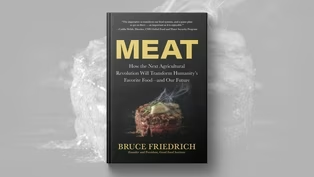
New book ‘Meat’ explores the next global food revolution
Video has Closed Captions
Clip: 2/3/2026 | 6m 40s | New book ‘Meat’ explores how the next food revolution could transform meat consumption (6m 40s)

News Wrap: U.S. forces shoot down Iranian drone
Video has Closed Captions
Clip: 2/3/2026 | 4m 23s | News Wrap: U.S. forces shoot down Iranian drone near aircraft carrier in Arabian Sea (4m 23s)
Providing Support for PBS.org
Learn Moreabout PBS online sponsorship
- News and Public Affairs

FRONTLINE is investigative journalism that questions, explains and changes our world.

- News and Public Affairs

Amanpour and Company features conversations with leaders and decision makers.












Support for PBS provided by:
Major corporate funding for the PBS News Hour is provided by BDO, BNSF, Consumer Cellular, American Cruise Lines, and Raymond James. Funding for the PBS NewsHour Weekend is provided by...