
Greenland push addressed Arctic security, Heinrichs says
Clip: 1/21/2026 | 5m 21sVideo has Closed Captions
Greenland push helped Trump address Arctic security, Rebeccah Heinrichs says
For perspective on the crisis over Greenland and what comes next for the U.S. and its allies, Geoff Bennett spoke with Rebeccah Heinrichs, a senior fellow at Hudson Institute, a think tank in Washington.
Problems playing video? | Closed Captioning Feedback
Problems playing video? | Closed Captioning Feedback
Major corporate funding for the PBS News Hour is provided by BDO, BNSF, Consumer Cellular, American Cruise Lines, and Raymond James. Funding for the PBS NewsHour Weekend is provided by...
Greenland push addressed Arctic security, Heinrichs says
Clip: 1/21/2026 | 5m 21sVideo has Closed Captions
For perspective on the crisis over Greenland and what comes next for the U.S. and its allies, Geoff Bennett spoke with Rebeccah Heinrichs, a senior fellow at Hudson Institute, a think tank in Washington.
Problems playing video? | Closed Captioning Feedback
How to Watch PBS News Hour
PBS News Hour is available to stream on pbs.org and the free PBS App, available on iPhone, Apple TV, Android TV, Android smartphones, Amazon Fire TV, Amazon Fire Tablet, Roku, Samsung Smart TV, and Vizio.
Providing Support for PBS.org
Learn Moreabout PBS online sponsorshipGEOFF BENNETT: And for perspective now, we turn to Rebeccah Heinrichs, a senior fellow at the Hudson Institute.
That's a think tank in Washington, D.C.
Thanks for coming in.
REBECCAH HEINRICHS, Hudson Institute: Good to be here.
Thanks for having me.
GEOFF BENNETT: I want to start with your reaction to President Trump today calling off tariff threats he had issued to help secure ownership of Greenland, while also backing away from a military invasion of that territory.
REBECCAH HEINRICHS: Right.
So, I think two big points.
It was clear to me during his speech at Davos that he wanted to disabuse anybody of the notion that the United States was credibly thinking of using military force against Greenland.
And the other thing I think is important is that President Trump threatened these tariffs against these particular allies in response to what he perceived as those allies potentially threatening the United States.
It was clarified that the reason those allies were deploying troops there was in response to President Trump alerting them to the threat from Russia to Greenland.
So they're responding within the alliance framework.
That seemed to satisfy the president as well.
And then he had some good conversations on the sidelines at Davos and then informed everyone that he would be calling off those tariffs, which is good news.
GEOFF BENNETT: To what degree, though, is this just a tactical reset after blowback from the markets and from allies?
REBECCAH HEINRICHS: Well, I think what we have seen from President Trump again and again is, he comes up with these attempts to effect policy, and then he looks for a response.
If there's strong pushback or a pushback from the markets -- on this particular case, you saw not just Democrats, but Republicans push back on even the implied threat, even if it was never explicit, that we might use military force or that we might forcibly annex Greenland by some other means.
And we saw that pushback coming from the House and the Senate.
So I think President Trump received all of that, took all of that in.
There was a couple of different polls across the American people.
There's no support or appetite across any political faction in the United States to do something like this.
So I think all of that was taken into consideration.
President Trump was convinced the juice wasn't worth the squeeze and decided to look for a more productive way to meet our security needs in the Arctic, which is what it looks like we're going to do.
GEOFF BENNETT: If his tone and his approach change seemingly day to day, how do NATO allies plan around that kind of volatility?
REBECCAH HEINRICHS: Well, I think that there's a lot of volatility.
It's not just that President Trump himself and his personality can be unpredictable.
We also have, of course, many shared adversaries in the Chinese Communist Party, the Russian Federation.
Russia is still engaged in its war of aggression against Ukraine.
So we still have the Iranian protests are still being cracked down on the part of the Iran regime now.
So, I mean, allies have a diverse set of threats all around them.
They have the president and the United States to work with.
He has done some very good things.
And I think, at this point, they should understand that the best way, when President Trump does something that surprises them, is to take a beat and look for a calm and a prudent way forward, give the president lots of options to find a collaborative path.
And that's what is going to work this time.
GEOFF BENNETT: There are critics who argue that even talk of acquiring an allied territory like Greenland destabilizes not just NATO, but the entire postwar order, to which you would say what?
REBECCAH HEINRICHS: I would say it's damaging.
One of the great benefits of being an ally of the United States is, the world's most powerful military, which we have seen demonstrated now with Venezuela and with Operation Midnight Hammer in Iran, that, if you're a friend and ally of the United States, we pose no threat to you.
And I think that that's something that the United States should not take for granted, should cultivate that carefully.
And I would expect there to be plenty of points of departure and disagreement between the United States and our allies.
And so I think it's regrettable, but I also think that the allies understand that it's an aberration.
It's not something that's going to be the norm from the United States.
GEOFF BENNETT: On that point, I wonder what you make of what we heard from Canada's Prime Minister Mark Carney, who said in Davos this week that the postwar bargain that the U.S.
made, where smaller countries depend on the U.S.
for leadership in exchange for protection, that that no longer works because the U.S.
has sought to use that as leverage even with its allies.
How significant a statement is that coming from one of our closest partners, one of the U.S.'
closest partners?
REBECCAH HEINRICHS: Well, there was lots in that speech from Carney.
I would say that some of it, I think, is understandable that he would be frustrated.
But there's parts of it that I kind of left my head -- scratching my head and thinking this sounds to me sort of like Angela Merkel, the former chancellor of Germany, who really didn't understand how to navigate the Trump era during the first administration and made some serious strategic errors for Germany and for Europe at large, including maintaining close relations with Russia and relying on Russian energy.
Or looking for investments in China, which, of course, is what Carney said in his speech, that, if we care about the rule of law, if we care about national sovereignty, we care about pluralism and freedom and liberty of the individual person, you don't hedge towards the Chinese Communist Party.
So I take what he said as -- I know it's an uncomfortable time, but he needs to be realistic about what he needs to do now to defend Canada and to provide more for collective security for the alliance.
GEOFF BENNETT: Rebeccah Heinrichs of the Hudson Institute, good to speak with you.
REBECCAH HEINRICHS: Good to be here.
Thanks.

'Get in the Game' explores connections between art, sports
Video has Closed Captions
Clip: 1/21/2026 | 5m 52s | 'Get in the Game' exhibition explores connections between art and sports (5m 52s)

How the affordability crisis evolved since Trump's return
Video has Closed Captions
Clip: 1/21/2026 | 6m 48s | How the affordability crisis has evolved since Trump's return (6m 48s)

News Wrap: Much of U.S. bracing for 'expansive' winter storm
Video has Closed Captions
Clip: 1/21/2026 | 6m 20s | News Wrap: Much of U.S. bracing for 'expansive' winter storm (6m 20s)
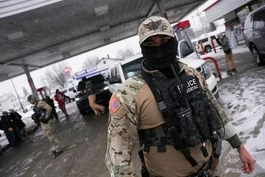
St. Paul mayor responds to unrest triggered by ICE raids
Video has Closed Captions
Clip: 1/21/2026 | 7m 24s | St. Paul mayor responds to unrest triggered by federal immigration raids (7m 24s)
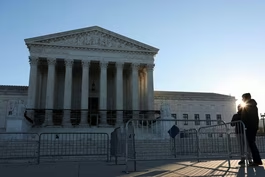
Supreme Court hears case on Trump's attempt to control Fed
Video has Closed Captions
Clip: 1/21/2026 | Supreme Court hears case on Trump's attempt to control Federal Reserve
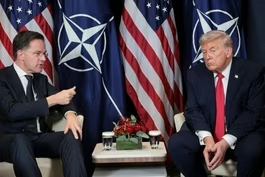
Trump backs down on threats against Greenland
Video has Closed Captions
Clip: 1/21/2026 | 4m 29s | Trump backpedals on threats against Greenland, but allies say damage has been done (4m 29s)
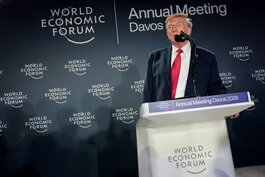
What's next for U.S., allies after Trump's Greenland demands
Video has Closed Captions
Clip: 1/21/2026 | 7m 47s | Anne Applebaum on what's next for U.S. and allies after Trump's Greenland demands (7m 47s)
Providing Support for PBS.org
Learn Moreabout PBS online sponsorship
- News and Public Affairs

FRONTLINE is investigative journalism that questions, explains and changes our world.

- News and Public Affairs

Amanpour and Company features conversations with leaders and decision makers.












Support for PBS provided by:
Major corporate funding for the PBS News Hour is provided by BDO, BNSF, Consumer Cellular, American Cruise Lines, and Raymond James. Funding for the PBS NewsHour Weekend is provided by...