
Alone & Together
Season 2 Episode 12 | 24m 35sVideo has Closed Captions
A rural DJ finds listeners; NASA studies isolation; an exonerated man rebuilds his community.
A rural radio DJ finds connection with an unexpected audience, NASA researchers study isolation in space, and an exonerated man rebuilds his community in the town that once turned against him.
Problems playing video? | Closed Captioning Feedback
Problems playing video? | Closed Captioning Feedback
Production Support Provided By: Riptide Waters LLC; Texas Parks & Wildlife Foundation; Texas Rural Funders, H-E-B”
Alone & Together
Season 2 Episode 12 | 24m 35sVideo has Closed Captions
A rural radio DJ finds connection with an unexpected audience, NASA researchers study isolation in space, and an exonerated man rebuilds his community in the town that once turned against him.
Problems playing video? | Closed Captioning Feedback
Where to Watch Texas Monthly Presents: The Story
Texas Monthly Presents: The Story is available to stream on pbs.org and the PBS app.
Providing Support for PBS.org
Learn Moreabout PBS online sponsorship- Humans are social creatures.
We're not meant to be alone.
I mean, I can't imagine what it's like to wake up every day and be in a cage.
- [Josh] NASA's trying to solve the puzzle of isolation and loneliness.
- Here's Adam Bork, y'all.
- [Judge] No judgment can fully remedy the burden that you have carried.
- Everybody needs a connection, and they need to know they're not forgotten.
- So it's imperative we find a way to overcome it together.
(radio static humming) (lively music) (crowd cheering) (keyboard clicking) (soft expectant music) (engine humming) Going to space is really dangerous.
No amount of testing and preparation can completely eliminate the risk inherent with sending humans into the void.
With those stakes attached, the psychological part of being out there becomes all that much more important.
So it's imperative that we find a way to overcome it together.
My name is Josh Alvarez.
I'm a senior writer at "Texas Monthly," and I reported the story "To Boldly Stay."
"Working Life" is a recurring column that highlights interesting, odd, or surprising jobs in Texas, and this might be the most surprising job that I have yet encountered.
(soft suspenseful music) What interested me was finding out about these extreme experiments that NASA was subjecting other humans to in preparation for an eventual deep-space exploratory mission, possibly to Mars.
What NASA's doing is they're creating these terrestrial experiments, what they call analogs, that basically recreate the conditions that astronauts would be facing, at least psychologically.
The test subjects very often are not going to be astronauts that are gonna be on these missions.
These are volunteers, and one of the analogs lasts more than a year.
(soft suspenseful music) (shoes clacking) - I came to NASA in a very roundabout way.
I started working in hospitals with patients going through different types of cancers where they would often be in an isolation ward of a hospital for months, sometimes even up to a year, in these stressful environments.
Psychology is actually really important to space flight, especially as we start thinking about long-duration missions.
The farther and farther from Earth we get, the more stressful it becomes.
- Isolation does not blend with our innate needs as social primates, and yet it's a cost that must be paid if we are to send any manned missions into outer space.
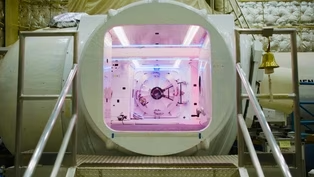
(contemplative ambient music) - [Sara] Welcome to the Human Exploration Research Analog, or HERA.
It is intentionally designed to operate like a space flight vehicle might.
So we simulate a lot of systems, but it gives crew things that they need to operate and work on and problem-solve in the same way that our real astronauts do.
- All in the meantime, that capsule is just lined with cameras.
Everything they do, even when they wanna just be by themselves, is being very closely monitored.
- We have the staff 24/7 communicating with the crew, helping get them through the procedures, or sometimes we even induce some stresses, like break some systems to kind of mimic what they would see in a mission.
MCC here.
- They really are almost like gerbils in a very controlled environment.
- [Sara] The cameras are also helping us understand subtle behaviors, how people use the space, how they interact with each other, what types of things facilitate a crew interaction or what types of things hinder that crew interacting together.
- [Josh] They even recreate difficulty connecting with people back home.
So any communications back to mission control or to their families are delayed what they would actually be delayed by while halfway to Mars.
It's actually kind of heroic what these test subjects are putting themselves through and voluntarily doing so.
- My HERA mission was 45 days.
Really missed my family, so at the time, my fiance, and fresh food.
(chuckles) - They're sacrificing their time and time away from friends, family, their communities, all in the name of science and in the name of the future success of a mission to Mars or even further.
(gentle aspirational music) - I think the CHAPEA crew that's going through an entire year mission has a whole different thing ahead of them.
(dramatic string music) - [Josh] CHAPEA is the analog that recreates a Martian terrestrial base.
- [Sara] It's four crew members for that 378-day time period.
- We send off our second volunteer crew of the Crew Health and Performance Exploration Analog, CHAPEA.
- In just a few moments, this door behind us will close, and for the next 378 days, it will not open again.
From that point forward, this is Mars.
- [Sara] It's this house-sized building inside of the hangar to mimic what a Mars surface habitat might look like.
And it's much more autonomous than our previous missions have been, meaning because we have almost a 20-minute comm delay, that crew has to figure out a lot of problems on their own.
- My wife would be so pissed.
(crew member laughs) (attendees clapping) - CHAPEA Mission 2 is a go.
- While I was reporting this story, CHAPEA was actually in use.
So what we did is send questions to the subjects, which was then transmitted to them, and then they have the capability to record responses and send it back with the same amount of lag time as if they were on Mars.
They have been in there for about six months now.
Let's take a look at what they had to say to our questions.
- I think we're all learning about ourselves.
Being in isolation and confinement certainly lends itself to a fair amount of self-reflection.
- I think about how incredible we are at surviving and how adaptable humans are, whether that's socially or physically or mentally.
- One positive outcome of my time here is a renewed appreciation for the things in my life back home, especially my husband and family and friends, also some of the mundane things like seeing sun rays poking through the clouds or going into a grocery store and having an endless variety of fruits and vegetables or hearing my mom laugh on the phone.
(soft pensive music) - I think maintaining connection with loved ones is gonna be one of the hardest challenges for us because with that comm delay, we're never gonna have a real-time family conversation.
- When you don't have your life in front of you, your friends, your family, you realize how much you miss that, so don't take it for granted.
- All that does is reflect a basic truth about humans that we all know about ourselves, is that we need each other.
Our existence depends on each other.
Even a group of people who may be coming from different backgrounds, if you put them together and find ways to cultivate a community, that creates the conditions for those individuals to thrive together and then ultimately to succeed together.
- [Sara] I was drawn to psychology because I wanted to help people, but at NASA, it's also in a bigger way contributing to the rest of humanity of just moving the bar forward, translating the cutting edge of science into the realm of everyday benefit.
(gentle upbeat music) - [Josh] Really what NASA's trying to do is to sort of solve the puzzle of isolation and loneliness.
This kind of research, I think, shows not only the limitations, but also the possibilities of what humans can accomplish together.
(wind whistling) (pages rustling) - All right, y'all, David Beebe here with the Night Train Express.
So glad to be here.
I am live in the studio tonight, and this is Marfa Public Radio, radio for a wide range, from the border to the basin and beyond.
So glad you're tuned in.
Don't go anywhere.
I'm with you till 11.
Here's Adam Bork, y'all.
(folksy bluegrass music) (wind swooshing) When I first moved to Marfa, I was going back and forth to Houston a lot and would always wind up coming into Marfa, you know, after dark late at night.
The radio was on automation.
It was playing songs that were like slow, like folk music and stuff like that.
And at one point in time, I actually literally punched my radio and was like, "This radio station's trying to kill me," because there was just no beat there.
So that's where the impetus to start the show came from.
It's the Night Train Express.
David Beebe with you till 11 o'clock, y'all.
Get your groove on.
That's what my job is here, is to just provide a soundtrack for two hours of nighttime hours per week for the last 17 years and counting.
And like, yeah, I've always mixed it up.
Like it's Texas music, music in Spanish, It's this Southern soul music, but it all fits together 'cause it actually all, that's what we are out here.
We're multicultural, but we are really Texans, Tejano and Texans.
(wind humming) - At Marfa Public Radio, we cover a broadcast area that's 30,000 square miles.
That's roughly the size of South Carolina.
So we're connecting communities that span across hours and hundreds of miles.
(suspenseful music) (paper swooshing) - About a year into the show, I started getting letters from prisoners at the Lynaugh Unit in Fort Stockton, a TDCJ prison.
They were giving me requests and feedback on the show and thanking me for playing the music.
(air swooshes) "David, que paso?
How's everything going?
Hope you're staying safe.
I also hope that you received the Christmas card I sent you."
"What's happening, David?
Thought you got rid of me?
Ha, no such luck, ha-ha.
I just ran out of stamps."
(laughs) Those guys would all listen individually with their headphone or whatever.
Then at lunch the next day, they would get together and be like, "What should we ask him to play?"
"Mr.
Beebe, it's been a long month.
There's some music that I really need to hear, some songs to get me through the hard times."
"Thank you for introducing me to a new favorite genre.
Keep introducing me to the different artists of the genre so I can have a good-size collection to search for later.
Thanks."
(laughs) That's super awesome, man.
Yo, that's classic Lil Rob, "La Cantina."
So glad to play that for y'all.
It goes up to the guys on the Lynaugh Unit in Fort Stockton.
Hope you guys are doing great, man.
"Thanks for turning me on to Lil Rob all those years ago."
I mean, I can't imagine what it's like inside there.
That's got to be a really tough balance to wake up every day and be in a cage with other people who are in a cage.
That's got to be indescribably difficult.
It's a lot.
"Hearing these jams took me out there to the great big busy world.
It's going on five years since I listened to music.
One thing these folks can never take away from me, it's my memories.
All I can do is walk with my head up high and chest out and give thanks to a higher power for another day above the ground."
It comes in waves.
The letters come in waves, whether it be letters and now emails.
It's just, it's a cyclical thing.
As long as they're there, I would predict that they're still listening 'cause it's available to them, and I'm not planning on quitting.
So, yeah.
(mellow upbeat music) Everybody needs a connection, and they need to know that they're not forgotten.
All right, everybody, that does it for me tonight.
Thanks so much for listening.
I'm David Beebe with you every Tuesday night from 9:00 to 11:00 PM.
It's the Night Train Express.
I hope you enjoyed the show as much as I enjoyed bringing it to you.
This is Marfa Public Radio, radio for a wide range from the border to the basin and beyond.
Y'all have a great night.
Y'all be careful.
See you next week.
Thanks.
(wind whistling) (pages rustling) - "In loving memory of Amy Ayers, Sarah Harbison, Jennifer Harbison, Eliza Thomas.
Forever in our hearts."
(wind rustling) It was an almost unimaginable horror.
You know, this is the kind of thing that happened in New York or LA, not in Austin, Texas.
(plaintive music) The story of the yogurt shop murders, why it happened, how it happened, who did it, has been a part of Austin's whole culture, Austin's history for more than a third of a century ever since 1991.
From 1991 to 2025, nobody in Austin knew for sure who had murdered those four girls.
My name is Michael Hall.
I'm a staff writer at "Texas Monthly," and I wrote "The Man Who Can't Forget."
(door creaks) The yogurt shop murder story has obsessed me since 1999.
So this is a story that I wrote for the January 2001 issue about the yogurt shop murders and the investigation, which at that point had been really messed up.
It's the first deep-dive criminal justice story I did here when I was a whippersnapper.
So we have Mike, Maurice, Robert, and Forrest.
And Forrest would sometimes get tears in his eyes during this whole process.
Forrest Welborn was arrested along with these other three guys in October of 1999.
There were all kinds of problems with the case.
I mean, there was no evidence that these four boys had anything to do with it, but two of them had confessed after long interrogations by the Austin Police.
Forrest was like the one who said, "I didn't have anything to do with this."
He was this, you know, long-haired, quiet kid who played music and liked comics and just kind of somehow found himself in the middle of this terrible, terrible story.
I've always wanted to talk with him, but there was no way in hell he was gonna talk to me.
Even though he was out on bond, he was still very much a suspect in the murders.
(pensive music) (wind whistling) - No judgment can fully remedy the burden that you have carried, but the court can and does state without qualification or hesitation that you are cleared and that your innocence is affirmed.
- [Michael] Through this long and elaborate detective work, a bullet casing, and some DNA, they found the true killer of those four girls, and it turned out to be a serial killer named Robert Brashers, who died by his own hand with the same gun he'd used to kill one of the girls.
- These innocent men, when they were boys, were manipulated by authorities in order to manufacture a false narrative, but that's now officially over.
- [Michael] So when I heard this news, I thought, "Oh my God, what a story."
I reached out to Forrest's attorney and asked, "Do you think Forrest would after all these years sit down and talk with me?"
(soft plaintive guitar music) So I met Forrest at this saloon that he had recently bought just south of the city of Austin.
It's like you're going back into a whole nother world.
It's a giant dirt parking lot under tall sprawling oak trees, and chickens are walking around, and there's yard art everywhere.
And the actual saloon itself looks like something that's been hammered together with nails and chicken wire.
It's the kind of place, it feels like Austin 40 years ago.
It feels like where the old hippies and the old rednecks would come together and drink beer.
Hey, Forrest.
- [Forrest] What's going on here?
(Michael and Forrest chuckle) - [Michael] He was a little bit distant at first, a little bit mistrustful, but he slowly started to kind of open up.
I was really shocked at how much he had been harassed by the cops and by regular citizens.
- When I got out of jail, the cops would pull me over like three times a week, put me in jail once a month.
Pretty much spent half my life on probation.
You know, it's just been a major struggle, you know, even from the community, people thinking that I'm a murderer, and I got away with murder.
And, you know, it's been awful.
- [Michael] Yeah.
- It's not a life that I'd want anybody to have to go through.
- Yeah.
When he was arrested in 1999, he had recently opened up a auto repair shop in Lockhart.
When he went back out there, all his tools had been stolen, and he had to shut the place down.
He would try and get a girlfriend, and she'd Google his name, and that was the end of that.
Anytime he went into downtown Lockhart or anytime he went into Austin, people would whisper.
They would point at him because Forrest was a very recognizable person, and he could not get away from that feeling that he had a mark on his forehead.
Forrest was always kind of a quiet kid, but he had a best friend named Maurice Pierce.
When Maurice Pierce told the cops that Forrest was the one who'd killed these girls, Forrest felt so betrayed that he allowed that feeling to push him into total isolation.
There was a lot wrong with how the police initially questioned Maurice and got his statement about Forrest being involved, and that really was the thing that roped all four of these guys into this whole mess.
Maurice's story is a tragedy unto itself.
After being behind bars for 3 1/2 years, he was released, but he had terrible trauma.
Years later when he was pulled over for a routine traffic stop in Austin, he overreacted, and a policeman shot him dead.
He was only 35.
- It's hard to have a friend that said that you did it.
I know he was forced to say it, you know, so, but it was still hard to believe and hard to take in, hard to trust anybody after that.
- [Michael] The closest people to him were his mother and his sister India.
- That's me and my sister.
Yeah, she was my best friend, my number-one supporter.
- [Michael] India never got to see her brother exonerated.
She was diagnosed with terminal brain cancer in July of 2025, and she died in September.
35 of his 50 years Forrest has felt like an outsider.
He's been pushed out.
He has wandered the wilderness trying to find a place where he belongs.
I do a lot of criminal justice stories, and I've found myself really focusing on wrongful convictions.
When somebody is wrongfully convicted, the stain of this accusation, even if they've been officially vindicated, it just, it stays with them.
It's like a deep-down psychological mark.
- You know, one minute I'm happy that it's finally gonna be over, and then (clears throat) you know, then I'm sad again because, you know, of what happened, you know, to everyone in the whole situation and just never been, never really been able to be too happy about it, you know.
We'll figure it out in the future, I guess.
- Yeah.
So, Forrest, since he got this place has been working on it.
He started turning this biker bar into a home away from home for all these people.
Hey, Sharon.
- Hi.
- How you doing?
- I'm good.
How are you?
- [Michael] Forrest's mom Sharon started making a big pot of soup and sometimes a tray of sandwiches to feed the regulars.
- After my daughter passed away, it just hit me how (patrons chattering) time just slips away.
And if you don't try to make an effort, you know, then you lose that chance.
- He was such an outcast for so long, and now he's found this place where he is just like the center of everything.
- Yeah.
- He doesn't take it for granted.
I mean, he's built his own family here of which you are a big part.
- Yeah.
Yeah, it's his little community.
It's his, like you said, his family.
He has regulars that come, and he's gotten to know them really well, and, you know, they all call me Mama.
(laughs) - Hey, Mama.
(guests chattering) - Got all kinds.
There's mechanics, framers, bike builders.
You know, there's lawyers.
You know, there's everybody, yeah.
- Most of these folks are regulars.
- Yeah, they're all regulars.
- Yeah?
For years, Forrest was alone.
He was isolated.
Now, kind of, you know, in spite of himself, (laughs) he's found himself in this great little community where he belongs.
(gentle upbeat music) Humans are social creatures.
We're not meant to be alone.
- [David] Everybody needs a connection, and they need to know they're not forgotten.
- [Josh] The way that we have survived as a species is through cooperation and through community.
That's where we get our mental health from.
That's how we're nurtured, is through other people.
- [Michael] I think that's one reason I love this story so much, is it's a real community.
It's a real community that they've built, and it's really great to see.
Video has Closed Captions
Preview: S2 Ep12 | 30s | A rural DJ finds listeners; NASA studies isolation; an exonerated man rebuilds his community. (30s)
Providing Support for PBS.org
Learn Moreabout PBS online sponsorship












Support for PBS provided by:
Production Support Provided By: Riptide Waters LLC; Texas Parks & Wildlife Foundation; Texas Rural Funders, H-E-B”