
August 17, 2026 - PBS News Hour full episode
8/17/2026 | 57m 46sVideo has Closed Captions
August 17, 2026 - PBS News Hour full episode
August 17, 2026 - PBS News Hour full episode
Problems playing video? | Closed Captioning Feedback
Problems playing video? | Closed Captioning Feedback
Major corporate funding for the PBS News Hour is provided by BDO, BNSF, Consumer Cellular, American Cruise Lines, and Raymond James. Funding for the PBS NewsHour Weekend is provided by...
August 17, 2026 - PBS News Hour full episode
8/17/2026 | 57m 46sVideo has Closed Captions
August 17, 2026 - PBS News Hour full episode
Problems playing video? | Closed Captioning Feedback
Where to Watch PBS News Hour
PBS News Hour is available to stream on pbs.org and the PBS app.
Providing Support for PBS.org
Learn Moreabout PBS online sponsorshipAMNA NAWAZ: Good evening.
I'm Amna Nawaz.
Geoff Bennett is away.
On the "NewsHour" tonight: The 60-day window to reach a deal to end the war with Iran expires, as tensions rise around key shipping routes.
The president calls for joint U.S.-South Korea military exercises to be scaled back, citing South Korea's unwillingness to help with the Iran war.
And scientists study whether it would be feasible to build a large-scale underwater barrier to slow the melting of glaciers.
DAVID HOLLAND, New York University: Can it solve it completely forever?
No, because, if you keep warming the atmosphere, this is going to retreat faster.
(BREAK) AMNA NAWAZ: Welcome to the "News Hour."
President Trump lashed out at U.S.
allies today, as the deadline to reach a deal to end the war with Iran expires.
The president threatened to bomb Oman, which has been mediating negotiations with Iran, and called for joint military exercises with South Korea to be scaled back, in part for refusing to join the war with Iran.
Trump also repeated the false claim that the U.S.
controls the Strait of Hormuz, the critical waterway through which 20 percent of global oil moved before the U.S.
and Israel launched the war in February and Iran effectively closed the strait.
He also threatened to seize the strait as a us territory.
DONALD TRUMP, President of the United States: I like the idea of declaring it a territory.
QUESTION: Why don't you do that?
DONALD TRUMP: We have total control over the strait.
We're taking out millions of barrels of oil a week.
If you look at the kind of numbers that we're doing, we're doing -- the strait is open.
AMNA NAWAZ: For an assessment of where the war stands and what happens next, we get two views.
Alan Eyre was a State Department subject matter expert focusing on Iran and a senior member of the Obama administration's negotiating team for the Joint Comprehensive Plan of Action, or JCPOA, deal with Iran.
He's now at the Middle East Institute.
And Reuel Marc Gerecht was a CIA operations officer in the Middle East in the 1980s and '90s.
He's now a senior fellow at the Foundation for the Defense of Democracies.
Welcome to you both.
REUEL MARC GERECHT, Senior Fellow, Foundation for the Defense of Democracies: My pleasure.
AMNA NAWAZ: Alan, I will start with you because you have made clear you opposed this war with Iran from the beginning.
This memorandum of understanding the U.S.
and Iran signed back in June was supposed to do a few things, calling for an end to military operations, for the U.S.
to end its naval blockade, for Iran and Oman to define the future administration of the strait.
The 60 days are up.
Why didn't this work?
ALAN EYRE, Middle East Institute: It didn't work because there was a total absence of any type of mutual goodwill.
And so, when you reach the ambiguity that's in even the best of MOUs -- and, in this case it was about Article 5 of the MOU about how to administer the Strait of Hormuz in the temporary period -- the ambiguity killed it, because it said Iran will administer, in essence, traffic through the strait.
But the U.S.
also was trying to get ships through the southern coast along the Omani border.
That is what -- that was the fatal flaw that blew up the MOU.
So it's like a -- it's like a sprinter tripping out of the starting gate.
It never really got a chance.
AMNA NAWAZ: Reuel, we should point out you supported the war.
I don't know if you do still, but you have.
Why do you think the 60-day deal collapsed?
REUEL MARC GERECHT, Senior Fellow, Foundation for the Defense of Democracies: Well, I'd have to back it up a little bit.
I would put the onus here on the United States, in that I think it was crystal clear that the Iranians had no intention whatsoever of giving up their claim to control the straits and to put levies on ships.
At the time they were negotiating this, if you were to read Revolutionary Guard Corps publications, this -- it was clear.
I mean, there was no ambiguity there.
So I don't know what Vice President Vance and others were doing in those negotiations, and I think they should have known that the Persian version of this was not the version that the Americans believed perhaps was going to come into play.
I think they were just being hopeful.
I think the United States wanted to get out of this war, and so was accepting a memorandum of understanding that really had no grounding in reality.
AMNA NAWAZ: So the U.S.
is -- President Trump, we should say, is claiming that the U.S.
does control the strait, that the U.S.
could control it and claim it as a territory.
Is any of that true?
ALAN EYRE: I think President Trump often says stuff for different reasons.
I don't think there's a necessary correlation between what he says at any given time about the situation and any underlying reality.
So, no, we don't control the strait.
The crucial factor here is Iran possesses the de minimis military ability to threaten traffic so that traffic will not go through the strait.
That's not going to change.
Unfortunately, despite the fact that our military is so much stronger, we cannot open and keep open the strait militarily.
Also, it is true that Iran has decided it wants to keep control of the strait as a form of strategic deterrence, and that's the hill that literally it's going to die on.
AMNA NAWAZ: Reuel, do you agree with that?
REUEL MARC GERECHT: I agree with that.
I don't think there's any chance the Iranian leadership is going to relent.
I actually think they want to intensify the war.
That's why the president, I think, has now decided to put all his chips onto the blockade and sanctions, economic warfare, to try to either bring the regime to the table or to collapse it.
However, I don't think that option, it can be accomplished quickly, if it can be accomplished.
And the clock could be very long on that.
AMNA NAWAZ: Well, the president continues to say that Iran does want to make a deal, but, as you point out, there's been economic sanctions, economic squeezing, a bombing campaign, a naval blockade.
None of that has worked.
What would bring the Iranians to the table?
REUEL MARC GERECHT: Oh, I don't think anything will bring the Iranians to the table.
I don't think they have any intention.
I think, right now, they believe in pushing this conflict actually gives them the best chance of seeing the United States fail, to actually have to admit defeat and withdrawal.
So I think that's what they're after.
They want the United States to effectively withdraw from the Persian Gulf.
They intend to dominate the Arab Gulf countries, to make them tributaries.
I don't see them relenting.
And the president of the United States, I think, has made it crystal clear that he doesn't want to fight the battle of Hormuz, and that he wants to go and try this economic approach.
And one can understand.
There's some foundation there.
I mean, the Islamic Republic is an economic basket case.
But these individuals who rule the country are extremely hard.
They have killed thousands of their own people to stay in power, and I just don't see them relenting.
AMNA NAWAZ: You agree with that, Alan?
ALAN EYRE: I agree with much of it, but I do think that Iran is open to negotiation.
They have it -- but they're going to negotiate while fighting.
The decision Iran has made collectively in the last week or so is that they're not going to decrease economic pressure on the West of the United States by reopening even partially the strait because they don't want to lose the initiative they feel they have.
The Iranian leadership now, more hard-lined, more militarized, thinks they're at a wartime footing.
You know, they have gone to the mattresses.
They don't expect hostility from the U.S.
or Israel to stop.
So what they need to do in their minds is prepare for ongoing war.
And the control of the strait is an essential component of that.
Now, if the U.S.
decides to lift sanctions, unlikely, $300 billion dollar reconstruction development, unlikely, unblock assets, less unlikely, then they might take it seriously, because they do need money, right?
But they could just as well try to cut separate deals with the six Gulf countries for revenue streams.
Because the two things they want, control of the strait for security, some form of income, because, as you point out, they are hurting economically.
AMNA NAWAZ: President Trump also continues to restart the bombing campaign.
Would additional military pressure change the landscape?
ALAN EYRE: No, but that's the whole point.
The theory of the case that, if we just keep escalating until Iran either capitulates or collapses, isn't going to work, because the people have been charge of Iran right now, if the pain gets to a certain point -- and don't forget, they're not feeling pain.
They make money off sanctions.
The Iranian people are getting the preponderance of this pain.
But at a certain point, if they're starting to feel pain themselves, they escalate against GCC energy and economic infrastructure to get the U.S.
to stop.
So I don't see the theory the U.S.
is pursuing in this war.
AMNA NAWAZ: Well, given where this is now, six months into the hostilities, do you look back on the decision for the U.S.
and Israel to launch the war in the first place as a mistake?
REUEL MARC GERECHT: Yes, I mean, given our reluctance to actually do what is necessary, which at a minimum means we're willing to fight the battle of Hormuz.
If we're not willing to... AMNA NAWAZ: You mean troops on the ground?
REUEL MARC GERECHT: Well, it may require that, yes.
You may have to have troops on the islands and on the mainland littoral.
I would be very curious to know what the U.S.
Navy, when it was doing the briefings before this war happened, what they told the president.
Did they tell the president that you could fight the battle of Hormuz?
Did they mention the battle of Hormuz?
Did they say you could do it without ground troops?
I mean, I -- or did the president discard that information?
But it's quite clear now that we're not willing to fight that battle.
And if we're not willing to fight that battle, I don't think we could win.
So -- and I'm -- yes, economic coercion has its place, but I don't think it can replace real warfare, kinetic warfare.
So I think they can probably outlast us.
I mean, that's a question that should go to Secretaries Bessent, Treasury, and the naval secretary of how long we can go on and endure, particularly if they start firing again at the Gulf Arab energy infrastructure, and they're able through their Houthi allies to shut down Red Sea traffic.
Then I think, economically, we're in a very bad situation.
AMNA NAWAZ: We will have to leave it there for now.
Reuel Marc Gerecht, Alan Eyre, thank you so much for being with us.
REUEL MARC GERECHT: My pleasure.
ALAN EYRE: Thank you.
AMNA NAWAZ: Today, exercises between the American and South Korean militaries began as scheduled, even after President Trump demanded they be scaled back.
This weekend and again today, the president said what he called war games were unnecessarily provocative and a challenge to North Korean leader Kim Jong-un, despite recent praise of South Korea by the administration.
Nick Schifrin joins me now here for more.
So, Nick, tell us more about these exercises and what exactly the president is calling for here.
NICK SCHIFRIN: So, these are annual U.S.-South Korean military exercises called Ulchi Freedom Shield involving tens of thousands of troops.
They started today what the U.S.
military calls a -- quote -- "defensive opportunity" to strengthen U.S.
and South Korean readiness.
They have been held for 50 years designed to deter North Korea.
But that is not how President Trump sees it.
He said they send a -- quote -- "inappropriate and hostile message to an unthreatening and respectful North Korea."
President Trump raised the possibility of restarting diplomacy with Kim Jong-un posting this 2019 photo from the demilitarized zone, writing: "Kim Jong-un and I get along great."
And, this afternoon, the president posted this meme of Kim calling President Trump: "Hey Donald, we cool, right?"
The president's criticism instead today fell on his ally, South Korean President Lee Jae Myung, calling him out over Iran.
Take a listen to... DONALD TRUMP, President of the United States: I called him, I said, would you like to give us a little hand?
We don't need help with Iran.
But if you would like, give us a hand with Iran.
He said, no thanks.
And I said, wait a minute.
We have 39,000 soldiers over there guarding you from Kim Jong-un, your next-door neighbor.
And you're not going to help us on a very easy military operation in Iran?
That's strange.
No, no, we'd rather not get involved.
I see.
Well, why are we involved in helping you?
NICK SCHIFRIN: So, Amna, it's a page out of the president's first-term playbook, joint exercises with South Korea, complaining about South Korean burden-sharing, while publicly messaging Kim Jong-un, let's talk.
AMNA NAWAZ: So we have heard that from President Trump in the U.S.
What have we heard from South Korean officials in response?
NICK SCHIFRIN: South Korea's response was muted.
The president's office in Seoul said that they were reviewing Trump's comments and that they would discuss helping the U.S.
over Iran.
They also said that they wanted a better U.S.-North Korea relationship.
And that is the irony, that the very South Korean administration that the president, President of the United States Donald Trump, is criticizing South Korea over is the diplomacy that South Korea's president, is the diplomacy that South Korea's administration wants the U.S.
to have.
Take a listen to Frank Jannuzi, the president of the Mansfield Foundation, which advocates for diplomacy.
FRANK JANNUZI, President and CEO, Maureen and Mike Mansfield Foundation: I think what is striking about what happened over the last 24 hours is that it appears to have been a move that took our South Korean allies by surprise.
And so these moves are always best when they are coordinated closely.
For the military planners on the peninsula, these exercises are at the core of our ability to deter North Korean aggression.
The United States and South Korea view these exercises as defensive in nature and essential to deterring North Korean aggression and to be prepared.
NICK SCHIFRIN: But North Korea has always seen these exercises, Amna, as provocative, accusing the U.S.
of planning strikes against North Korea's leadership.
And just this week, in fact, Pyongyang launched more missiles, as it almost always does before these exercises begin, following other tests earlier this year of new weapons.
Take a listen to Jennifer Kavanagh.
She is the director of military analysis for Defense Priorities, which advocates for restraint in U.S.
policy.
JENNIFER KAVANAGH, Defense Priorities: When the United States conducts what adversaries consider to be provocative exercises close to their borders, rather than being deterred, they increase their military spending, their own military activities in their region by conducting additional exercises of their own, by increasing pressure on neighbors, by test-firing or experimenting with new weapons.
My view is that South Korea should be defending itself.
And to that extent, having the United States and South Korea training together is unnecessary.
Instead, the United States should be pushing South Korea to carry out these activities on its own without U.S.
support.
And that's the baseline that South Korea should be preparing for.
NICK SCHIFRIN: Kavanagh actually argues that reducing exercises is a small step, Amna, compared to, for example, troop withdrawals or reducing U.S.
commitment to South Korea, of course, threats the president has also made against South Korea.
AMNA NAWAZ: Nick, go back for a second to the public messages to Kim Jong-un you mentioned earlier.
Is there any sign that North Korea is actually interested in that diplomacy?
NICK SCHIFRIN: Publicly, no.
As far as we can tell, North Korea is not interested in talking, especially about denuclearization.
And it's in a much stronger position than it ever was during Trump's first term.
China and Russia have stopped adhering to U.N.
sanctions on North Korea.
Russia is believed to be providing technology to North Korea, improving its missiles.
In fact, Ukrainian President Volodymyr Zelenskyy, who has received North Korean ballistic missiles fired by Russia, says that they have become 300 times more accurate just in the last year-and-a-half, thanks to that Russian technology.
Listen to Frank Jannuzi again.
FRANK JANNUZI: This means that North Korea is going to play hard to get.
And if Trump is serious about opening up channels to North Korea, he's going to have to come bearing gifts.
And that's a very uncomfortable position for a U.S.
president to be in, in negotiating with North Korea.
NICK SCHIFRIN: But, clearly, President Trump is interested in restarting that diplomacy, Amna, and is doing so by publicly criticizing his ally South Korea and calling for these exercises to be scaled back.
AMNA NAWAZ: Nick Schifrin, thank you very much.
NICK SCHIFRIN: Thank you.
AMNA NAWAZ: The day's other headlines begin in the Midwest, where a week of heavy storms and catastrophic floods has killed at least seven people.
In Indianapolis this weekend, the White River rose to record-breaking levels, submerging homes and washing out roads and bridges.
Officials said wind gusts in other parts of the state reached about 100 miles an hour, downing trees and power lines.
More than 100,000 people are still without power.
The storms led to similar scenes across much of Illinois, Ohio, and Kentucky.
And there were still flood watches and warnings across parts of the Midwest and mid-Atlantic even today.
Meanwhile, thousands of miles away, Hurricane Lala has weakened to a tropical storm, but not before leaving a trail of destruction across the Big Island of Hawaii and the other Hawaiian Islands.
Authorities say raging rivers and mudslides swept around 100 homes off their foundations.
But the state's governor says no one is believed to have died.
The storm hit some areas with nearly three feet of rain as it passed to the south of the islands without making landfall.
Over 100,000 homes and businesses remain without power since the weekend, and officials say outages could take days to repair in some areas.
In Indonesia, thousands of people are in limbo as they wait for aid to trickle in after a powerful 7.7-magnitude earthquake.
Collapsed buildings and mounds of rubble line the streets.
The earthquake also ripped deep cracks in roads, structures, and bridges.
At least 68 people have died, and nearly 20,000 others have been left without housing.
Many are now sleeping in tents.
One father shared his family's harrowing experience during the quake.
MUHAMAD MAHAT HIR, Displaced Resident (through translator): I woke up carrying my child together with my wife.
We tried to get out of the room, but the shaking was so strong that we were thrown to the ground several times while trying to open the door.
At that point, we surrendered everything to God, whatever was going to happen.
AMNA NAWAZ: Rescuers have struggled to reach isolated communities, including thousands on the hard-hit island of Flores.
Indonesia, along the Pacific's Ring of Fire, has seen more than 1,500 aftershocks since the Saturday quake.
Turning now to the Middle East, U.S.
envoy and Trump son-in-law Jared Kushner left Israel today without a breakthrough on the president's stalled Gaza peace proposal.
After an hourslong meeting with Israeli Prime Minister Benjamin Netanyahu, the two sides agreed to create two working groups on Gaza.
But Netanyahu insisted that Israel would not withdraw from Gaza, as the plan calls for, until Hamas fully disarms.
This all follows a rare meeting mediated by Egypt that Kushner held this weekend with Hamas political leader Khalil Al-Hayya, who is not pictured.
The Supreme Court has rejected for a second time President Trump's long shot appeal of a $5 million civil judgment in favor of writer E. Jean Carroll.
In 2023, a jury found that Mr.
Trump sexually abused miss Carroll in a New York City department store in the mid-1990s.
The president paid the money last month.
He's also asked the High Court to toss another larger $83 million verdict that he had defamed Ms.
Carroll.
The earliest the justices would reconsider that case would be after recess in the fall.
Mr.
Trump has denied all wrongdoing.
Stocks fell on Wall Street today amid rising oil prices and Iran war tensions.
The Dow Jones industrial average lost more than 270 points, or half-a-percent.
The Nasdaq fell by point 3 percent.
The S&P 500 slipped, but remained near its all-time high set last week.
And we have two passings of note tonight.
First, in the world of sports, legendary pitcher Tommy John has died.
He entered the majors in the early 1960s and won nearly 300 games over 26 seasons.
But John is perhaps best known for his return to the sport after undergoing a groundbreaking, but risky elbow reconstruction now known as Tommy John surgery.
His career flourished in the years that followed, and thousands of other players have seen their own successful returns from the operation.
Tommy John died this weekend while in hospice care.
He was 83 years old.
And Hayden Panettiere has died.
No official cause of death was given for the versatile actress and Golden Globe nominee.
But multiple news outlets report that emergency responders found her in cardiac arrest before she was pronounced dead.
Police say there was no evidence of foul play.
Our senior arts correspondent Jeffrey Brown has this remembrance.
HAYDEN PANETTIERE, Actress: I'm just here to deliver a message.
You're in danger.
JEFFREY BROWN: Hayden Panettiere spent much of her life in front of the camera.
HAYDEN PANETTIERE: OK.
Show us what not to do.
JEFFREY BROWN: And it began in infancy with a baby commercial at all of 11 months.
HAYDEN PANETTIERE: Why do you dress so weird?
JEFFREY BROWN: Her big film breakthrough came in 2000 opposite Denzel Washington as the football-obsessed daughter of a coach in "Remember the Titans."
HAYDEN PANETTIERE: You did a good job up here.
You ran a tough camp, from what I can see.
DENZEL WASHINGTON, Actress: I'm very happy to have the approval of a 5-year-old.
HAYDEN PANETTIERE: I'm 9.5, thank you very much.
JEFFREY BROWN: She later said the role helped form her approach to acting and a career.
HAYDEN PANETTIERE: I felt like that really shaped me, really shaped my perspective of the industry, made me feel like now I know what kind of actor I want to be.
I want to be generous and I want to be there for people, but this can also be fun.
JEFFREY BROWN: From there, wider fame came on the small screen, first on NBC's "Heroes" as Claire Bennett, a teen cheerleader with extraordinary powers to heal, then in "Nashville" as Juliette Barnes, a rising country singer whose personal struggles play out alongside her career.
Panettiere also put her voice to work, including Princess Dot in Pixar's "A Bug's Life" and in the video game "Kingdom Hearts."
But behind the scenes, she was dealing with her own struggles.
After the birth of her daughter in 2014, she suffered from postpartum depression while also battling alcoholism.
Four years later, she would give up full custody of her child to the father, Ukrainian boxer Wladimir Klitschko.
She spoke candidly in a "Good Morning America" interview in 2022.
HAYDEN PANETTIERE: I didn't have any negative feelings towards my child.
I just knew I was deeply depressed and I didn't know where the alcoholism was ending and postpartum was beginning.
JEFFREY BROWN: She went into more detail in a memoir released earlier this year, "This Is Me: A Reckoning," writing of addiction, depression, sexual harassment, and the pressures of growing up in Hollywood.
And she spoke about it in a recent appearance on the "Jay Shetty Podcast."
HAYDEN PANETTIERE: I just wanted to help people.
I want what I have gone through to be for a reason.
I finally feel like I have shaken off all of this darkness and this negativity.
And that means I have closed one door and another door is opened.
And I can feel it opened.
And I can feel all the possibility.
JEFFREY BROWN: Hayden Panettiere died yesterday in Greenville, South Carolina.
She was 36 years old.
AMNA NAWAZ: And still to come on the "News Hour": the United States approaches a staggering $40 trillion of debt; Tamara Keith and Amy Walter look ahead to the next round of primaries; and instead of selling his company for millions, one CEO decides to donate its profits to charity.
Well, the U.S.
national debt is expected to hit a record high as soon as this week, crossing a major threshold of $40 trillion.
Our congressional correspondent, Lisa Desjardins, joins us now to explain why that milestone is a warning sign for many economists.
Lisa, remind us what this all means and why it all matters.
LISA DESJARDINS: Right.
The U.S.
national debt is important to us because it helps drive the engine of our government, but it is also a cornerstone of the world economy.
Those sometimes can be good things.
But let me explain why this level is now a new red flag.
Let's take a look and define terms.
We are fast approaching $40 trillion in gross or total national debt.
One major problem is that interest alone now costs more than $1.2 trillion a year for U.S.
taxpayers.
That's according to the Federal Reserve.
So we now spend more on interest, Amna, than we do on national defense, and basically more than almost anything else the government does.
Rising debt also adds inflationary pressure to the economy.
We spoke with Carolyn Bourdeaux of The Concord Coalition, and she explained the concern if this red ink line keeps rising.
CAROLYN BOURDEAUX, The Concord Coalition: Eventually, we will hit some sort of very serious fiscally induced economic crisis, which means that massive debt we're carrying, we will keep adding to it, and eventually it will cause a very serious economic crisis, and that can take many different forms.
Often, it takes the form of hyperinflation, high interest rates, really, really serious problems that will be very, very difficult for us to get out of.
LISA DESJARDINS: That future is not here yet, so why worry about it so much?
Because neither Congress nor the White House is really addressing the core of this problem.
AMNA NAWAZ: Obviously, all of this has been a long time in the making, Lisa.
Remind us how we got here in the first place.
LISA DESJARDINS: Well, part of it have been specific economic crises, but another part has been very distinct crisis of leadership.
If you look at the debt for the past 50 years here, you can see where it rocketed up in those two places.
One of those was 2009 with the recession, another 2020 with COVID.
But you can also see that, even as the government flooded the zone to try and rescue the economy there here in recent years, you can see it has risen outside of those economic shocks.
And both Republicans and Democrats, we see our two most recent presidents there, have seen the debt rise sharply under their watch.
Now, as for Congress, it has repeatedly solved problems -- I have sat here and talked about it -- by just spending more money.
And Republicans have continued to cut taxes.
All of that sounds great, except we don't have the money to do those things, really, when you look at our debt line.
So what's happening right now is a lack of leadership and, honestly, not just financial sobriety, but honesty about the problem.
AMNA NAWAZ: And $40 trillion is such a huge amount.
It is almost incomprehensible.
How do we begin to get our heads around it?
LISA DESJARDINS: Right.
We thought about this.
First, I just want folks to look at the number.
Let's look at it.
That's 40 with 12 zeros after it.
That's what $40 trillion looks like.
But what does that mean?
It's almost impossible.
One way you can think of it, is if you stacked up $1 bills, we hear this a lot, it would actually go all the way around the sun if it was $40 trillion.
Another thing that might not make much sense -- so we tried to come up with a more tangible way of expressing this.
Let's talk about houses in America.
Right now, the average single-family home costs about $400,000.
And if you do the simple math here, 100 homes would be 40 million -- I'm sorry, would be $40 million.
But then let's zoom out to all of America.
That's where you hit $40 trillion.
That is more than the worth of every single family home in this country.
We have about roughly 90 million single-family homes.
So if you want to know what 40 trillion is, just look at the houses around you.
It is the worth of every single family house in this country.
AMNA NAWAZ: You mentioned the lack of leadership on this.
Is anyone in Congress talking about how to tackle this?
LISA DESJARDINS: There are some, but, by and large, they just talk about their own slice of it, and they're unwilling to compromise over the tough things that they need to do to get us here.
One example is the Freedom Caucus in the house.
They have been pushing for tighter budgets for years, but they actually did not get the kind of spending cuts that they campaigned on.
And also, in truth, they're not willing to give on taxes and revenues.
They want revenue cuts.
There's a big debate over what tax cuts do.
Senator Rand Paul is an example of a senator as someone who votes against spending cuts, spending bills repeatedly over the national debt, but very few members of Congress actually do.
And no one is talking about the big picture like Social Security reform, Medicare.
What's more too, the biggest voices here are leaving Congress this session.
That's Republican Congressman Dave Schweikert of Arizona and also Democratic Congressman John Larson of Connecticut.
He -- they spend a lot of time talking about Social Security.
Carolyn Bourdeaux points out that one of the issues here is that not just we have a problem now, but if lawmakers don't deal with it soon, they're going to have to take more and more drastic measures.
And we're talking about significant spending cuts, but also potential significant tax increases to actually deal with it.
And right now we just don't see anyone talking about it.
One more problem, we're at $40 trillion, but, Amna, we're now just a few years away from $50 trillion in national debt as well.
AMNA NAWAZ: It's another staggering figure.
Lisa Desjardins, thank you very much.
LISA DESJARDINS: You're welcome.
AMNA NAWAZ: At a time when the impact of climate change is undeniable, some researchers suggest we need to start work on far more ambitious approaches for tackling these problems.
These proposals are often referred to as geoengineering .
Science correspondent Miles O'Brien looks at one such concept to deal with the melting of glaciers and sea ice.
It's for our series Tipping Point.
MILES O'BRIEN: It's time for some scientific fieldwork.
Fortunately, mathematician and climate researcher David Holland of New York University has a short commute.
The glacier he is studying is right on his doorstep.
DAVID HOLLAND, New York University: It's life-changing when you actually experience it and see it.
It transforms it to something very real.
MILES O'BRIEN: This is Greenland's Jakobshavn Glacier, which has a peak flow rate of about 150 feet a day, one of the fastest moving glaciers on Earth.
DAVID HOLLAND: You're losing more than you're gaining.
So it's like a bank account that's being dwindled down.
MILES O'BRIEN: He is joined by his partner in every respect, wife Denise Holland, the logistical genius that makes it all happen in this tricked-out scientific encampment.
DENISE HOLLAND, Holland Lab Director: We have been doing this for 20 years, and for 20 years I have been sleeping on the ground on a tent.
So when the opportunity came along, I said, OK, let's do this right.
MILES O'BRIEN: Just before they left for Greenland, we caught up with them as they were tallying and testing gear at their home base in the East Village of New York City.
DENISE HOLLAND: This is the packing stage for the luggage, and it's controlled chaos,yes.
So that's what I do.
I use the skills that I have to kind of make sure everything goes where it's supposed to go.
MILES O'BRIEN: They're hoping to better understand the glacier's rapid retreat by gathering synchronous data from radar, seismic sensors, drones, weather stations, and satellites.
DAVID HOLLAND: There's no A.I.
way out of this.
This is just go get data, and that's why we want synchronous data, so something will pop out, and we will say, uh-huh.
MILES O'BRIEN: Ultimately, they want to improve predictions on how much and how soon this and other glaciers will add to sea level rise.
And that's what propels them on a bipolar scientific odyssey.
Four months before he set up camp in Greenland, I joined David on a voyage to Antarctica to the Thwaites Glacier.
The size of Florida, it and the ice it holds back store enough water to raise global sea levels by as much as 10 feet, and it is melting at an astonishing rate, losing about 300 feet of thickness every year.
DAVID HOLLAND: Undeniably, it's melting.
Then the question is, why?
MILES O'BRIEN: Warm, salty, dense seawater flows beneath a layer of cold, fresh meltwater, where it attacks the glacier from below, accelerating its melt.
But researchers need more data to say much beyond that.
DAVID HOLLAND: We have a few measurements, a few snapshots, but we have never gotten the sustained measurement at Western Thwaites.
MILES O'BRIEN: Holland had hoped to deploy a sophisticated temperature sensor into the sea beneath the glacier.
Unfortunately, the effort came up short.
As the sensors descended, the super cold glacier ice grabbed them and wouldn't let go.
It was a crushing blow.
But David Holland had another mission on his manifest for this cruise.
Five days after the sensor deployment went awry on the glacier, we were 80 miles away, and he was on the poop deck orchestrating the deployment of a pair of robotic moorings.
DAVID HOLLAND: This goes first, right?
WOMAN: Yes, this goes first, and the line will go out.
DAVID HOLLAND: Come out.
MILES O'BRIEN: They are designed to continuously climb and descend on the rims of an underwater canyon that funnels warm water toward Thwaites.
Holland hopes the buoys will provide some initial data on the feasibility of a crazy-sounding idea.
Could an underwater barrier, a so-called sea curtain, slow down the melting?
He showed me a 3-D scale model of the undersea terrain near the glacier.
DAVID HOLLAND: It's quite a coincidence that this particular slice of Antarctica is the place where the warm water is butting up against the continental shelf break.
MILES O'BRIEN: For thousands of years, the continental shelf protected Thwaites from exposure to a strong deep current of dense warm water that circulates around Antarctica.
But researchers believe climate change has altered wind patterns here, creating a pathway for deep warm water to spill over the continental shelf and flow to the Thwaites grounding line.
DAVID HOLLAND: This is such a small region of the Earth that it just might be possible to block it and pinch it.
MILES O'BRIEN: The undersea canyon is nearly 60 miles wide.
The twin robots will measure the depth of the warm water and the strength of the ocean currents, critical data for determining whether an underwater barrier is even feasible.
DAVID HOLLAND: This modification could potentially stop that warm water and block it up.
And if this height is adequate, the water will be at bay.
MILES O'BRIEN: But none of this is keeping critics of the idea at bay.
Rob Larter is a Marine scientist with the British Antarctic Survey.
ROB LARTER, British Antarctic Survey: It really seems like something that's very impractical to me.
MILES O'BRIEN: The underwater barrier is just one of a handful of geoengineering ideas aimed at slowing the loss of glacier ice that Larter finds fault with.
Some of the other ideas include draining the meltwater from beneath glaciers to reduce their slide toward the sea, artificially thickening sea ice to support glacier fronts, injecting aerosols into the air to reduce the amount of sunlight that gets through, or spreading reflective material over the snow and ice to reduce the melting.
ROB LARTER: After looking at them from various different aspects, from the feasibility, from how quickly they could be developed to a stage where they might be deployed, from the potential adverse consequences, ecological effects from the difficulty of governing them in a very geopolitically complex world, none of them, none of them pass these tests.
MILES O'BRIEN: David Holland takes great pains to remind us he's not building a sea curtain, but, rather, a trove of data that can inform a decision on whether a barrier makes sense someday in the future.
DAVID HOLLAND: Now, in Greenland, the people of Greenland will decide, in Antarctica, less clear.
But without this data we're collecting for Greenland and Antarctica, humanity will be left without an engineering solution to stabilize these glaciers.
MILES O'BRIEN: Between Thwaites and Jakobshavn, David and Denise Holland are moving from the frying pan to the fire at two of the most consequential glaciers on the planet.
They are scrambling to create a forecast of how long the world's glaciers might last and pondering the audacious notion that humans could do something about it besides reducing our appetite for fossil fuels.
DAVID HOLLAND: Can it solve it completely forever?
No, because if you keep warming the atmosphere, this is going to retreat faster.
MILES O'BRIEN: The Hollands have a front-row seat to a global problem that is moving at glacial pace.
But that may not be as slow as we imagine.
For the "PBS News Hour," I'm Miles O'Brien.
AMNA NAWAZ: The 2026 primary season enters the homestretch with only a handful of states remaining after polls close tomorrow in Alaska, Florida and Wyoming.
Our Politics Monday duo is here to break down those races and more.
That is Amy Walter of The Cook Political Report With Amy Walter and Tamara Keith of NPR.
Great to see you both.
AMY WALTER, The Cook Political Report: Good to be here.
AMNA NAWAZ: Let's begin in Alaska, where voters will head to the polls in nonpartisan primaries tomorrow.
We know the top four contenders in the U.S.
Senate race head to the general in November.
Amy, this is a race Cook Political and you have rated as a toss-up.
Just days before the primary, though, there was some reporting about a campaign staff shakeup by the Democrat in this race, the former Representative Mary Peltola, senior officials removed from their jobs.
What is going on there?
And can a Democrat win?
AMY WALTER: Yes.
Well, first, look, what's going on there, the Peltola campaign says this isn't really a lot about nothing.
This is just shifting job responsibilities of the campaign manager to a different responsibility and putting the deputy campaign manager into more of a day-to-day responsibility.
Regardless, it gets to your bigger question, which is, can a Democrat win in this state?
Now, Mary Peltola has actually proven she can win in this state.
She won here in 2022 as a congressperson.
Remember, Alaska has only one member of Congress, so she has had to run statewide before, won statewide.
And even when she lost reelection in 2024, she still outran Kamala Harris by 11 points.
Her bigger challenge is that even 11 points wasn't quite enough to get over the finish line.
This is a very Republican state.
And, for her, her biggest concern right now, even as Trump is less popular than he was in 2024, is that the Democratic brand isn't any more popular.
Already, we saw this last week former presidential nominee Kamala Harris sent out a fund-raising e-mail saying, I want to contribute money to Mary Peltola, give to my PAC so I can give her money.
The Peltola campaign said, yes, thanks, but no thanks.
We don't really want to be associated with those on the Lower 48 who have a Democratic big D label attached to them.
AMNA NAWAZ: Meanwhile, on the Republican side, Tam, I know you're following this drama around the Dans Sullivan.
This is a phrase I believe you coined here.
Two Republicans, one is, of course, the incumbent Senator Dan Sullivan, both are on the ballot.
What are you watching for here, other than confusion on the... TAMARA KEITH, National Public Radio: Right.
So there is Dan J. Sullivan, a retired teacher and Forest Service employee, and Dan S. Sullivan, the senator for the state.
And they are both Republicans who will be on the ballot.
Now, it's a top four primary, so it is quite possible that both Dans Sullivan will make it through to that general election, which then has ranked-choice voting.
There's actually been all kinds of interesting shenanigans in this race with outside super PACs, spending money to boost unheard of basically novelty campaigns and various other people who are also on the ballot in an effort to try to game this.
But because it is a top four primary and because it then becomes ranked-choice voting, there's just less gaming to actually successfully do in this race.
AMNA NAWAZ: Let's turn now to Florida.
I know we have been reporting here, and you have been following the Republican Congressman Cory Mills reelection campaign.
He's being investigated by the House Ethics Committee, allegations of campaign finance violations and domestic violence.
And, Amy, all of that has led Florida Governor Ron DeSantis to say he is not backing Cory Mills in this primary.
This should be a safe Republican seat.
Does that change if Mills wins?
AMY WALTER: I think it absolutely changes if Mills wins.
Now, this is still a very red seat.
Trump won this district by 12 points.
But Trump is much less popular even in Florida than he was back in 2024.
And you also have two members of the Florida delegation.
It's not just Ron DeSantis.
It's two Republican members of the delegation also endorsing against their colleague.
With Trump less popular, Congress obviously not very popular either, in a year like this, to have somebody with this baggage is just one more reason potentially for voters in that district to either vote against a Republican or to stay home.
And so this is why the worry from many Republicans, especially with such a very narrow margin in the House, of just putting any seat in play, and this -- his own baggage puts it in play.
AMNA NAWAZ: Tam, meanwhile, on the Democratic side in Florida, Congresswoman Debbie Wasserman Schultz, one of the most powerful women on Capitol Hill, is not running in her own district, which was redrawn by Republicans there to be more red.
Instead, she's running in a neighboring district that's actually a majority-minority.
It's a district that's consistently sent Black Democrats to Congress for decades.
What are you watching for in this race?
TAMARA KEITH: Watching to see obviously whether she's able to win in this race.
She is obviously the biggest name running in this race.
And there are multiple other candidates who are African American who are running, but they might end up diluting the vote.
Or - - it's one Debbie Wasserman Schultz versus a field of other candidates.
This is not the only seat that had been or has been held by a Black member of Congress that may ultimately not be held by a Black member of Congress anymore.
The Congressional Black Caucus is expected to shrink because of this Supreme Court decision that threw out part of the Voting Rights Act and led to a scramble of Southern states redrawing district lines to basically draw out the seats that had been held by Black Democrats.
AMNA NAWAZ: Meanwhile, Amy, before we let you go, we saw House Minority Leader Hakeem Jeffries this weekend, even as primaries are still under way, making a prediction about what will happen in the next Congress.
He said at least 220 members of the House Democratic Caucus, when, as he puts it, they will take back the majority.
Is that number something you're seeing at Cook Political when you run the numbers?
AMY WALTER: Right.
So 218 is the bare majority.
So what he's saying is, they will have a two-seat -- he's guaranteeing he will have at least a two-seat majority.
(CROSSTALK) AMY WALTER: Now, look, setting the bar low is a classic thing that leadership does, right?
So you can say, oh, my gosh, look at how far above this bar that we have -- we have gone.
But I do think he's being realistic in this case as well.
The map is very, very small.
The redrawing of the lines, especially after the Supreme Court decision, made that field even narrower.
Our prediction right now, our range of outcomes are anywhere from Republicans holding the majority by just three seats to Democrats holding it by 11.
So he's definitely within that range.
TAMARA KEITH: And a 220-seat majority is the thing that nightmares are made of on either side of the aisle.
You do not want to be the leader with that narrow a margin, because, well, we have seen what happens.
It becomes almost impossible to pass legislation, especially on the Democratic side, where you're going to have a bunch of these DSA candidates who will be DSA members of Congress who may not want to fall in line.
AMNA NAWAZ: Tamara Keith, Amy Walter, great to see you both.
Thank you.
Late last month, Eddie Smith, the 83-year-old owner of Grady-White Boats in Greenville, North Carolina, made waves when he announced he was pledging nearly all his company's future profits to charity.
Instead of selling Grady-White, Smith chose to gift it to a perpetual purpose trust that will distribute profits to causes, including conservation, health care, and education.
Liz Landers recently spoke with Smith about that decision and why he hopes other business leaders will follow suit.
LIZ LANDERS: Eddie Smith, thank you for joining us.
EDDIE SMITH, Owner, Grady-White Boats: It's my pleasure.
LIZ LANDERS: Why did you decide to turn down the offers -- and one of them was more than $400 million -- and instead put your company in a trust for employees and give away the profits?
EDDIE SMITH: That's a great question.
And some of the offers were actually well north of $400 million.
But I have seen so many of my friends in this industry sell their companies and then be very, very sorry about what happened to their companies after the sale.
Even though they have been promised that the culture would remain the same, everything would stay the same, it never, ever does.
And I saw that time and time again.
And I had hoped and thought my son would take the company into the next one more generation anyway, but, unfortunately, he passed away from ALS, so then I was faced with trying to figure out, OK,who's going to take the company forward in the future?
And the only option seemed to be to sell the company and hope that you could find a buyer that would keep the company pretty much like it is.
I happened to be reading New York Times article a couple years ago about Mr.
Chouinard at Patagonia and the fact that he had been in a similar situation and had put his company in a perpetual purpose trust.
So I started doing some research on that and decided that that was a much better way for me to go.
So I feel really, really good about it.
I think some friends think I'm probably crazy for giving away most of my net worth, but it's the right thing to do, and Grady-White's future is secure.
LIZ LANDERS: With the structure of this trust, what do you stand to gain financially from this?
EDDIE SMITH: Nothing whatsoever.
All the voting chairs go into the trust.
The majority of the common shares goes into a new 501(c)(4) nonprofit.
And so the trust with all the voting shares will own and guide Grady-White in perpetuity.
And then the profits, more than 90 percent of the profits forevermore will go into the nonprofit, go to charity and hopefully do some really good things and touch lots of lives.
LIZ LANDERS: How did your employees react when you shared the news?
EDDIE SMITH: Well, I'm sure when they walked up on the stage and looked out at those 350 very apprehensive people in front of me, they were pretty positive I was getting ready to tell them that I'd sold the company.
But when I explained to them that the company would never be sold, that it would always be the company that they know and love and have built, and that we would always share profits with them and furnish all the other things that we do for them, it was screaming, hollering, some tears.
It was exciting.
LIZ LANDERS: You mentioned some of the charitable projects.
What are the charitable projects that you hope the profits go towards?
How do you hope that the community is impacted?
EDDIE SMITH: I have a family foundation that I started years ago, and so it'll basically track along the same things that we have been doing for years.
We really care about this 29 Eastern rural underserved counties in Eastern North Carolina, and lots of opportunity here to do a lot of good.
And so we concentrate primarily on education.
We do an awful lot in the area of health care and then conservation.
I'm very concerned about clean rivers, clean ocean, fishery resources for future generations.
LIZ LANDERS: We live in a moment where there is a pretty large wealth disparity in the United States, and not many other millionaires and billionaires are making the kind of decision that you made with your business.
What is your message to other business owners and other high-net-worth individuals?
EDDIE SMITH: Well, frankly, that's -- I mean, the main reason that I did what I did was to preserve Grady-White forevermore for our employees, our dealers, our customers, and the community.
But a secondary motive on my part was to make people aware.
I mean, I wasn't aware of a purpose trust until I happened to read the Patagonia article.
And I know most of my peers, CEOs across the country that I talked to have never heard of it.
So my hope was that it would educate and maybe inspire other business owners to at least consider that path if it fit them, but if it didn't fit them, that I wanted to at least nudge their consciousness about philanthropy.
There's so much need, and how much can you need?
I mean, I'm comfortable.
I'm -- but I just felt very strongly that maybe, maybe it would get many other people thinking about their philanthropic journey.
And, indeed, I have had calls from all over the country from businessmen asking for more details about the purpose trust and to talk about philanthropy.
So, hopefully, hopefully, that's done some good.
And certainly talking to you and sharing with your viewers hopefully will do more of the same.
LIZ LANDERS: I went to college with your granddaughter Sudie (ph), and I had the pleasure of meeting your son Chris a few times before he passed.
How do you think that he and your late wife would react to what you have done with the business?
EDDIE SMITH: Liz, I am absolutely positive that they're smiling really big time.
I know they would -- they both loved all of our people at the plant and loved the journey we have been on for 58 years with Grady-White, and there's no doubt in my mind they're smiling big time.
LIZ LANDERS: Eddie Smith of Grady-White Boats, thank you so much for joining us.
EDDIE SMITH: Thank you.
AMNA NAWAZ: And that is the "News Hour" for tonight.
I'm Amna Nawaz.
On behalf of the entire "News Hour" team, thank you for joining us.

Business owner donates company to trust for charity
Video has Closed Captions
Instead of selling, business owner donates company to trust for charity (6m 27s)

News Wrap: 7 dead after storms and floods in Midwest
Video has Closed Captions
News Wrap: 7 dead after storms and catastrophic floods in Midwest (4m 22s)

Remembering the life and career of Hayden Panettiere
Video has Closed Captions
Remembering the life and career of Hayden Panettiere (3m 15s)

Scientists explore geoengineering to slow glacier melt
Video has Closed Captions
Scientists explore large-scale geoengineering to slow glacier melt (8m 3s)
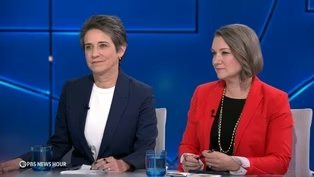
Tamara Keith and Amy Walter on primary races to watch
Video has Closed Captions
Tamara Keith and Amy Walter on primary races to watch in Florida and Alaska (7m 50s)

Trump lashes out at South Korea, downsizes military drills
Video has Closed Captions
Trump lashes out at South Korea over its refusal to join Iran war (6m 18s)

U.S. approaches staggering $40 trillion in debt
Video has Closed Captions
National debt nears $40 trillion: How we got here and why it matters (5m 33s)

Where Iran war stands as 60-day negotiating window expires
Video has Closed Captions
Where the Iran war stands as 60-day window to reach peace deal expires (9m 59s)
Providing Support for PBS.org
Learn Moreabout PBS online sponsorship New Episode
- News and Public Affairs

Today's top journalists discuss Washington's current political events and public affairs.

- News and Public Affairs

FRONTLINE is investigative journalism that questions, explains and changes our world.
 New Episode
 New Episode
 New Episode
 New Episode
 New Episode

 New Episode
 New Episode
 New Episode
 New Episode
Support for PBS provided by:
Major corporate funding for the PBS News Hour is provided by BDO, BNSF, Consumer Cellular, American Cruise Lines, and Raymond James. Funding for the PBS NewsHour Weekend is provided by...