
February 2, 2026 - PBS News Hour full episode
2/2/2026 | 56m 44sVideo has Closed Captions
February 2, 2026 - PBS News Hour full episode
Monday on the News Hour, the latest batch of Epstein files raises concerns about the Justice Department’s handling of sensitive information. The Rafah border crossing between Gaza and Egypt reopens, but only a small number of Gaza’s sick and wounded are allowed to leave. Plus, the Studio Museum in Harlem reopens in a larger space showcasing the history of Black artists.
Problems playing video? | Closed Captioning Feedback
Problems playing video? | Closed Captioning Feedback
Major corporate funding for the PBS News Hour is provided by BDO, BNSF, Consumer Cellular, American Cruise Lines, and Raymond James. Funding for the PBS NewsHour Weekend is provided by...
Support provided by:

February 2, 2026 - PBS News Hour full episode
2/2/2026 | 56m 44sVideo has Closed Captions
Monday on the News Hour, the latest batch of Epstein files raises concerns about the Justice Department’s handling of sensitive information. The Rafah border crossing between Gaza and Egypt reopens, but only a small number of Gaza’s sick and wounded are allowed to leave. Plus, the Studio Museum in Harlem reopens in a larger space showcasing the history of Black artists.
Problems playing video? | Closed Captioning Feedback
How to Watch PBS News Hour
PBS News Hour is available to stream on pbs.org and the free PBS App, available on iPhone, Apple TV, Android TV, Android smartphones, Amazon Fire TV, Amazon Fire Tablet, Roku, Samsung Smart TV, and Vizio.
Providing Support for PBS.org
Learn Moreabout PBS online sponsorshipGEOFF BENNETT: Good evening.
I'm Geoff Bennett.
AMNA NAWAZ: And I'm Amna Nawaz.
On the "News Hour" tonight: The latest batch of Epstein files raises concerns about the Justice Department's handling of sensitive information.
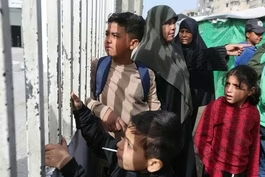
GEOFF BENNETT: The Rafah Border Crossing between Gaza and Egypt reopens after more than a year-and-a-half with only a small number of Gaza's sick and wounded allowed to leave.
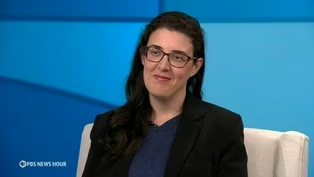
AMNA NAWAZ: And the Russian-Israeli doctoral student held hostage in Iraq for more than 900 days shares her harrowing story.
ELIZABETH TSURKOV, Released Hostage: Freedom is truly something you don't appreciate until you lose it.
(BREAK) GEOFF BENNETT: Welcome to the "News Hour."
Political fallout is mounting today after the Justice Department released three million more files related to the investigations of the late convicted sex offender Jeffrey Epstein.
AMNA NAWAZ: The DOJ has come under fire for how it's handled the release, with advocates raising questions about transparency and if the department has done enough to hold Epstein's associates accountable.
Our justice correspondent, Ali Rogin, has been digging into the latest documents, and she joins me now.
So, Ali, what more have we learned about the extent of Epstein's connections with some very prominent figures?
ALI ROGIN: Amna, taken together, these documents really indicate just -- they paint a deeper picture of Epstein's connections to some of the most influential people in politics, business, entertainment, even royalty.
There are new photos in this tranche of former Prince Andrew now, Andrew Mountbatten-Windsor, appearing on all fours kneeling on a female.
Epstein also makes lurid claims in an e-mail against Microsoft co-founder Bill Gates, which a Gates spokesperson calls absurd and completely false.
There are e-mails between staffers of former President Bill Clinton in 2002.
One of them e-mailed asking for then-Prince Andrew's address to invite him to a dinner.
Keep in mind that was in 2002.
Epstein was not formally convicted with prostitution and registered as a sex offender in 2007, but allegations state back far earlier than that.
Speaking of this timeline, what really stands out, apart from these more salacious details, is just how open the lines of communication remained between Epstein and these powerful people for years after his initial arrest.
For example, Tesla founder Elon Musk was exchanging e-mails with Epstein as late as 2014, including this one, where he asked Epstein if he had any parties planned and said he wanted to let loose and that a peaceful island experience is the opposite of what I'm looking for.
AMNA NAWAZ: On Friday, I know you reported a lot about references to President Trump in some of these files.
What more do we know about that and what have we heard from the president?
ALI ROGIN: Yes.
And, of course, being mentioned in these files does not necessarily mean there was any wrongdoing.
And the Department of Justice noted that they were required by law to include documents that may have been fake or falsely submitted.
But last night at the Grammy Awards, host Trevor Noah did joke about Trump spending time on Epstein island with Bill Clinton, which elicited this response from Trump on his social media -- quote -- "I can't speak for Bill, but I have never been to Epstein island."
And he said Noah should get ready for a lawsuit.
AMNA NAWAZ: Well, we know among those pushing for the release of these files have been the many survivors of Epstein's abuse.
What are we hearing from them?
ALI ROGIN: Epstein survivors say two things.
Number one, a lot of stuff was over-redacted that should be released to the public and other information was under-redacted that should have been kept secret.
Earlier today, I spoke with survivor Liz Stein, who is now an educator and activist fighting human trafficking worldwide.
And shortly before we spoke, she said she had found her own name in the files.
LIZ STEIN, Jeffrey Epstein Survivor: When we see things that we know perhaps should not be redacted, yet we see the release of survivors' information all over the place, it just feels incredibly careless.
I think perpetrators are being protected, but victims of this crime, survivors of these crimes are not.
ALI ROGIN: Of course, Epstein died by suicide before he could be held accountable for his crimes, but many victims have been calling for justice for his co-conspirators.
Over the weekend, Attorney General Todd Blanche indicated that there was nothing in these documents that he thought could lead to anything, allow them to prosecute anybody.
But Stein and many of her fellow survivors say this isn't over.
LIZ STEIN: We have seen them say that this is the end before.
And I think that, despite the injustices that we're seeing as survivors in the release of these files, it makes it all the more clear how important it is to get to the bottom of what happened here.
This was a crime.
It was a crime of sex trafficking.
It's not about politics.
It's not about what a famous person's name or position is.
This is about men who victimized girls and young women.
ALI ROGIN: Today, the Justice Department said they had identified some documents that they said were inadvertently produced and contained victim-identifying information.
And they said they had removed all documents requested by survivors and their counsel by yesterday evening.
But, of course, again, Liz Stein said she found her name in the documents today.
AMNA NAWAZ: Justice correspondent Ali Rogin.
Ali, thank you.
ALI ROGIN: Thank you.
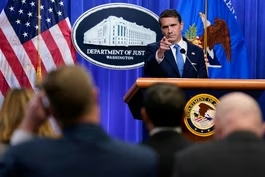
GEOFF BENNETT: And for a closer look at the legal issues surrounding this latest release of Epstein files, we turn to Barbara McQuade.
She's a former federal prosecutor and a professor at the University of Michigan Law School.
It's great to have you back on the program.
BARBARA MCQUADE, Former U.S.
Attorney: Thanks, Geoff.
Glad to be here with you.
GEOFF BENNETT: So the Justice Department says Friday's release brings it into compliance with the Epstein Files Transparency Act, but millions of files, as you well know, remain unreleased, withheld for reasons like attorney-client privilege, privacy concerns, and the like.
Democrats are now demanding access to the full record.
From a legal standpoint, did the DOJ actually comply with the law?
BARBARA MCQUADE: Well, no.
First of all, the deadline was December 19, and here we are many weeks after that deadline.
But also, in light of all of these redactions, Geoff, I think there is some room to argue here that they're not in compliance in it.
Within 15 days, which should have been 15 days from December 19, the Justice Department is also required to produce a log explaining what was redacted and why.
One of the things they have said they have redacted is internal memoranda and things that disclose their deliberative privileges.
But that was specifically spelled out in the statute that required production.
That could be something that the Justice Department and Congress might have to litigate if the Justice Department continues to refuse to produce those things.
But I think that the enormous amount of redactions seems to go beyond the scope of what would be obvious, things like names of survivors and other things.
And so I think we're going to have to see that log first before Congress can really ascertain exactly what was withheld.
GEOFF BENNETT: Why have no perpetrators beyond Jeffrey Epstein and Ghislaine Maxwell been charged, despite years of investigation and the volume of information that's now public?
BARBARA MCQUADE: Well, of course, we still don't know what's behind those redaction bars.
But I think what the public is seeing here is, there is a difference between things that are wrong, morally reprehensible, shady, even awful.
But to prove a crime, you would have to show that someone engaged in actual sex trafficking.
That means transporting someone across state lines who is underage for the purpose of engaging in sex acts or, if they are not a minor, doing so through threats or coercion.
That requires a level of intent, knowledge, and the actions of doing these things.
And I don't know that we have seen any evidence that that was done.
Certainly, just associated with Jeffrey Epstein or even making comments about women is not enough to bring a case.
And so, as I said, we don't know what's behind those redaction bars, but it would not surprise me if the Justice Department simply did not have sufficient evidence to prove some of these cases.
GEOFF BENNETT: And that might address a question I have seen a lot online since Friday's release, which is, why did the Justice Department, under multiple presidential administrations, to include the Biden administration under Merrick Garland, why did they not pursue broader prosecutions tied to Epstein's network?
BARBARA MCQUADE: Yes, I think it's the same.
So, certainly, Jeffrey Epstein was charged before he committed suicide, and Ghislaine Maxwell was charged and convicted.
I think her trial occurred in 2021.
But just because -- we had a term we used when I was working as a prosecutor, which is awful, but lawful.
Sometimes, people engage in really hideous conduct.
You investigate, but you are just not able to prove the elements of an offense beyond a reasonable doubt.
And so certainly there is some shady information here going on, but it is actually one of the reasons that the Justice Department typically does not disclose records unless there is an indictment.
And that is to protect people's reputations when there really is just sort of this sort of slimy, kind of awful conduct that doesn't amount to a crime.
So we're seeing all these disclosures about these wealthy and powerful men and their affiliations with Jeffrey Epstein.
Certainly, perhaps they showed poor judgment.
They may even have attended parties and gone to his island and other kinds of things.
But if they have not engaged in the crime of sex trafficking, it's really sort of inappropriate.
Typically, the Justice Department protects people like that from disclosure to protect reputations when they cannot prove a criminal case.
GEOFF BENNETT: We have also seen some survivors say that their identifying information was released accidentally.
I would imagine, in these documents that they weren't properly redacted.
What obligation does the DOJ have to survivors in releases like this?
And what corrective steps, if any, could be taken at this point to correct the wrong?
BARBARA MCQUADE: Well, the statute itself said that they should not produce, they should withhold and protect from production the names and other identifying information about survivors, which is par for the course.
It is typical, when the prosecution produces even discovery to a defendant, to redact those names and provide only that which is necessary to share with them for a fair trial.
And so, in some instances, it strikes me as sloppy.
Now, I know they had millions of documents they had to review in a very short period of time, but that's the law.
You need to make those your priorities.
Maybe there's some things you can't do that month.
Maybe there's some immigrants, Geoff, that can't be arrested that month because you need prosecutors to be reviewing the documents, in compliance with the law.
What can be done about it?
I suppose there could be civil lawsuits to the extent that survivors want to file a lawsuit to suggest that they have been defamed in some way by the production of their names, in violation of this federal statute.
I think they could have some civil remedies available.
GEOFF BENNETT: I also want to get you to weigh in on another important matter.
And that's President Trump today suggesting that Republicans should, in his words, nationalize the voting process.
And he argued it's necessary to prevent what he calls crooked Democrat-led states from allowing illegal voting.
Here's what he told Dan Bongino.
DONALD TRUMP, President of the United States: These people were brought to our country to vote, and they vote illegally.
And the -- amazing that the Republicans aren't tougher on it.
The Republicans should say, we want to take over.
We should take over the voting in at least many, 15 places.
The Republicans ought to nationalize the voting.
GEOFF BENNETT: When the president says "these people," he's talking about undocumented immigrants.
The Brennan Center for Justice has said time and time again that this is a lie.
It's a conspiracy theory.
There is no widespread voting by noncitizens.
But from a constitutional standpoint, what would it even mean to nationalize elections?
And does the federal government have the authority to do that when elections are the authority of state governments?
BARBARA MCQUADE: No, the Constitution says that it is the states that set the time, place and manner for elections.
And that has consistently been held to mean that we have not one national election.
We have 50 elections throughout our country on Election Day.
And there's good reason for that.
One is state sovereignty, but another is, that kind of decentralized system is what protects us against some sort of widespread fraud that attacks our nation or the collection of one database of all voting records.
But in terms of administering the elections, that is all done at the state level by the Constitution.
So the only way to nationalize elections would be through a constitutional amendment.
GEOFF BENNETT: Barbara McQuade, always a pleasure to speak with you.
Thank you.
BARBARA MCQUADE: Thank you, Geoff.
GEOFF BENNETT: For the first time in more than a year-and-a-half, Gaza has a border open to the outside world.
But today's reopening of the Rafah Crossing with Egypt was limited and comes after a deadly weekend in Gaza.
Palestinians say Israeli strikes killed more than 30 people.
Israel says it was targeting Hamas reconstituting in Gaza.
Here's Nick Schifrin with more.
NICK SCHIFRIN: Tonight, after sunset, a new day for a handful of Palestinians, ambulances full of the wounded evacuating to Egypt, and dozens of Palestinians returning from Egypt to Gaza, eager to come home.
Earlier today, their families waited to welcome displaced relatives.
Imam Rashwan hasn't seen her mother and sister for nearly a year.
IMAM RASHWAN, Separated From Family (through translator): We have been waiting for it for a long time, and every time it is not true.
But this time it was true.
I hope that the crossing will open, God willing, not just for 56 people to return or leave.
God willing, the crossing will open for everyone.
NICK SCHIFRIN: Israel and Egypt say every Palestinian who returns or leaves must be vetted.
And so far, Israel is blocking any goods from crossing, the lucky few approved to leave a fraction of the estimated 20,000 Gazans in need of medical care, like Mohamed Abu Mustafa, whose wounded eyes today were covered by his mother, Rajaa.
The family says an Israeli strike blinded him as he waited for food to fight the family's hunger.
RAJAA ABU MUSTAFA, Mother of Medical Evacuee (through translator): For two years, we have been waiting for the crossing to open.
And now the Ministry of Health called us, telling us that we will travel to Egypt in order to complete his treatment.
NICK SCHIFRIN: International organizations say only half of Gaza's hospitals and health care centers are even partially functional, but today's opening a key step toward phase two of the cease-fire that calls for Israeli troops to leave Gaza and be replaced by international forces, Hamas to be demilitarized, a step it has so far refused to take, and for Gaza's reconstruction, as envisioned here in a recent U.S.
presentation.
The Palestinians say the cease-fire is in name only following a deadly weekend the Palestinians say killed more than 30.
Saturday was the single deadliest day in Gaza in more than three months.
The strikes hit an apartment building in Gaza City, a Hamas-run police station, and a camp housing the displaced.
Israel says Hamas violated the cease-fire the day before and that it targeted Hamas leaders and weapons, storage and manufacturing sites.
Boys mourn their father and emergency crews try to identify the badly disfigured.
MOHAMMED TAMMOUS, Spokesperson (through translator): This is supposed to be a cease-fire, and this happens again.
Our capacities are very limited.
We need proper machinery, equipment to help us save injured civilians and bring out the martyrs' bodies from under the rubble.
NICK SCHIFRIN: The U.N.
says that 80 percent of Gaza's buildings are largely rubble.
The U.S.
hopes that Gaza's future in the next three months includes a surge of humanitarian aid and a new rebuilding plan.
But, until then, the displaced and death are still Gaza's present.
For the "PBS News Hour," I'm Nick Schifrin.
AMNA NAWAZ: Turning to the day's other headlines: President Trump says there can be no changes to a funding package that the House aims to pass this week to fully reopen the federal government.
He also says he's working hard with Speaker Mike Johnson to make that happen.
A partial government shutdown began at the end of last week.
That came after the Senate passed a measure on Friday that would extend funding for the Department of Homeland Security for just two weeks, as Democrats push to rein in President Trump's immigration crackdown.
House Minority Leader Hakeem Jeffries told reporters today that he's also working with Johnson on a potential deal, but that DHS funding remains a sticking point.
REP.
HAKEEM JEFFRIES (D-NY): Still haven't seen a clear path articulated, an ironclad path articulated by the Trump administration related to the type of dramatic changes that are necessary in order to Reiner ICE in.
It's out of control and the American people know it.
AMNA NAWAZ: This latest funding battle comes just months after a 43-day shutdown last fall, which was the longest in history.
Parts of the Southeastern U.S.
are digging out from another weekend winter storm.
This time, it was North Carolina that took the biggest hit.
Some areas broke records with more than a foot of snow, and there were more than 1,000 traffic collisions, two of them fatal.
In the meantime, tens of thousands are still without power across the South more than a week after the last crippling storm, while, in Florida, farmers rushed to protect their citrus crops from some of the coldest air in decades with the cold weather set to continue.
Meantime, in Pennsylvania this morning: MAN: It's Punxsutawney Phil!
AMNA NAWAZ: The world's most famous groundhog reportedly saw his shadow, which, by tradition, means six more weeks of winter, though, to be fair, national weather experts say Phil is accurate less than half the time.
What we do know is that milder temperatures are coming tomorrow for parts of the Southeast and mid-Atlantic, with temperatures rising above freezing for the first time in days.
In Dilley, Texas, officials at an immigration detention center are working to contain a further spread of measles after two infections were reported this weekend.
The facility is where 5-year-old Liam Ramos and his father were held until their release over the weekend.
MAN: Do you want some gifts?
AMNA NAWAZ: The pair flew from San Antonio back to Minneapolis yesterday after a judge ordered they be freed.
Meanwhile, the public school district in Minnesota where Ramos attended classes was shut today due to what authorities are calling a credible threat.
A police official described it as racially and politically motivated, but did not mention Ramos by name.
Police in Arizona say they're investigating the disappearance of the mother of today's show host Savannah Guthrie as a crime; 84-year-old Nancy Guthrie was last seen on Saturday night near her home in Tucson and was reported missing yesterday.
Officials say Guthrie has physical ailments but no cognitive issues.
Pima County Sheriff Chris Nanos is asking for the community's help and says that authorities have not ruled out foul play.
CHRIS NANOS, Pima County, Arizona, Sheriff: We know she didn't just walk out of there.
That is -- that, we know.
There are other things that the site, at the scene that indicate there was a -- she did not leave on her own.
We know that.
AMNA NAWAZ: Nanos also said that Savannah Guthrie is now in Arizona with her family.
Earlier, she issued a statement thanking supporters and saying that -- quote -- "Our focus remains on the safe return of our dear mom."
Ukrainian President Volodymyr Zelenskyy said today that he believes it is -- quote -- "realistic" to achieve a dignified and lasting peace with Russia.
This comes ahead of a new round of U.S.-brokered talks set for later this week in Abu Dhabi.
In the meantime, in Ukraine, a Russian drone hit a bus carrying mine workers in the southeast of the country.
Officials say at least 12 people were killed.
Earlier in the day, another strike hit a maternity hospital, injuring six people.
A resident who lives nearby says she doesn't hold out much hope for a cease-fire.
DARIA MAKARENKO, Zaporizhzhia Resident (through translator): And, today, Russia is simply wiping people out.
Personally, no, I don't believe it, no truce.
Until they wipe us all out, nothing will happen.
AMNA NAWAZ: President Zelenskyy also said today that there had been no new targeted strikes on Ukraine's energy infrastructure, even as many Ukrainians suffer from frigid temperatures.
Last week, President Trump said he convinced Russia's of Vladimir Putin to pause strikes for a week because of the cold, but that halt was due to have expired yesterday.
President Trump says he's cutting tariffs on India from 25 percent to 18 percent.
In a social media post, Trump said the change comes after Indian Prime Minister Narendra Modi agreed to stop buying Russian oil.
India is the second largest buyer of Russian crude after China.
Trump says India will instead buy more oil from the U.S.
and potentially from Venezuela.
In the meantime, on Wall Street today, stocks rose to start the week.
The Dow Jones industrial average added more than 500 points, or about 1 percent.
The Nasdaq gained around 130 points.
The S&P 500 also ended the day in positive territory.
And it was a night of firsts at the 2026 Grammy Awards.
Bad Bunny won album of the year for "Debi Tirar Mas Fotos," the first sung entirely in Spanish to earn the top prize.
BAD BUNNY, Musician: I want to dedicate this award to all the people that had to leave their homeland, their country to follow their dreams.
AMNA NAWAZ: In his speech, the superstar continued his criticism of the Trump administration's immigration crackdown.
It comes just a week before he headlines the Super Bowl halftime show.
It was also a historic night for Kendrick Lamar, whose 27 Grammy makes him the most awarded rapper ever.
And a gold trophy went "Golden" from the blockbuster hit "KPop Demon Hunters," making it the first ever K-pop song to win a Grammy.
Still to come on the "News Hour": the president announces a two-year closure of the Kennedy Center for renovations after cancellations by multiple artists; Tamara Keith and Amy Walter break down the latest political headlines; and the historic Studio Museum in Harlem reopens in a larger space to showcase the history of Black art in America.
GEOFF BENNETT: The John F. Kennedy Center of the Performing Arts recently renamed the Trump Kennedy Center will likely be closing its doors for two years starting this summer.
President Trump made the announcement on social media yesterday, claiming it's necessary for renovations.
Our White House correspondent, Liz Landers, spoke with a former Kennedy board -- excuse me -- former Kennedy Center board member earlier as part of our ongoing coverage, Art in Action, exploring the intersection of art and democracy.
LIZ LANDERS: Geoff, two sources told me that the Kennedy Center staff found out about the changes on TRUTH Social.
The president said that this would take effect July 4, pending approval of the board, a group that he has appointed and made himself the chairman of.
For more on all this, let's bring in former Republican Congresswoman Barbara Comstock, who served on the Kennedy Center board.
Congresswoman, thank you so much for joining us.
FMR.
REP.
BARBARA COMSTOCK (R-VA): Good to be with you.
LIZ LANDERS: What was your reaction when you saw this announcement from President Trump?
FMR.
REP.
BARBARA COMSTOCK: Well, with so many things with Donald Trump, he always makes it about himself.
The Kennedy Center has been a living memorial for 55 years to President Kennedy and to the arts, and it's been nonpartisan.
And in just one short year, he has destroyed all of that.
So it's very troubling for those of us who have enjoyed it for decades.
And for somebody who did participate as a board member, it's very troubling to see another lawless action.
First, he put his name on it, and he has attacked and besmirched people who were involved in dedicating their careers to the Kennedy Center.
So he makes it about himself.
And now, because it's been a failure, because people have left and not wanted to be involved with it now because of what he has done, he's now shutting it down, and now we have to worry about what he might do.
Will he try and destroy the building itself, like he has the East Wing?
We can't trust that he will do anything legal, because there's an open case right now challenging what he's done on putting his own name on it.
What if -- that itself, I certainly don't think is legal.
The way he's removed board members, certainly, we don't think it's legal.
And he hasn't involved Congress in this, which provides funding, and we don't see that the leadership in Congress will step up and challenge him.
LIZ LANDERS: This closure for renovation depends on the board's approval.
Do you think that they are going to approve this?
And to your point about members of Congress, should Congress have some oversight about this closure and renovation for the next two years?
FMR.
REP.
BARBARA COMSTOCK: Well, certainly, Congress should.
I don't have a lot of kind of trust that they will, because this Congress, this leadership has shown no interest in standing up to Donald Trump.
Certainly, this board, which is his board -- I mean, he made this decision.
Then he said, oh, well, I will give it to my board.
And we know how his boards usually perform.
So it is very troubling.
But, yes, Congress should stand up and do its own job, since they provided the money.
And if they don't, I certainly hope that those of us who are involved in -- the people who are involved in lawsuits, I certainly hope those who are concerned about it will withhold funding until he -- until it's shown that there will be bipartisan action on this.
And it should not be shut down.
I mean, that is very troubling.
All of us who have seen the Kennedy Center in action for these many -- for decades have seen that this has functioned fine until he came along in this past year and has destroyed all of that.
LIZ LANDERS: So we spoke with the Kennedy Center president, Ric Grenell, who said that they are changing programming to appeal to a wider audience.
Here's what he told Amna last month.
RICHARD GRENELL, Interim President, Kennedy Center: This is a phenomenon that's been going on for decades.
Arts centers are struggling.
And the only way that you can go forward and have an arts institution that's financially secure is to look at the holistic aspect.
We cannot have arts institutions that lose money because you have programming that is woke or not popular.
LIZ LANDERS: Do you think that his point there and what he says, that the president is also making that point, he was saying too, that the programming needs to appeal to a broader audience, do you think that the Kennedy Center programming was not appealing to a broad audience and needed some changes?
FMR.
REP.
BARBARA COMSTOCK: Well, I think the programming, it has been speaking for itself.
It has been filled up for decades.
And Ric Grenell is certainly not a competent person to be heading it up.
He did not have the background to be put in charge of this.
So it's very sad to see a partisan like this, again, somebody who's been smearing the reputations of the people who have been involved on a voluntary basis, dedicating their money, as well as their careers, to this institution, and then he comes along and attacks it with no background or experience in this.
LIZ LANDERS: What would a two-year shutdown of the Kennedy Center mean for the arts, both locally and nationally?
Do you think that the venue can recover?
FMR.
REP.
BARBARA COMSTOCK: Well, I certainly hope it doesn't come to that.
But, listen, they have been -- my understanding is Donald Trump has been out there shaking down the community for money.
So what has been -- who's been giving money to this right now?
What's going on?
What is the plan for this?
When we look at what he's done, the example already we have seen of what he's done with the East Wing, what is the vision of what he's going to do.
When he's asking people to give money, and then he has this partisan board that is his board, who is making these decisions?
So I think this needs to be taken out of his hands and out of the hands of his partisans and put it back into the hands of an independent board, into the hands of Congress and oversight.
I mean, it would just be tragic to have this revered arts center destroyed by somebody who's never shown any love of the arts.
LIZ LANDERS: Former Congresswoman Barbara Comstock, thank you for being here.
FMR.
REP.
BARBARA COMSTOCK: Thank you.
GEOFF BENNETT: And, late today, President Trump said he would not be -- quote -- "ripping down" the Kennedy Center, but indicated the interior could be gutted.
AMNA NAWAZ: Meanwhile, a special election in the Lone Star State further erodes Republicans' margin in the U.S.
House of Representatives, that as the federal government partially shuts down again.
For more, we turn to our Politics Monday duo.
That is Amy Walter of The Cook Political Report With Amy Walter and Tamara Keith of NPR.
Great to see you both.
TAMARA KEITH, National Public Radio: Good to be here.
AMNA NAWAZ: Let's talk about Texas, two races I want to ask you about, one, not a surprise, the 18th Congressional District there.
A Democrat, Christian Menefee, won a special election to fill a seat that's been vacant since a member passed over a year ago.
The other, Amy, for a state Senate seat and Fort Worth, with Democrat Taylor Rehmet won in a district that Trump won by 17 points last year.
What happened there?
AMY WALTER, The Cook Political Report: Well, I think it's easy to look at this and think, well, we're living through a time right now where Trump, the backlash to ICE, his approval ratings going down, thinking that this is directly connected to that.
But if you look overall, look at all the special elections that have been taking place since 2025, this fits into the pattern that we have seen, which is Democrats outperforming what Kamala Harris got in those districts in 2024 by an average 13 points.
So it is part of the headwinds that continue to batter Republicans right now.
You could look at 2025 and say, well, maybe these will ease up as we get into 2026.
Obviously, this race in Texas shows that there's absolutely none of that happening right now.
AMNA NAWAZ: Concerns for Republicans in the midterms.
What are we hearing from the White House?
TAMARA KEITH: Yes, and special elections are special.
So you can't take one election and say, wow, this is how every one is going to be in the fall.
But a fascinating case with this race, President Trump did endorse that candidate.
He did go on social media and say, you got to get out there, you got to vote.
And then when asked about him losing by a really significant margin, the president was like, what?
I'm just learning about this right now.
Who are you talking about?
I don't know what you're talking about.
When I'm not on the ballot, sometimes, people lose.
And that has been his answer to a lot of these losses.
The reality is, whether he's on the ballot or not, he will be on the ballot in November, not just because Democrats will make sure that people are voting based on Trump and his policies and putting a check on him, but also because the White House has said they intend to make these elections about him.
They want him out there campaigning once a week.
They want him being the face of the Republican Party.
AMNA NAWAZ: Amy, do we know if that will make a difference?
AMY WALTER: Well, right now, what this race and other special elections have shown is that it's not just that Democrats are turning out at a higher level, and they are.
They're more enthusiastic than Republicans to vote.
But independents are breaking dramatically to Democrats.
Again, this is a district, as you said, that Trump won by 17 points.
It doesn't mean all districts in 2026 that he won by 17 are going to suddenly become Democratic.
But if you're a Republican sitting in a district that Trump won by double digits, normally, you would feel pretty safe.
But I'm looking at these numbers, the president's overall approval ratings.
Other data points suggest this could be a very, very difficult night even for Republicans in so-called safe seats by the time we hit the midterms, if this continues.
AMNA NAWAZ: Meanwhile, we're in another partial government shutdown.
Tam, we know Democrats have been using this to try to push for changes to ICE tactics as part of the immigration crackdown.
Just today, we saw the homeland security secretary say, effective immediately, they will be deploying body cameras to all field offices in Minneapolis.
They'll expand it nationwide, she said, as funding is available.
This is something Democrats wanted, though.
Are they getting what they want from this shutdown?
TAMARA KEITH: This is one of the things that Democrats wanted.
This is not the only thing that Democrats want.
They also want these immigration officials, enforcement officers to remove their masks and identify themselves.
They want judicial warrants, instead of administrative warrants.
An administrative warrant is basically like you can sign it yourself if you're law enforcement.
You need a judge for a judicial warrant.
And also changes to the approach to the use of force.
Are Democrats going to get all of that?
Probably not.
However, I will say that one interesting thing to watch is that there are going to be these hearings with the top immigration officials coming up to Capitol Hill.
And they are going to get pressed.
And I expect they are not just going to get pressed by Democrats, but they're going to get pressed by Republicans on some of these things.
And so will Democrats get their maximalist desires?
Probably not.
Republicans actually have a lot of maximalist desires too on immigration.
They'd like to go even farther in the other direction.
But the potential does exist for a compromise.
The potential also exists for them to kick the can by a couple of weeks for the rest of the year.
AMNA NAWAZ: How are Americans looking at the shutdown and the crackdown?
AMY WALTER: Yes.
I think what we're seeing right now, two things.
We have Americans and we have partisan voters.
I think one challenge, one interesting thing to watch, if there is a compromise, will be how Democratic primary voters or Democratic partisans respond to this.
I was talking last week to a Democratic strategist who said, look, even as we talk about maybe some compromise, maybe getting the administration to do some of the things we would like to see them doing, I don't know, this person said, if it can meet this level of rage within the Democratic base right now about how ICE is performing.
I've been watching a lot of campaign ads in Democratic primaries.
ICE is front and center in those ads.
So Democrats have a - - Democratic voters have a very clear idea what they would like to see.
Well, let's see what a final package could look like.
Finally, how are Americans seeing this?
Well, when the spotlight is on issues related to the border or just overall security, are we living - - are we the people who are coming here safe, do we want to deport criminals, that's where Trump has an advantage.
But when it's focused on how ICE is carrying out its duties, that's where Trump is at a very deep disadvantage.
And, as we know, for these last few weeks, we haven't been talking very much about the border.
We've been talking overwhelmingly about ICE.
AMNA NAWAZ: Amy Walter, Tamara Keith, always great to start the week with you both.
Thank you.
AMY WALTER: You're welcome.
TAMARA KEITH: You're welcome.
AMNA NAWAZ: Now, a journey to freedom after more than 900 days in captivity.
Elizabeth Tsurkov, a Russian-Israeli doctoral student at Princeton University, was conducting research in Baghdad in 2023 when she was kidnapped and held by an Iran-linked militia for more than 2.5 years.
Her release last September followed a high-stakes international push.
We sat down recently for her first American television interview.
Elizabeth Tsurkov, welcome to the "News Hour."
It's so good to see you here in person.
ELIZABETH TSURKOV, Released Hostage: Thank you so much for having me.
AMNA NAWAZ: So, first and most importantly, you've been free for just a few months now.
How are you?
How are you feeling?
How are you doing?
ELIZABETH TSURKOV: Well, mentally, I feel I'm well.
Obviously, I'm in therapy, but I'm well.
And I'm happy to be alive.
And I appreciate things about life that I previously took for granted, like having windows in the room and being able to see what's outside and the sun and enjoying its warmth, not here in D.C., but in theory, in general.
(LAUGHTER) ELIZABETH TSURKOV: And being with my loved ones and being able to say what I want and read what I want, and freedom is truly something you don't appreciate until you lose it.
And I didn't appreciate it.
Physically, I'm not great because of the torture.
All my joints are damaged.
Now, sitting, the knee hurts.
on top of that during the torture, Kataib Hezbollah, the militants who kidnapped me, herniated two discs in my back.
So I'm sitting now with a belt to kind of hold it in to prevent the pain.
And a lot of the time, I'm -- basically at home, I kind of half-lie, half-sit.
It's still a struggle.
AMNA NAWAZ: You wrote an essay detailing your experience.
ELIZABETH TSURKOV: Yes.
AMNA NAWAZ: And you titled it "I Was Kidnapped By Idiots" about your treatment and your torture while you were kidnapped and held hostage.
You said that, after they discovered you were Israeli, the treatment changed.
ELIZABETH TSURKOV: Yes.
AMNA NAWAZ: How so?
ELIZABETH TSURKOV: Basically, I was kidnapped for ransom as a foreigner, not as an Israeli.
AMNA NAWAZ: They thought, this is a moneymaking exercise by grabbing you.
ELIZABETH TSURKOV: Exactly.
And even after they realized that I'm Israeli, it remained very much about money for them.
They genuinely believed the confessions that they extracted under torture, that I'm a double CIA and Mossad spy.
Before that, they would starve me.
They -- the kidnapping itself was extremely violent.
But other than that, the interrogations did not involve violence.
But afterwards it became basically the rule is that I'm getting tortured, being strung up to the ceiling while handcuffed, either with hands above my head or hands behind my back, and being pummeled, beaten, electrocuted, put into painful positions.
And this is what caused the damage to the nerves and damage to my joints and my back.
AMNA NAWAZ: Elizabeth, for you to sit here and list the treatment like that, something that happened to you, something you endured, something you survived, what is that like?
ELIZABETH TSURKOV: It's something that I was -- before my kidnapping, I worked on human rights issues, both in Israel-Palestine and in the Syrian context, and I have friends who have gone through torture in Syria and Iraq and Iran.
So I knew a lot about torture, probably one of the most knowledgeable people about torture in a theoretical sense who has ever been then captured and tortured.
And still nothing really prepares you for that horror.
All the theoretical knowledge you can have about different positions and about - - it's still -- it's just -- there's something deeply dehumanizing about that experience.
And just witnessing people who enjoy doing that, I wouldn't do this to a cat, you know?
And they were doing it to a fellow human being who is screaming and talking to them in their language.
They understand me fully.
And yet they're capable of doing that.
I mean, this is kind of pure monstrosity.
AMNA NAWAZ: We know now that it took months and months of sustained diplomatic pressure from the U.S., from Israel, from Iraq to secure your release.
But what is your understanding of why they decided to let you go in the end?
ELIZABETH TSURKOV: Things really changed when President Trump won the election.
And I was about to say, was sworn in, but actually action began even before he was sworn in.
Adam Boehler, who was one of the early appointments in the Trump administration... AMNA NAWAZ: He leaves the Hostage Affairs Office in the White House.
ELIZABETH TSURKOV: Exactly.
So he agreed to take on my case.
Then Adam Boehler traveled to Iraq, forced his way into a meeting with the prime minister, demanded my release.
And, finally, the person who sealed the deal is Mark Savaya, who is an Iraqi-American, was recently appointed as the special envoy to Iraq of the Trump administration.
And he traveled in early September 2025 to Baghdad, met with Sudani, the prime minister of Iraq, and told them to tell Kataib Hezbollah, to tell the leadership that if they don't release me within a week, Trump is going to kill them.
And because Trump had killed the previous commander of Kataib Hezbollah, Abu Mahdi al-Muhandis, in 2020, they believed him.
And they released me within a week.
Mark stayed behind in Iraq waiting for me to get out.
AMNA NAWAZ: So much of your academic work that you mentioned, you're still continuing now focuses on the kind of people who kidnapped you, who tortured you for those years.
You're continuing that work now.
But I wonder, if you look at that entire world of power and militias and all of this, do you look at it differently now?
ELIZABETH TSURKOV: Oh, absolutely.
Basically, my roommates, my guards, right, were Kataib Hezbollah members.
And this allowed me to learn so much about them.
These militias in their rhetoric, the way they present themselves, they're always, we are a resistance movement against the U.S.
occupation, against Israel, et cetera.
In reality, the majority of their victims are Arabs.
The Iraqi militias throughout their entire history have killed only two Israelis with a drone attack.
And I'm their only victim, kidnapping victim, who is an Israeli.
The rest are Iraqis.
All the cars in which I was driven were new, had new car smell, were leather seats.
In the last facility where I was held, there was a Jacuzzi, not for me, obviously.
The commanders of these militias are extremely rich men.
And this was very evident also in the members who interacted with me or my guards.
There are people who are just there for salary, because Iraq doesn't have a private sector.
And this is a way to get a job.
And the additional perk you get is that you are also intimidating your surrounding.
So it draws people who enjoy feeling power over others, scaring their neighbor.
I can park in his parking spot.
He's not going to do anything.
I'm with a militia.
It often draws people from very poor backgrounds, people who were looked down upon, and now they want to feel strong.
AMNA NAWAZ: Can I just say, Elizabeth, to hear you talk about it this way, this is clearly your area of expertise.
You have encyclopedic knowledge, but to have lived through what you lived through, it must feel very personal now.
ELIZABETH TSURKOV: It does.
It does.
And knowing that these militias, the way they're viewed in Washington, which is very understandable, is, they are a threat to US national security.
And that's clear.
These militias have killed American soldiers in Iraq.
But I also see basically the human cost that they exact from Iraqi society.
The cell where I was held in the first prison had bloodstains on it.
That blood was not mine.
That was blood from some Iraqi who was kidnapped by this group and tortured.
These militias, their influence, their capture of the Iraqi state means misery for the millions of Iraqis who live there.
So, of course the U.S.
is out there to pursue its own interests.
But those interests often align with the interests of the Iraqi people, who are the main victims of these militias.
It's not the U.S.
and it's not me.
AMNA NAWAZ: It's a testament to you and your work and your spirit that you are sharing their stories as you sit here today, but we're so glad to see you... ELIZABETH TSURKOV: Thank you.
AMNA NAWAZ: ... here today.
And thank you so much for making the time to speak with us, Elizabeth Tsurkov.
ELIZABETH TSURKOV: Thank you.
GEOFF BENNETT: It is a celebration, as well as a reckoning.
The Studio Museum in Harlem reopened this fall after seven years in a new building that showcases its history of highlighting Black artists, a history and project credited with helping change and diversify the art world.
Senior arts correspondent Jeffrey Brown visited the museum for our arts and culture series, Canvas.
JEFFREY BROWN: Today, Thelma Golden is a widely respected and much loved figure in the art world.
But everyone has to start somewhere.
And as it happens, an important somewhere for her was as a young intern at the very place she's now led for 20 years, The Studio Museum in Harlem.
THELMA GOLDEN, Director, The Studio Museum in Harlem: This museum opened up a world for me, because here was this museum that was founded so specifically to steward the work of Black artists.
And what I encountered here as a young person was a group of people who were so passionately committed with so much purpose and that were doing it in ways that didn't ever occur to me were possible.
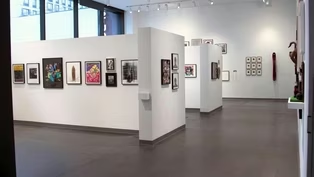
JEFFREY BROWN: All these years later, Golden is presiding over the reopening of the museum in a stunning new $160 million building that somehow fits into its former site on 125th Street in the heart of Harlem, an historic center of Black American life and culture, seven floors, doubling its former exhibition space, offering multiple pathways in a design by Adjaye Associates, a large lobby with a neon Me We by artist Glenn Ligon.
A roof garden with stunning views out over Manhattan skylines, water towers and church steeples included.
But the underlying story remains how the studio from its founding in 1968 helped change what's seen on museum and gallery walls around the world.
THELMA GOLDEN: The Studio Museum was necessary because the contributions of artists of African descent were not being adequately acknowledged.
Works were not being collected or shown in institution.
Art histories were often excluding some of the major voices.
JEFFREY BROWN: They were there.
They were doing their work.
THELMA GOLDEN: They were doing their work.
They were there.
There was a century of contribution, but quite often art history was not including them.
And The Studio Museum, our founders, were part of a larger movement which really looked at what it meant to revise the canon.
JEFFREY BROWN: An archival exhibition now captures some of that history, its founding in a loft over a liquor store by a group of artists and philanthropists amid the turmoil of the 1960s and the civil rights movement, the move in the early '80s to its present site, a former bank building.
One of the first artists shown in 1968, Tom Lloyd, who created electric light sculptures, is now honored with a solo exhibition in the new space.
The main exhibition, titled From Now: A collection in Context, contains works by early pioneers such as Romare Bearden, Jacob Lawrence, Elizabeth Catlett, and later generations who've burst the seams of the art world and drawn international attention.
A few among very many, painters Kerry James Marshall and Jean-Michel Basquiat, photographers Carrie Mae Weems and Dawoud Bey, sculptor Barbara Chase-Riboud.
It also captures the diversity of Black art, political, as in David Hammons' Pray For America, and personal, Tom Feelings' Mother and Child, representational, Barkley Hendricks' Lawdy Mama, and abstract, William T. Williams' Train.
THELMA GOLDEN: There is no one way we can describe Black art.
That is where we understand the sort of multiplicity of voices, the multiplicity of ways of seeing and imagining.
JEFFREY BROWN: Another exhibition celebrates The Studio Museum's artist in residence program, which has given space, time and support to more than 150 artists, and helped launch many international careers, including that of 36-year-old Jordan Casteel, who grew up in Denver knowing of the museum's history before coming to New York as a young artist.
JORDAN CASTEEL, Artist: Word on the street amongst artists was so attached to what this museum had done for them, either personally or a place that they would visit, a sense that they could feel themselves and belong to them.
Whether they were a resident or not, it didn't matter.
They ultimately all felt a sense of belonging.
And I think... JEFFREY BROWN: And you wanted to be a part of that.
JORDAN CASTEEL: And I wanted to be a part of that.
I desperately wanted to be a part of that.
And when I got the call from Thelma Golden, I remembered thinking this was a moment that could change my life forever.
JEFFREY BROWN: One of the paintings Casteel made during her residency, a portrait of Kevin the kite man, a man she saw every day out her window across 125th Street.
It became part of a series of paintings of local figures with a goal of representing the neighborhood, bringing its people and life inside the museum.
JORDAN CASTEEL: I wanted to create that bridge quite literally in terms of the representation, the furthering of the bridge of what this institution meant for me and wanting to share it out onto the street to the people that I was meeting.
JEFFREY BROWN: That sense of being a part of Harlem is crucial here and scenes of its life are everywhere, in Lorraine O'Grady's Art Is series, and an exhibit titled Harlem Postcards, photographs by local and visiting artists over several decades.
CHRISTOPHER MYERS, Artist: Harlem has always been this kind of like gathering place of people thinking and people doing and this museum has been a nexus for decades.
JEFFREY BROWN: Artist and writer Christopher Myers remembers coming here as a child with his father, Walter Dean Myers, the renowned author of books for children and young adults.
Now Christopher has created a commission work for the museum's new education center, where children will come for school and after-school visits.
His large paintings on steel titled Harlem Is a Myth portray local figures.
The famous such as Kareem Abdul-Jabbar and everyday, young girls in front of a movie theater, giving them mythological wings and other traits.
CHRISTOPHER MYERS: I'm thinking about just the kind of mythic resonance of all those people.
JEFFREY BROWN: I mean, literally because you're making them into mythic characters.
CHRISTOPHER MYERS: Of course.
And I feel like sometimes we lose sight of the specialness of what it means to be part of a myth like Harlem,and especially for young people to understand that they need to imagine themselves to be larger than their environment, larger than their world.
They need to imagine themselves to be as big as Harlem.
JEFFREY BROWN: If The Studio Museum originally opened in one period of turmoil in the 1960s, it reopens in another amid attacks on diversity programs, museums and how American history and culture are presented.
THELMA GOLDEN: It continues the resolve for what it means to have public institutions that are committed to what it means to create space, right, in moments like this.
Our archive keeps telling me so much from the past of where this is exactly where our founders were in 1968, so also thinking about this as the legacy of this institution, right, to continue to work in ways that promote those sort of widest ideals of democracy and justice.
JEFFREY BROWN: On the one hand, the museum celebrates its success in helping widen the lens of the larger art world.
On the other, Golden insists the necessity of a museum capturing the vision and voices of Black artists is as strong as ever.
For the "PBS News Hour," I'm Jeffrey Brown at The Studio Museum in Harlem.
GEOFF BENNETT: And that's the "News Hour" for tonight.
I'm Geoff Bennett.
AMNA NAWAZ: And I'm Amna Nawaz.
On behalf of the entire "News Hour" team, thank you for joining us.
Doctoral student held hostage in Iraq shares harrowing story
Video has Closed Captions
Doctoral student held hostage for years in Iraq shares her harrowing story after release (9m 15s)
Few of Gaza’s medical evacuees leave through Rafah crossing
Video has Closed Captions
Few of Gaza’s sick and wounded allowed to leave through reopened Rafah crossing (3m 17s)
Former prosecutor analyzes legal issues over Epstein files
Video has Closed Captions
Former federal prosecutor analyzes legal questions over the DOJ’s Epstein files release (7m 39s)
The Studio Museum in Harlem showcases history of Black art
Video has Closed Captions
Inside the Studio Museum in Harlem’s showcase of Black art history in America (7m 55s)
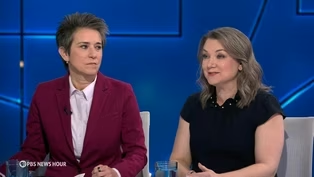
Tamara Keith and Amy Walter on GOP’s shrinking House margin
Video has Closed Captions
Tamara Keith and Amy Walter on the GOP’s shrinking margin in the House (6m 26s)
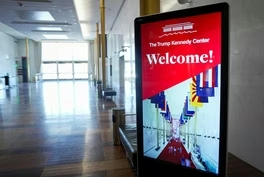
Trump announces controversial closure of Kennedy Center
Video has Closed Captions
Trump announces 2-year closure of Kennedy Center after multiple cancellations by artists (6m 46s)

What to know about Epstein’s ties with prominent figures
Video has Closed Captions
What latest released files show about Epstein’s ties with prominent figures (4m 41s)
Providing Support for PBS.org
Learn Moreabout PBS online sponsorship
- News and Public Affairs

FRONTLINE is investigative journalism that questions, explains and changes our world.

- News and Public Affairs

Amanpour and Company features conversations with leaders and decision makers.












Support for PBS provided by:
Major corporate funding for the PBS News Hour is provided by BDO, BNSF, Consumer Cellular, American Cruise Lines, and Raymond James. Funding for the PBS NewsHour Weekend is provided by...