NJ Spotlight News
NJ Spotlight News: September 2, 2024
9/2/2024 | 26m 46sVideo has Closed Captions
A tribute to the life and legacy of our beloved colleague, consummate newsman Michael Aron
In this special edition of NJ Spotlight News, we share a tribute to the life and legacy of our beloved colleague and consummate newsman Michael Aron, who died recently at the age of 78 after a career that spanned four decades.
Problems playing video? | Closed Captioning Feedback
Problems playing video? | Closed Captioning Feedback
NJ Spotlight News is a local public television program presented by THIRTEEN PBS
NJ Spotlight News
NJ Spotlight News: September 2, 2024
9/2/2024 | 26m 46sVideo has Closed Captions
In this special edition of NJ Spotlight News, we share a tribute to the life and legacy of our beloved colleague and consummate newsman Michael Aron, who died recently at the age of 78 after a career that spanned four decades.
Problems playing video? | Closed Captioning Feedback
How to Watch NJ Spotlight News
NJ Spotlight News is available to stream on pbs.org and the free PBS App, available on iPhone, Apple TV, Android TV, Android smartphones, Amazon Fire TV, Amazon Fire Tablet, Roku, Samsung Smart TV, and Vizio.
Providing Support for PBS.org
Learn Moreabout PBS online sponsorship- [Announcer] Funding for "NJ Spotlight News" provided by the members of the New Jersey Education Association, making public schools great for every child, RWJBarnabas Health, let's be healthy together, and New Jersey Realtors, the voice of real estate in New Jersey.
More information is online at njrealtor.com.
(lively music) (dramatic music) (dramatic music continues) From NJ PBS Studios, this is "NJ Spotlight News" with Briana Vannozzi.
- Good evening, and thanks for joining us on this Labor Day.
I'm Briana Vannozzi.
Tonight, a tribute to the life and legacy of our beloved colleague and consummate newsman, Michael Aron, who died recently at the age of 78 after a career that spanned four decades, covering every major political story of our state dating back to the days of Governor Brendan Byrne, earning the respect and admiration of everyone with whom he crossed paths, dubbed the Dean of the State House Press Corps.
But Michael Aron was also an avid soccer player, a father, a grandfather, a David Bowie fan, and had a heck of a sense of humor.
Senior Correspondent Brenda Flanagan takes a look at the impact his journalism made on the state.
(light music) (upbeat music) - Welcome to "Reporters Roundtable."
I'm Michael Aron.
- [Brenda] For 40 years, Michael Aron took New Jersey's political pulse with shows like "Reporters Roundtable," his meticulous journalism, and one-on-one interviews with the state's most powerful officials.
Michael talked to everybody.
His friend, the late pundit Nick Acocella, summed it up nicely on his show, "Pasta and Politics."
- [Nick] The Dean of the Trenton Press Corps, Michael Aron has interviewed every New Jersey governor, Senate president, speaker, US Senator, and Chief Justice in his 35 years of covering New Jersey politics.
- He was a consummate journalist, and a throwback of a most delightful kind of throwback back to an an era where one person could command complete respect from all sides.
- [Brenda] "Star-Ledger" Editor Tom Moran often sat in on "Reporters Roundtable," and says Michael was curious about everything.
He wasn't an original Jersey guy.
A graduate of Harvard and Princeton, Michael worked in New York City for "Rolling Stone" before accepting a job offer at "New Jersey Monthly Magazine."
As he told Nick- - I thought, "New Jersey, "gritty, interesting, tough."
I thought, "If it were 'Connecticut Magazine,' no, "but New Jersey, sure."
- [Brenda] Michael joined New Jersey Network, went on TV in 1984.
Year by year, his stature grew.
Newsmakers in Trenton always took his phone calls.
He had a reserved seat for press conferences in the governor's outer office.
- And I think it was Corzine who dubbed him the Dean of the Press Corps, but it stuck because it's true.
I don't think there's any debate that he was the leader of the pack down there, and was relied on as the authoritative voice.
- He was the GOAT.
He was the guy who showed everyone the unglamorous street work of being a field reporter who everyone knew, who everyone respected, or in some cases, feared, including the young reporters who would follow his every move.
- [Brenda] NJTV News anchor Mary Alice Williams says few politicians ever turned down Michael's requests for interviews.
Every reporter who knew him can tell you why.
- He would never take political sides.
He would never make snarky comments about someone that we were covering, ever.
He was always fair, no matter what, and I guess that's why the answer was always yes.
- I get no satisfaction out of taking somebody down.
- Neither do I.
- I see my job as being a vehicle through which they speak to the public.
- Right.
- [Brenda] Michael did that job unflinchingly, even when he got under President Bill Clinton's skin.
- Even people who agree with you and like what you're doing think that you change your positions too much- - I disagree with that- - Too easily.
- I disagree with that.
- And he looked at me, and his eyes bugged, and his face reddened.
(Nick laughing) - I disagree with that.
- And he said, "I disagree with that."
- I disagree with that.
- "I disagree with that."
- And he got right in your face.
- Right in my face.
"That is pure press propaganda."
With all due respect, people do say that.
- Well, if you tell 'em that enough, they might.
- I really had to gather myself.
I had just been screamed at by the leader of the free world.
- Right.
- Michael often invited young journalists to join him on "Reporters Roundtable," including POLITICO's Matt Friedman.
- He put me on "Reporters Roundtable" when I was, you know, just a 20-something-year-old brand-new reporter who didn't know anything about New Jersey politics, but who helped learn about it in part from being on that show.
I think Michael Aron probably helped start hundreds, I imagine, at least dozens of journalism careers, whether they stayed in New Jersey, or not, from that show.
- [Brenda] Michael calmed their jitters about being on TV, would always ask reporters to, quote, "Save it for the show."
But Friedman also says the veteran newsman had a sharp sense of humor.
When the Taj Mahal Casino auctioned off its contents, Michael found a random guy taking a shower there, and did an interview.
- Hi, how you doing?
- There is a guy in the shower.
- Wanna interview me?
- Yeah.
- Okay, come on.
- Okay.
- I don't want you to get wet.
Hi, how you doing?
- [Brenda] And at the annual State House Correspondents Club shows, Michael performed brilliantly.
Here's a duet with him impersonating former Governor Chris Christie.
♪ I gotta know, do I please you ♪ ♪ Are you using me until the election's through ♪ - [Brenda] He remained with NJN when former Governor Chris Christie zeroed its funding and transferred the operation of the network to WNET's New Jersey subsidiary, Public Media NJ, Inc. As the years went by, Aron opted out of the anchor chair.
- He's stepping down from his daily duties at NJTV.
He will still be around, only not as much.
- Remember, if you're a reporter, New Jersey never lets you down.
- [Brenda] Nick asked him about his plans for the future.
- You're not going anywhere, anywhere soon, I hope?
- A friend of mine says, "Ride the pony until it dies."
- [Nick] There you go, there you go.
- I was the friend who told him that.
He took it to heart, and in our minds, Michael was only ever semi-retired.
His legacy will always be felt in our newsroom.
- Michael was well-respected and trusted throughout the halls of the State House on both sides of the aisle, even from the toughest of critics.
He spent 15 years covering Governor Chris Christie and his team as both US Attorney and Governor.
As Christie describes it, he reported on his tenure without fear, or favor, a scrupulously prepared journalist who was always on the hunt for the truth.
Former Governor Chris Christie joined me to share his memories of what it was like being on the receiving end of those tough questions.
Governor, when I think back to your tenure, you often called on Michael Aron first when you would hold those sort of epic press events in the outer office.
Everyone was crammed in there.
Was it out of respect for the elder statesman, or were you genuinely curious what was on Michael Aron's mind to ask you that day?
- Both.
First and foremost, it was out of respect for him.
I had known him for a number of years already at that point.
He had covered me through my seven years as US Attorney, and in the '09 campaign for governor.
And so, I'd known Michael for a long time, but also it was because he always seemed to get not to the obvious point, but to the subtext, and I enjoyed the banter back and forth, and we would have a lot of good banter back and forth, and then I hope that we kind of set the tone for what the rest of the press conference would be like.
- You did, and yet he always remained so serious, even when you had a few jokes to quip.
He sort of, he was unflappable in that way.
- Absolutely, look, he was a pro in every sense of that word, and he, when you were off the record, as you know, Briana, had a great sense of humor, and enjoyed a good laugh as much as anybody.
But when it was game time, Michael brought his game, and you had to be ready as the person who was on the receiving end of those questions.
- That makes me think of, and of course, you weren't there, but one of the Correspondents Club's dinners, Michael dressed up as you, he sang "I Got You, Babe" song acting as you.
I think he also dressed up as your Press Secretary Mike Drewniak once.
I never got to ask you what you thought of that, and his rendition of you singing the song was, and just taking on the role of Governor Christie.
- I thought it was great, and it was a compliment, and like I said, I was referencing before, he had a great sense of humor.
And so, in those moments were the times when he got to display that sense of humor to a broader audience.
But I loved it, I laughed, and we talked about it afterwards, and he wanted to make sure that I was okay with it, and I told him I was just fine.
- Was there ever a particular story he did where it made you shift in your thinking, or even in how you approached a policy?
Did he ever move the needle for you in that way when reporting on you?
- You know, it was more the things that he would change in me would be the way I would think about a topic, or approach it.
Michael's questions were often very analytical.
As I said, he would often go for what the subtext was, what he used to call the real story.
And so, he would get me to look at things a little bit differently often than I did before, and I would often take delight, 'cause he was great at reading the tea leaves, I'd often take delight when I would get a chance to fool him, and one time I remember in particular was when I had to appoint the replacement for the late Senator Frank Lautenberg- - Yeah.
- And Michael was speculating with a lot of different names, but he did not speculate about the one I ultimately picked, Attorney General Jeff Chiesa, and when the two of us walked out of my inner office to the outer office, Michael was sitting in his typical front-row seat, and he looked at me, and he winked, and he said, "Hiding in plain sight."
(Briana laughing) - What a typical Michael one-liner.
Hey, how did he come to have that designated seat in your outer office?
- It wasn't us.
It was the respect that the rest of the members of the press corps had for him.
I don't think any of them would dare take it.
They knew that was where he should be, and while there were a lot of other senior people who covered me over time, there was no one like Michael, and everyone else knew it, and he stood up for the other members of the press corps, too.
There was a time when one reporter wrote a story that I thought was really unfair.
And so, I did what I would do from time to time with reporters that would do something like that.
I called it putting them in the penalty box, and they would come to the next press conference, and they'd be raising their hand, and I just wouldn't call on them.
And this one particular time after we were done with the press conference, my secretary came back in, and said, "Michael Aron wants to see you alone "for a moment off the record."
I said, "Okay," and he came back in, and he said, "Look, I know you put this particular reporter "in the penalty box today, as you call it," and he said, "Governor, I wanna urge you don't do that."
He said, "It affects his ability to do his job, "and that's not right."
And you know what, he was right, and those are the kind of ways that Michael had influence on me, and I think that story not only shows how honest he was willing to be with me privately, but also how he felt like every member of the State House Press Corps was someone that he wanted to make sure got treated fairly, and that if necessary that he would protect himself.
- Governor Christie, thanks for coming on to share some memories about our friend, our colleague, Michael Aron.
Thank you so much.
- Briana, thanks so much for having me, and my condolences to Michael's friends and family.
He will be missed.
- Well, we've shared that Michael was a mentor to many of us here at "NJ Spotlight News."
His search for the truth inspired us all.
He had more institutional knowledge of New Jersey policy and politics than just about anyone in Trenton.
His reporting gave voice to important issues in the state, and the public important insight on what they were about.
Joining me to talk about how Michael's work shaped local news reporting here are Senior Political Correspondent David Cruz and Senior Writer Colleen O'Dea.
David, so of course, you had a great working relationship with Michael and personal relationship.
You also took over two of the shows.
One has since changed.
But what do you feel like you gained by working alongside Michael and also being his pal in the newsroom?
- Let me say, first of all, I feel every week the big shoes that I have to fill.
Every week, you know, when we're trying to be smart, we're trying to contextualize, you know, I feel that every week- - [Briana] Because Michael was known for that- - Yeah, totally, totally, especially with "Roundtable," which was his baby, literally, you know?
But I just, a couple of things.
When I first, the first time I ever saw Michael, we were outside WBGO, which is down the block from the old NJN headquarters in Downtown Newark, and Michael was walking by, and I just looked at him.
I was like, "Oh, that's Michael Aron," and he was just- - Stoic?
- Straight ahead, right?
And I'm like (scoffs), "Who's this guy," you know?
But then years later, the first conversation I ever had with Michael, I'm on a shoot, and I get a call from Tim Stollery, who was his longtime cameraman with whom I also worked a few years.
He says, "I got someone who wants talk to you."
I'm like, "Okay."
So I pick it, I'm on the phone, and he says, "David, this is Michael Aron," and in that voice that he had- - Yeah.
- Was uniquely his.
- Yeah.
- And he complimented me on the package that I had done two days prior just talking about the writing and all the stuff that I take pride in, and he just nailed it, and he didn't have to call me to say anything to me, but that I took like a, "I am here now."
- He was really good, Colleen, I love that story, David, and something that has come out from a lot of other journalists is how Michael promoted everyone else's work.
That's something that I've taken with me in my professional side of life is to promote other people's work, to recognize when it's smart, and it's thorough, and detailed, and Michael did that regardless of whether you were a competing outlet, or not.
It's only in recent years that you and Michael worked in the same newsroom, but you've known each other for a long time.
- Yeah, and, you know, for me, I was a young, quite young reporter down at the State House.
And so, he was kind of like, everyone looked up to him, right, 'cause he's Michael Aron, you know?
He's the guy who always, you know, asks the great questions at news conferences.
And I remember the first time he asked me, I was there a couple of months, to do "Roundtable," and I said, "Oh, I couldn't do that," you know, "I couldn't be on there.
"I don't know anything.
"I don't, you guys, and all"- - You sort of questioned, "Why is he asking me to come on?
"He knows everything"- - Right.
- "He doesn't need me on here."
- And the guests, you know, all of these other reporters who've been working there for so long.
He says, "You know, I read your stuff, I look at your stuff.
"You're doing a great job.
"You're smart, you'll do fine," and I said, "Oh, okay," and, you know, he came in the first time, you know, when I was getting makeup, and said, "Don't worry about it, you're gonna be fine.
"You know, you're gonna be fine."
And I, you know, probably did "Roundtable" once a month after that, so- - Right.
- He really gave me the confidence to feel, because you can, it's a daunting place down there.
It's not the place it used to be.
There are not as many, nearly as many reporters as there were, you know, back 20, 30 years ago.
- Right.
- But everybody there, at least once you, when you first get there, seems like they know everything, and it just makes you feel like, "Oh, boy, I have, you know, "I don't know anything.
"I don't know what I'm doing"- - Sure, right.
Well, when you have someone with that type of gravitas who says, "You're talented," right, you believe it, and I wonder what we now lack by having that sort of person with that institutional knowledge.
You know, Michael was a walking encyclopedia of state politics.
What we lack now in our landscape without someone like him to not just point out, "Hey, you're talented," but he also had a way of helping you cultivate it, especially for those of us who got to work alongside him.
Where do you see the landscape now shifting with so much turnover, especially in this market?
- Yeah, I mean, that's a real problem.
You know, you've got a Charlie Stile at "The Bergen Record," right?
He's got that kind of institutional knowledge, and there are some reporters down there who are very good, and who've been there for a while.
But it seems like too many places, and there are not a lot of news outlets that are covering Trenton anymore, but too many places, you know, when there are unfortunately layoffs, or when folks decide to leave and move on, you know, somebody goes in there who's just green, and then they don't have that institutional knowledge, and so much really, I think, depends on that.
You need somebody who can say, "Well, you know, back 20 years ago, "they tried to do this with the property tax," or, they, you know, "They did this five years ago"- - Yeah, "This bill has died six times.
"It's never gonna make it."
- Exactly.
- But, I mean, to Colleen's point, David, a lot of journalists see New Jersey as a whole as a stepping stone, right, to get to a major, or national media market.
Michael, of course, did not.
Many of us don't see it that way.
But what does that say about sort of the platform that Michael set up to say, like, "This is a place to not only hone your skills, "but spend your life's work"?
- Yeah, I think it's funny, 'cause Michael started in national outlets, and then, you know, kind of- - True.
- Boiled it down to New Jersey.
I think for me, I'm really concerned, I was thinking about this as, you know, we were dealing with the reality of Michael's passing is that this is a really important time right now in our business.
I call it the era of the shrinking reporter, because while we have thousands of outlets, we have fewer and fewer reporters who have the stuff that Michael had, integrity.
- Yeah.
- Just smarts, institutional history, all of those things that aside from how you deal with other reporters, how are you dealing with the news of the day, and providing really good journalism that now it's much more hit and miss than it used to be, and for me, that's what I miss about seeing Michael passing.
- And do you think that a lot of that has to do with the fact that we're all chasing the fact that we're not just a 24/7 news cycle, but we've got, you know, eight to 20 different platforms that people are consuming news on.
When you think about someone like Michael, that wasn't necessarily his thought.
His thought was, "I'm gonna probe, "and dig into this story, whatever it is."
And so, I wonder moving forward how he would approach what we're all confronted with every day.
- To me, the danger is fitting the reporter to the format and not making a format for the reporter, and I think that that's really important, because you can chase algorithms all you want, and find out that everybody loves videos of puppies, but that's not necessarily news, you know?
And so, sometimes, it's gotta be reversed.
You have to trust the people who do the journalism to know what's happening and then work away so that it, you can put it on the 80 different platforms that people are gonna be watching it on.
- Coll, you were shaking your head to that.
- Oh, yeah, I mean, it's just, it's just miles away from where I started out, where Michael started out in terms of things like having to worry about X, former Twitter, Facebook, Instagram, TikTok- - [Briana] Right, and what plays on each format, and- - Right, what plays on those formats, and how to, you know, create these little snippets, or these really quick bites to try to catch people's attention.
I mean, what we're in the business to do is try to explain things, you know?
We don't, we tend to not think that, you know, we're chasing that spot news story.
I mean, we go for those, and we hit them, but we wanna give people context, and we wanna give them the background that they need to kind of, you know, be better informed citizens, and make good decisions, I'm thinking in our election coverage, right?
- Yeah, well, and that was the charter of public television- - Absolutely.
- Public media.
- Right, right, but so, that doesn't play as well today, or it's harder - It is.
- For us to get that across.
And so, thankfully, we do have a team that, you know, it's a small, but mighty team that helps us with social media, but it's a hard thing to then get those really important messages across.
- Mm-hmm, so something that I often would ask Michael is just, you know, "What do you think about this story," or, "What do you think about whatever, you know, "craziness was happening in politics," or with a certain politician, or what have you.
So I wanna just ask you both what you would leave to say to are younger generation of journalists who are coming into this pipeline, or in school now to become a reporter, or thinking about it, about how to approach stories, and how to ensure that we keep the integrity of the landscape that New Jersey media has had for so many years?
- This is a business that can make some reporters of a certain age feel like a dinosaur because so much is happening just in terms of platforms that are being created, and used, and brought to the front.
What I would say to new reporters is don't go into journalism, honestly, because it's not so much, it isn't as much a place for all of these things that Michael brought to the table as it used to be, and that makes me concerned.
- Colleen, we'll go out on your final thought.
- I'll try to be a little bit- - More optimistic.
- More positive.
To certainly use all of those skills that you're learning in school, that you've learned in school that maybe we didn't have, right, but don't forget the basics of journalism, which is to make sure you get all of the background, make sure you get all the facts, and present the facts, and not the fake news kind of stuff, and make sure that you get both sides.
Make sure that you use that integrity.
- Sure.
- Right?
You do that reporting that- - So no matter what happens, how much things change, the fundamentals, those building blocks- - Absolutely.
- Don't change, they're still there- - [David] The fundamental things apply.
- The fundamental things apply.
Colleen O'Dea, David Cruz, so good to sit and chat with you both.
Thanks.
(gentle music) We truly are all better for having known Michael, forever our Dean of the State House Press Corps.
To honor Michael's legacy, his family is hosting a memorial service on Saturday, September 7th at 2:00 p.m.
It's at the First Congregational Church, which is on South Fullerton Ave in Montclair.
The service is open to all who knew him, and to those whose lives he touched.
That's gonna do it for us tonight.
I'm Briana Vannozzi, thanks for being with us on this Labor Day, and sharing in this tribute to Michael's work.
We'll see you right back here tomorrow.
(lively music) - [Announcer] NJM Insurance Group, serving the insurance needs of residents and businesses for more than 100 years.
Horizon Blue Cross Blue Shield of New Jersey, an independent licensee of the Blue Cross and Blue Shield Association, and by the PSCG Foundation.
- [Announcer] NJM Insurance Group has been serving New Jersey businesses for over a century.
As part of the Garden State, we help companies keep their vehicles on the road, employees on the job, and projects on track, working to protect employees from illness and injury, to keep goods and services moving across the state.
We're proud to be part of New Jersey.
NJM, we've got New Jersey covered.
- [Announcer] If you need to see a doctor, RWJBarnabas Health has two easy ways to do it from anywhere.
You can see an urgent care provider 24/7 on any device with our TeleMed app, or use our website to book a virtual visit with an RWJBarnabas Health Medical Group provider, or specialist, even as a new patient.
You've taken every precaution, and so have we, so don't delay your care any longer.
RWJBarnabas Health, let's be healthy together.
(dramatic music) (dramatic music continues) (dramatic music continues) (dramatic music continues)
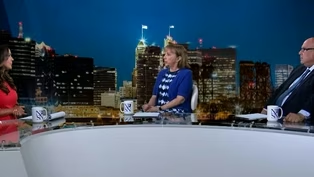
Remembering the legacy of Michael Aron
Video has Closed Captions
How Michael Aron's work shaped local news reporting (11m 19s)
Providing Support for PBS.org
Learn Moreabout PBS online sponsorship
- News and Public Affairs

Top journalists deliver compelling original analysis of the hour's headlines.

- News and Public Affairs

FRONTLINE is investigative journalism that questions, explains and changes our world.












Support for PBS provided by:
NJ Spotlight News is a local public television program presented by THIRTEEN PBS