
Water Wars
Season 2 Episode 11 | 23m 35sVideo has Closed Captions
Across Texas and beyond borders, communities clash over an increasingly precious resources.
Across Texas and beyond its borders, communities clash over an increasingly precious resource. A desalination plant threatens coastal wildlife, and two nations grapple with dwindling water supplies.
Problems playing video? | Closed Captioning Feedback
Problems playing video? | Closed Captioning Feedback
Production Support Provided By: Riptide Waters LLC; Texas Parks & Wildlife Foundation; Texas Rural Funders, H-E-B”
Water Wars
Season 2 Episode 11 | 23m 35sVideo has Closed Captions
Across Texas and beyond its borders, communities clash over an increasingly precious resource. A desalination plant threatens coastal wildlife, and two nations grapple with dwindling water supplies.
Problems playing video? | Closed Captioning Feedback
Where to Watch Texas Monthly Presents: The Story
Texas Monthly Presents: The Story is available to stream on pbs.org and the PBS app.
Providing Support for PBS.org
Learn Moreabout PBS online sponsorship- We are not close to solving the Texas water crisis.
- [Sally] Here we go.
(dramatic music) - The river's gone.
It runs dry in huge portions.
This was a real battle with real stakes.
- Running the desal brine through Baffin Bay would be the worst thing we could do.
- Activism sometimes just means showing up.
(Esteban speaking in foreign language) (gentle orchestral music) (dramatic orchestral music) (gentle orchestral music) (boat whirring) - The very first thing I do is say a prayer.
Thank God for the opportunity to be able to do this, and pray for safety for everybody, and of course, big fish.
(jacket rustling) Ready to roll?
- I'm ready.
- All right, here we go.
(boat whirring) (dramatic orchestral music) - This story is about the coming challenges for small communities while we all work together to solve the water crisis.
- The fact that they were planning on dumping brine into already hypersaline bay system was just ridiculous.
So that just wasn't an option.
- Why destroy our bays?
It is not necessary.
- I think we have a duty as Texans to protect and defend our land and our water.
- My name is Bekah Stolhandske McNeel, and I wrote "The Battle Over Baffin Bay" for Texas Monthly.
You wouldn't think water would be such a complex issue, but it really is.
(low tense music) So, getting a water story on the front page, it's a relatively new trend, but it's gonna happen more and more because Texas as a state (pages rustling) is in a water crisis as a whole.
We've got areas that are running dry.
(page rustles) We have big business coming in, tipping areas that had enough to being scarce.
And when we look to where we're gonna find solutions, where are we gonna find what we're calling new water, it's often small towns where that's gonna happen.
That led us to Captain Sally Black.
(birds chirping) (water lapping) Sally is a fishing guide who takes people out on boats to catch probably the biggest fish of their life.
- I was a paralegal for 15 years, but I always just fished.
So, after my last big case, I decided to be a fishing guide, and I pulled a boat for about 13 years.
And then it got kind of crowded in Rockport, so I decided to move to Baffin Bay, and there's still so much beauty and peace here and not very many people.
It's really a treasure.
(calm music) - [Bekah] So, it's very obvious when you're on Baffin Bay that it's special.
But through the eyes of someone like Sally, it's incredibly special.
- [Sally] Baffin Bay is one of the most unique bays in the great state of Texas because it's so remote.
- Because it's a closed bay, fish live a very unstressed life and can get really, really big, and so you have a lot of trophy fishing.
And those guides who that's their livelihood, those were the people who we thought, "All right, if Baffin Bay changes, their whole livelihood changes, their whole way of life."
(water sloshing) - This place is the home of the trophy trout on the Texas coast.
That's like the Holy Grail of fishing.
- Baffin has got the best concentration of decent-sized trout as far as I know on the coast.
And we've got red fish here, and the black drum fishing is fantastic.
Hadn't become, you know, Baytown or Bayport or whatever, and we're trying to keep it (laughs) as much as we can, so I hate to say too much on anything.
(laughs) Hi.
- [Person] Howdy.
- The bay is beautiful, but it's also very, very fragile.
(boat humming) (calm music) - It's already a hypersaline bay system, so any slight change in the environment here can affect so many things, and we're not gonna let that happen.
- So, one day, the local community got wind of a planned desalination plant nearby.
One of the things that raised alarms about this desal plant was that nowhere in their contract was there anything to stop them from dumping their wastewater into nearby Petronila Creek, which would then end up in the bay.
- My name's Andrew Mendez.
I'm a lifelong resident of Kingsville, Texas.
I've lived here my entire life.
My family's been here for generations.
I heard about the desalination plant from our local news.
- Water is a precious resource here in South Texas.
How one proposed solution is raising more red flags than providing answers.
- It was revealed that the South Texas Water Authority and a private company called Seven Seas Water Group ultimately had been planning this out for several years.
- [Reporter] The news shocked everyone, including Kingsville mayor, Sam Fugate.
- I just found out about this today, and I'm the mayor.
The city of Kingsville will not be a part of this.
- So, the big question for the people in that area was, how does the desal plant work?
(bird calling) And could wastewater affect the bay?
(pensive ambient music) Most of the desal plants in Texas are actually desalinating groundwater.
They're going into the ground (pipes hissing) and they're taking out water that's too full of minerals and they're treating it.
The entire Coastal Bend is looking for new water.
They've been in a drought for a long time, and due in large part to industrial demand, they're using more than they can replenish.
So, South Texas Water Authority, who's in charge of supplying water to two very dry counties, was on the hunt for new sources of water to meet that demand, and that's how they found Seven Seas Water Group.
- My name is Henry Charrabe.
I'm the CEO of Seven Seas Water Group.
Seven Seas is committed to providing brackish water desalination solutions throughout Texas by our trademarked water-as-a-service model, introducing innovative approaches that are already providing benefits to customers in Texas, such as in the city of Alice.
- Desal is gonna be a competitive business in Texas.
We're dumping billions of dollars into this industry, and it's gonna be private companies largely who bring those services to municipalities.
- Our most recent contract for a brackish water treatment plant with the South Texas Water Authority in Kingsville will produce a discharge stream with a projected quality of 12,000 TDS, which is a measure to use to determine the salinity of water.
This stream will join the stream from our desalination plant in Alice, directed into Baffin Bay.
- Desalination sounds like a silver bullet, but there's really no such thing as a silver bullet when you're talking about natural resources.
There's always a catch.
The catch with desalination most immediately is, what do you do with the waste?
And dumping is always gonna be the cheapest option.
- Our discharge will be beneficial to Baffin Bay as it will dilute the hypersaline body of water, ultimately reducing the salinity and thereby allowing the revitalization of the bay while providing fresh drinking water to citizens further inland.
- The problem with it is it's not just salt water.
You have all these heavy metals and impurities.
That stuff gets filtered out, and all of that ends up in your brine discharge, so brine discharge is not just salty water.
- Seven Seas ultimately said they would only do what they're allowed by state regulators when it came to the discharge.
I asked Seven Seas about their plans for community engagement to make sure all concerns had been heard.
They said they take stakeholder engagement seriously and their approach is to bring everyone into the loop at the appropriate time.
And I think that for the residents of the Baffin Bay area, to them, the appropriate time would've been much earlier in the process.
- We weren't aware of it until it actually kinda hit and it was almost taking place, right?
We were some of the last people to find out.
We're kinda left in the dark.
(pensive music) - The people around Baffin Bay, they're very pro-business.
They're very independent.
They don't necessarily trust government regulation.
But more than one person said, "Overnight, I had to become an environmental activist because the environment was my own backyard."
- This is our home, and Baffin Bay is a generational fishing place.
It's where our grandparents took us to fish, our fathers and uncles.
- If bad things happen in Baffin Bay, it, of course, will affect my livelihood, but more importantly, it would affect my soul.
This place is one of those kinda places that you get to fish once in a lifetime.
And I just love this place.
It's so peaceful just being out here on a daily basis as a gift from God.
- When it comes to whose job it is to protect Baffin Bay, Sally told me point blank, "It's our job.
It's everybody who loves the bay has to protect the bay."
- Activism sometimes just means showing up, and so we all band together and decided to fight.
- I am here to talk about the discharge potential going into Baffin Bay.
- There's no denying that we're in a water crisis.
- I have no problem with using desal.
I think you guys are having tough decisions to make.
- It's not that people don't want desalination to get water.
It's they just want it done right.
- [Sally] It didn't matter if they were hotel owners or fishing guides or even scientists.
They all showed up to the meetings.
- You're being asked to approve a project that would discharge brine and chemicals into a fragile enclosed bay system on a hope and a whim that it will all just work out.
- Running the desal brine through our Baffin Bay would be the worst thing we could do.
You do that, we're losing a whole huge fishing industry.
- It's worth saving, and it was very heartening to see all of the stakeholders get together and fight.
- One of the funniest parts about meeting Sally Black is that she gave me one of the best kickers of my career.
She said, "Don't make me get the birders involved."
(Bekah laughs) - [Sally] We just have to make a lot of noise and make sure that people hear our side of the story, not just industry.
- Put on your party pants, be ready to talk, and tell these guys, "No, not on our watch."
(car droning) (slow somber music) (slow somber music continues) - My main concern with these stories is that as we seek solutions to the water crisis that there is accountability.
(bird calling) This battle is a blueprint for a battle that's going to be fought over and over again all over the state.
And so communities like this are gonna have to go through the posted agendas for governing boards that no one's ever even heard of to see if they are contracting with the desal plant and where that desal plant is gonna put its waste.
It's a ton of work, and it falls on local communities who have never had to really worry about this before.
(boat whirring) - Hey, guys, just real quick, I slipped away from a Redfish Bay CCA Anglers' Night Out just to share the news that once again, if you think your voice doesn't matter, it does.
It matters very, very much because the South Texas Water Authority just voted not to discharge their desalination plant in Driscoll, Texas into Baffin Bay.
That is a gigantic win.
It's a gigantic win.
Public voices do matter.
Your input does matter.
You can move the needle, and thank you for everything that you guys did to help make that happen.
- Ultimately, the community was successful, and so it was a big win, and the community celebrated that.
And so, we sat with Sally and Andrew and asked, "Is it over?
Do you feel like you've won?"
- I'm not sure we stopped it yet, but I think we have slowed it down a little bit.
At least brought some sunlight to the situation.
- I call it we're playing tower defense here or whack-a-mole.
We stop 'em somewhere, and then they just kind of shift and pivot somewhere else.
- Right.
- As Texas tries to solve its water crisis, local communities are gonna have to look out for themselves and look out for each other.
- It's really important for everybody in these areas that could be affected.
It's very important to keep everybody involved.
I don't think the fight will die, and we'll just keep fighting until we get the answers that we want.
(inspirational classical music) So, whatever it takes, we're gonna keep doing it.
- We are not close to solving the Texas water crisis.
The threats are kind of everywhere.
And the idea of water wars is much bigger than just Texas.
(pages rustling) (wind whooshing) (calm music) - [Jack] I knew the Rio Grande was in trouble, but I did not realize the level of danger we're experiencing right now.
It runs dry in huge portions.
It frequently fails to reach the Gulf.
Cities like Laredo, McAllen, Brownsville, if the Rio Grande stops flowing, if the reservoirs along the river run dry, they run out of water.
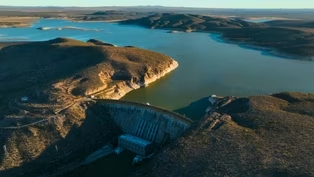
On the map, it looks like the Rio Grande starts in Colorado and runs down through Texas to the Gulf, but in reality, a major tributary of the river actually flows north from Mexico, and that's the Rio Conchos.
When it comes to tensions between the United States and Mexico over the water in the Rio Grande, no river is more important than this Rio Conchos in Chihuahua.
I'm Jack Herrera, and I reported "The Treaty and the Tributary" for Texas Monthly.
(subtle moody music) The Rio Grande is this unique river in that it has major tributaries that flow across borders.
So, in 1944, the United States and Mexico went to the table and made a treaty to guarantee that both countries would be providing a fair amount of water to each other.
For the last 30 years, Chihuahua has been keeping more and more of the Rio Conchos water for its own agricultural sector.
At the same time, this entire region has been in a megadrought that is decreasing the total amount of water available in the system.
Tensions really heated up between the United States and Mexico.
Trump was threatening tariffs on Mexico if they didn't send more water north.
When the United States and Mexico are fighting over water, this is the river they're fighting over.
- Las presas no se han recuperado.
La última vez que creció el río completamente, todo estaba lleno de agua.
Fue en 2022.
- Hoy día.
Los granjeros y los políticos en Tejas están exigiendo a México para enviar agua del Río de Conchos.
Por eso hay mucha tensión entre los los de Chihuahua y los de Tejas.
- Pero pues dicen los agricultores de aquí, "Bueno, pues, ¿de dónde les mandamos agua si nos tenemos ni para nosotros?
- La historia que cuentan los granjeros en Tejas es que hay una riqueza de agua en Chihuahua y ustedes son como tacaños con el agua y no están compartiendo la, ¿Qué piense de eso?
- Pues yo creo que si nos sobrara el agua, pues no tendríamos ningún problema con eso.
Y es que, el miedo, como te comentaba, es de que miles de personas viven exclusivamente de eso.
- [Jack] Chihuahua feels like they don't have any extra water.
They feel like they're living on the razor's edge of drought.
They're not planting their entire crops 'cause they don't have enough water for their own people.
Nosotros somos un municipio meramente agrícola ganadero.
Pues dependemos totalmente del agua que corre por nuestro Río Conchos.
La verdad es que sí, estamos preocupados porque pues no tuvimos ciclo agrícola del año pasado y este que viene, pues va a ser muy restringido.
Si el Río Concho no estuviera, no corriera por aquí, yo creo que nada de esto estaría asentado aquí en esta población.
Entonces, pues el río, el agua es la vida, lo es todo para nosotros.
- [Jack] Chihuahua had the look of a place that's dried out, that is in decline, that is struggling.
The Rio Grande is dying.
It's being killed.
There's too many people who want its water, and it doesn't have enough water for everybody, and that's true in Mexico and it's true in the United States.
- Ahí está, presa Francisco I. Madero.
(subtle moody music) - [Jack] The exact battle line is La Boquilla Dam, which has the gates that when you open it up, that water starts charging north to Texas.
But in 2020, it basically stopped, and that's because of what happened that year.
(tense classical music) When they opened up the gates to send water to Texas, that was scary enough for farmers in this region that they rose up and took control of the dam and kicked out the federal forces, occupied it, shut the gates, and kept the water in Chihuahua.
This was a real battle with real stakes.
One of the protestors, she was a small farmer and rancher in this area, and she was shot by the military.
- No, no, no era algo que estábamos, este, que teníamos nosotros planeado en nuestras vidas.
Pero solo que nos llena de orgullo haberlo hecho en ese momento porque creo que todos hicieron su parte como podían hacerlo.
Ese ese monumento que está ahí es el de, ese es el que hicimos en honor a Jessica Silva.
- Jessica Silva.
- Ajá, se sintieron amenazados.
Y este pues abrieron fuego contra los civiles, el ejército, y la Guardia Nacional argumentó que les habían disparado, que tenían armas, cosa que se comprobó que era totalmente falso.
(dog barking) - [Jack] ¿Qué debe vemos entender los Estados Unidos sobre la situación de agua aquí?
- Pues mira, si no estuviéramos, en unas condiciones de sequía severa, como hemos estado viviendo en los últimos años, pues no estaríamos ni siquiera hablando del tema.
O sea, realmente no podemos ir en contra de la naturaleza.
Pues no podemos mandar algo que no tenemos, ¿no?
Y no es porque no existe la intención, es que no hay, de sequía.
Pero pues también tenemos que tenemos que que de alguna manera ambos países hacer nuestra parte para que el agua sea mejor utilizada.
- Enfrentamos la misma crisis.
- Exacto.
Estamos enfrentando la misma crisis que pues la naturaleza nos tiene metidos en esto, ¿no?
- [Jack] Texas has been limping along without really any water from the Rio Conchos.
(pensive music) The society we've built, the industry we built, the cities we built in Texas haven't escaped the basic human need for water.
And if we run out of it, there is no plan B.
- Good night!
- [Jordan] Goodnight, I love you.
- Good night!
- Good night!
- [Jordan] Goodnight, Maggie.
I love you.
The existential dread, it can be really overwhelming.
See you later.
I try not to bring it home.
- Bye.
Bye.
Love you.
- Bye.
- I miss 'em a lot.
And they're so young, like, I mean, I'll only be gone for like a week or so, but it feels like they've grown up a ton.
When we pass a river, sometimes they'll be like, "Is that the Rio Grande?"
(laughs) I'd be like, "No, not quite."
I try to talk about, like, the things we love about the water and why it's worth protecting and you guys have the future to take care of these things.
But I mean, in the back of my mind, I'm thinking like, "I don't know if there's gonna be anything left for you to protect in 20 or 30 years."
(camera shutter clicks) (camera whirring) - When we pitched that story, I said, "You know, this is something that in the next 10, 15 years, we could see the collapse of this river system."
And I really thought we'd get on this story, and we talked to experts, we talked to farmers, we'd see the river for ourselves, and we'd have people tell us that's a worst-case scenario that maybe happens in 30 years.
- [Jordan] Right, unlikely, but- - Unlikely, but we need to prepare for it.
- Yeah.
- And the possibility of things maybe working out doesn't feel on the table even.
(pensive ambient music) - Es muy personal y es muy querido, sobre todo por todos nosotros, pues por lo que representa.
Porque es lo que nos mantiene aquí en nuestra tierra.
Porque pues de esa forma no tenemos que irnos a buscar a otros lados.
Nos podemos quedar aquí con nuestra familia, con nuestra gente.
Es como dice el himno de Chihuahua, - [Jack] Sí.
Amemos la tierra que nuestras padres amaron.
[Jack] Sí, muy bien.
- [Jack] Texas feels like Chihuahua's holding back unfair amounts of water, and Chihuahua feels like Texas is asking for water that they do not have to give.
The simple reality is, there is a limited amount of fresh water on planet Earth, there is a very limited amount of fresh water in Texas, and we are using too much of it.
(subtle dramatic music) - I've committed my career to human stories and how humans interact with systems, and I think that means for the foreseeable future, I'm going to be writing about water.
Things are getting drier.
The rain is getting more unpredictable, but one thing that I'm anticipating is that these fights are gonna bring out the best in Texas and remind Texans that taking care of their neighbors is a very Texan thing to do.
- [Jack] We can cooperate out of this crisis.
It just is gonna take change on a pretty profound level in this state and this country.
(emotional piano music)
Video has Closed Captions
Preview: S2 Ep11 | 30s | Across Texas and beyond borders, communities clash over an increasingly precious resources. (30s)
Providing Support for PBS.org
Learn Moreabout PBS online sponsorship












Support for PBS provided by:
Production Support Provided By: Riptide Waters LLC; Texas Parks & Wildlife Foundation; Texas Rural Funders, H-E-B”