
'O'Hare Flyer' Would Offer 15-Minute Rides From Airport to the Loop
Clip: 8/27/2026 | 9m 36sVideo has Closed Captions
A Chicago-based team is working to get the project off the ground.
The privately funded express train would run on a dedicated track from near the Old Post Office to O'Hare's Terminal 2. Speeds would reach 80 mph.
Problems playing video? | Closed Captioning Feedback
Problems playing video? | Closed Captioning Feedback
Chicago Tonight is a local public television program presented by WTTW
WTTW video streaming support provided by members and sponsors.
'O'Hare Flyer' Would Offer 15-Minute Rides From Airport to the Loop
Clip: 8/27/2026 | 9m 36sVideo has Closed Captions
The privately funded express train would run on a dedicated track from near the Old Post Office to O'Hare's Terminal 2. Speeds would reach 80 mph.
Problems playing video? | Closed Captioning Feedback
Where to Watch Chicago Tonight
Chicago Tonight is available to stream on pbs.org and the PBS app.

WTTW News Explains
In this Emmy Award-winning series, WTTW News tackles your questions — big and small — about life in the Chicago area. Our video animations guide you through local government, city history, public utilities and everything in between.Providing Support for PBS.org
Learn Moreabout PBS online sponsorship>> Getting from the loop to O'Hare could take just 15 minutes in the near future.
Sound impossible.
Well, Chicago based team is working to get the O'Hare flyer off the ground.
It's a privately funded express train that would run on a dedicated track from near the old Post office to award these terminal.
2 trains departing every 15 minutes in speeds reaching 80 miles per hour.
Joining us to discuss the details Are Co founder Christina She's also the former director of the Illinois Tollway and former CEO of the Chicago Skyway, co-founder and CEO Dave Lundy, a strategic consultant and Mark Waldron, the project's chief engineer, as well as a co-founder.
The Suns.
Interesting everybody.
Thank you for joining Thanks for having.
Thank Okay.
So privately funded transit.
Pretty common outside of the U.S.
It's sort a novel idea here, Mark, or did the inspiration come from?
>> I've been working on a number of projects in the Chicago area and then begin to work directing projects in Europe, in paper all over Europe and they kept looking at it saying Chicago has a lot of real corridors.
There must be a way to tie all this together over time of the real.
Let's begin to move their facility south.
And as they did that begin to free up the corridors.
So we started discussions with rare was to see if there might be a possibility but agreement to use part of their facilities to get between downtown and no >> Chrissy, what approvals do you need to get this on track?
Well, look, we've got work to do moving from the private planning phase of this project to the public phase.
So we're going to be working with the city and the airport, of course, we'll need to have an agreement with the airport to come on.
Airport property will need to work with various levels.
The federal government, the FAA, this is a railroad.
So the stb, the FRA.
So there's there's doubt that the alphabet soup.
The alphabet soup agencies.
But >> all in all, you know, we're very confident that with the amount of planning that we've put in were prepared for all of those discussions.
And to some degree we we you know, we keep hearing about what the rail companies themselves having their bye and what how does that work now?
So.
>> As Mark mentioned, we are traveling on an existing rail corridor that currently is controlled by 3 class.
One freight railroads.
We have an agreement low.
I signed with CSX, which is one of our major partners.
And we're in negotiations now with CNN and Union Pacific, who are the other 2 ends of the of of the 18 mile corridor that gets us here in downtown the crisis in the works.
Dave, the goal is to launch from what we understand next 5 years.
What would you say are the biggest for this project?
You know, between today and >> the day you have passengers on board.
>> You know, look, any major project, the funding approvals partnerships.
But the great news about this project because we have spent 3 years working on this and developing a plan and developing a we have a platform, a world-class partners, a list of the top firms in the world that can execute on this project.
We actually feel very good about our chances of getting the start in doing that within the next 5 years.
>> Mark, CTA strains have a top speed 55 miles an hour on straight track, which is, of course, much slower than the 80 miles an hour.
You all are planning.
How would our existing infrastructure support that kind of speed or would there need to be improvements upgrades?
We were very fortunate.
The corridors that we looked at where the last 2 that were built into Chicago, the first ones were built in 18 40's.
>> These were built.
We later.
And because of that, they were built straight and fast.
Now they were primarily used for freight, but they were of the design that allows us to use them to go faster and we have to make improvements and those quarters and build new tracks and so forth.
But the actual right away itself is designed for this kind of speed, OK?
So I give us a little more specificity if you can, about which train tracks were talking about.
That would be used.
>> You know, would there be any conflict with Metro or freight trains?
Freight lines know we were very careful to ensure we don't have any conflict with freight movements in the Chicago area.
We have no conflicts with Metra Amtrak or CTA.
The tracks that we would put him would be ours alone, which means we dispatch uncontrolled, which is critical for a project like this where you have trains running every 15 minutes.
Chrystia, you know, we just heard Dave mentioned, you some of the world class partners.
We know this project is thus far privately-funded costing about 2.2, 5 billion dollars.
>> What can you tell us about your investors?
Who are they?
Well, look, >> we've raised money from investors to get us to this point.
But now as we move into this public phase of the project, we're going to be going out and raising money in the capital markets and we think that they'll be a lot of interest in a project like this.
You know, this is a first of a kind project in the United States.
There's no other place in the United States where you have airport express service like this with battery elected trait, battery electric trains.
And and, you know, there's a lot of investment out there in the infrastructure space looking for these types of opportunities where think Chicago is good test market market to do this.
look, you know, 3rd largest city in the United States.
O'hare is airport.
That traffic.
Is it an customer?
Flyers are coming in and out all the time.
Those numbers are projected to over the next couple of years significantly to hub airports here.
It's just, you know, it has all the makings of of a great service, a world-class airport, a world-class downtown.
And we're going to be connecting the 2 with the world class train service.
Any idea yet what the cost to the customer would Well, are projecting that the cost to customers going to be, you know, somewhere, you know, approximately half of what an Uber or rideshare would cost too the airport.
We think that, you know, ultimately, you know, these are going to be travelers and and business people and tourists coming in from the airport who voiced, you know, had to battle a long long drives on the Kennedy.
So again, we just think it's a tremendous opportunity for Chicago and for the various partners here, Dave, besides the convenience, of course, of travel between downtown and O'Hare on because it's going to take some time whether you're on the CTA or in traffic on the Kennedy.
>> What other benefits might the flyer have on the city?
You know, the biggest benefit from an economic development standpoint think about what it's going to mean when we try to sell conventions.
Where tries corporate headquarters.
>> If we get to tell people if you show up at our station at 0 15, 30 45 you will be at O'Hare in 15 minutes.
Reliably every time.
So it's really it's golden opportunity for this.
The city to be able up economic development opportunities.
And the other thing is Chicago is the real capital of America.
It's also the capital of real innovation in America.
So it's just it is the perfect place to do this.
First of its kind in the U.S.
service.
>> proposal would put V the train stopped at the old post office.
This is sort of in the West outside of what is technically the loop and downtown.
Does that location?
Does it sort of defeat the convenience that it that the train is intended to provide?
>> Well, the great thing about that first of all, is that you're a block from union station.
You're a block from the Clinton Blue Line stop.
We know we will be connected by PED Way to union station there.
Opportunities to connect to the blue line.
And so there's also the bus terminals right there.
Greyhound is.
Is is close by.
You know, you're really not far from anything, but we know that we're going to want to have shuttle services.
And so we're going to have Charles Services that Co, for example, to the downtown hotels, we're going to have probably should partnering with Mike Pier.
We would hope to have shuttles to go to the because you think, again, on this convention issue, imagine if you're a convention, you're in.
You're coming to O'Hare and 15 minutes.
You're at that downtown.
And then you immediately have a shuttle waiting for you because it's coordinated.
One of the great things about this is that we're going to have partnerships all over town and make this as easy as possible for people.
>> Mark, we have seen a lot of other ideas like this.
Elon Musk promised rapid autonomous underground vehicles through the boring company several years ago.
United promised air taxis.
Why do you think this will work?
Well, repurposing an asset in the region.
>> And catch you way ahead of the game because you don't have to take houses.
You don't have to dig tunnels.
You don't have to do anything other than lay new rail, existing right away and that makes it much more flexible and easier to be able to finance privately.
And that's why the entire operation can not only feed the airport, but the downtown is right in the middle of a transit connection.
state pension that feeds the entire region, which means people as they come realize, oh, I can get around without having to rent a car and clog up our facilities should be exciting
 New
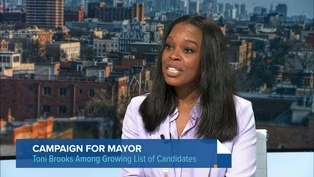
NewChicago-Born Veteran Toni Brooks on Her Bid for Mayor
Video has Closed Captions
Chicago’s next mayoral election is less than a year away. The list of candidates continues to grow. (7m 25s)
 New
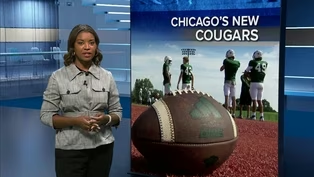
NewChicago State University Gears Up for Its First Football Game
Video has Closed Captions
Several Chicago-area players are getting the chance to make history. (2m 59s)
Providing Support for PBS.org
Learn Moreabout PBS online sponsorship New Episode
- News and Public Affairs

Top journalists deliver compelling original analysis of the hour's headlines.

- News and Public Affairs

Today's top journalists discuss Washington's current political events and public affairs.




 New Episode


 New Episode
 New Episode
Support for PBS provided by:
Chicago Tonight is a local public television program presented by WTTW
WTTW video streaming support provided by members and sponsors.